Jan 14, 2026
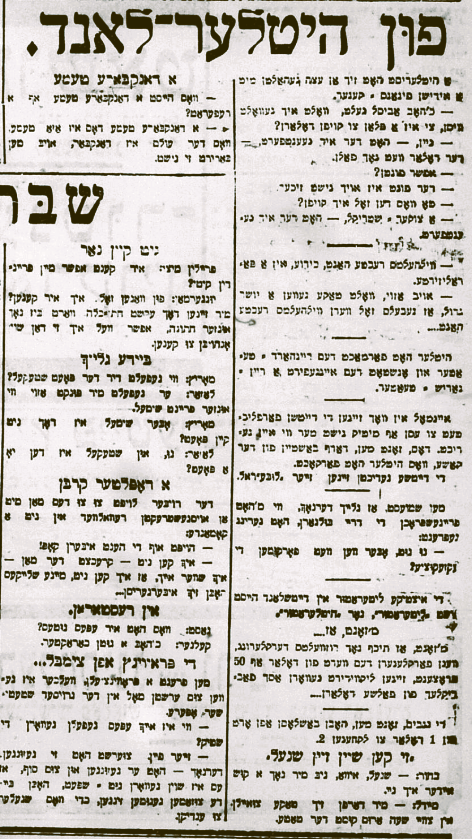
From Frimorgn (Riga), January 26, 1934, 7. Microfilm held in the collection of the New York Public Library, Dorot Division.
INTRODUCTION
As part of the research for my master’s capstone in the history program at Rutgers University, I went to the New York Public Library's Dorot Division, diving into the archives there in search of Yiddish newspapers from interwar Latvia. “Fun Hitler-land” (From Hitlerland) stood out from the other articles I read and translated. It used humor in a way I hadn’t seen in other sources about Nazis and Nazism from the period, and it illuminated an understudied moment in Latvian Jewish history.
The article was published by the newspaper Frimorgn (Morning). Per the YIVO Encyclopedia of Jews in Eastern Europe, Frimorgn ran from January 1926 to May 1934, created by editors who left a newspaper called Dos Folk in order to make a nationally-oriented newspaper that appealed to a wide Jewish base. 1 1 Kotlerman, Boris. 2010. Frimorgn. YIVO Encyclopedia of Jews in Eastern Europe. https://encyclopedia.yivo.org/article/1734. Kotlerman depicts Frimorgn as “nonpartisan,” but I have found material in sections of the paper in 1934 that refer to its “Zionist-Socialist” allegiance (e.g., saying things like “we Zionist-Socialists”). Perhaps the paper’s alignment shifted over time, or this may instead simply have been the view of individual authors/editors. “Fun Hitler-land” is a set of jokes found at the end of Frimorgn’s January 26, 1934 issue, mocking Hitler and his accomplices by noting different ways in which they have made Germany worse. I focused on six in particular because of their direct commentary concerning Hitler’s Germany. This piece seemed both a light-hearted act of spiritual resistance in the face of danger and a tragic reminder that even in a moment so close to destruction, few could see what would follow. Though I did not ultimately discuss “Fun Hitler-land” in my capstone paper, I still think about it often.
The six jokes were as follows:
A Hitlerist asks a Jew for financial advice (the Jew has no nice answers).
א היטלעריסט האָט זיך אַן עצה געהאַלטן מיט אַ אידישן פינאַנס- קענער.
—כ׳האָב אַביסל געלט, וואָלט איך געוואָלט וויסן, צי איז אַ פּלאַן צו קויפן דאָלאַרן?
—ניין,—האָט דער איד געענטפערט,—דער דאָלאַר וועט נאָך פאַלן.
—אפשר פונטן?
—דער פונט איז אויך נישט זיכער.
—טאָ וואָס דען זאָל איך קויפן?
—אַ צוקער-שטריקל,—האָט דער איד געענטפערט.
A Hitlerist sought advice from a Jewish financier.
“I have a little money, and I want to know, is it a good idea to invest in dollars?”
“No,” the Jew answered, “the dollar will fall further.”
“What about the pound?”
“The pound is also unstable.”
“Then what should I invest in?”
“Something to keep you from falling apart,” answered the Jew. 2 2 Literally, a sugar-string (tsuker-shtrikl).
2. A two-liner compares the paralyzed condition shared by Kaiser Wilhelm II and Josef Goebbels and suggests these two men are actually not alike despite their shared disability and shared attempts to rule over Germany—i.e., Goebbels is a sad successor to Germany’s past great leader.
—ווילהעלמס רעכטע האַנט, כידוע, איז אַ פּאַראַליזירטע.
—אויב אזוי, וואָלט טאקע געווען אַ יושר גדול, אַז געבעלס זאָל ווערן ווילהעלמס רעכטע האַנט . . .
Wilhelm’s right hand, everyone knows, is paralyzed.
If so, it would have been a great justice if Goebbels were Wilhelm’s right-hand man . . .
3. A pun about Hitler shutting down Reinhardt’s Theater, in order to create his “Rein-narish” Theater. 3 3
4. Wordplay in Yiddish that blends the words for meals, grains, and courts describes Hitler as creating gross meals that can also be interpreted as grossly-ran courts.
איינמאָל אין וואָך זיינען די דייטשן פאַרפליכטעט צו עסן אַף מיטיק נישט מער ווי איין געריכט. דאָס, זאָגט מען, דאַרף באַשטיין פון דער קאַשע, וואָס היטלער האָט פאַרקאָכט.
די דייטשע געריכטן זיינען זייער ׳לוּבּע׳ראל.
Once a week, Germans are required to eat only one course/courts for dinner. This, people say, needs to be composed only of buckwheat, which Hitler cooks up.
German courts are full of groats injustice.
5. Another two-liner mocks Göring’s love of executions.
מען שמועסן, אַז גלייך דערנאָך, ווי מ׳האָט פרייגעשפּראָכן די דריי בּוּלגאַרן, האָט גערינג געפרעגט:
—נוּ גוּט, אָבער ווען וועט פאָרקומען די עקזעקוּציע?
People say that immediately after the three Bulgarians were acquitted, Göring asked:
That’s all well and good, but when will the execution occur?
6. One last pun claims that literature from Germany can no longer be considered literature: It’s now “Hitliterature.”
די איצטיקע ליטעראַטוּר אין דייטשלאַנד הייסט נישט "ליטעראַטוּר", נאָר "היטליטעראַטוּר".
In Germany today there’s no “literature,” only “Hitliterature.”
All six jokes all depict Hitler and his henchmen as idiots bound to fail, maintaining a breezy tone while discussing very serious subjects. To me, this represented confidence in the inevitable failure of immoral actors, in a faith still held by many Latvian Jews that their home republic would shield them from destructive neighbors. At the same time, they knew danger loomed and chose to use humor as a way to push through the fear.
Latvia’s diverse population included ethnic Latvians, Russians, Germans, and Jews. During the initial phase of the first Latvian Republic, the government ensured minority protection and representation in the Saeima (parliament). Jews established political parties, social and cultural organizations, presses, and more, including newspapers in Yiddish and Hebrew. Diverse forms of Jewish ideological and cultural life blossomed in Latvia.
This all changed in 1935 when Kārlis Ulmanis and his far-right Peasant's Party seized the Saeima in a bloodless coup on May 15th, 1934. Nearly every Jewish political party was outlawed, except for the Agudas Yisroel, the Orthodox party, which secured its position through a very questionable arrangement. The new, fascist Saeima arrested left-wing Jewish party affiliates and sent them to a concentration camp at Libau to meet a grim fate. Further repression and devastation came in 1939 following Soviet occupation after the Molotov-Ribbentrop Pact, and truly unprecedented levels of horror followed Germany’s occupation in 1941.
This context is what makes “Fun Hitler-land” so interesting. Yiddish cultural life in Latvia is not very widely known. The archive is one of the places where it can still be uncovered. “Fun Hitler-land” sits on the precipice of immense historical change, revealing the difficulty of envisioning future events before they arrive. To the writers and readers of Frimorgn (and likely the Yiddish-speaking community at large), humor and faith in their circumstances served as a form of spiritual resistance.
I not only found “Fun Hitler-land” interesting from a historical perspective—I also found it compelling as a student of Yiddish. The text tested my linguistic abilities to understand and translate Yiddish jokes (which necessarily rely on Yiddish language conventions and 1930s cultural contexts) into contemporary English. This fun little exercise in thinking across time and culture revealed much about language itself as a mode of expression. For example, the first joke about the Jewish financier ends with the Hitlerist (a common pre-World War II term for any supporter of Hitler) asking the Jew for advice on the best investment. In the original, the Jew answers: “A tsuker-shtrikl.” A sugary string? Initially, I had no idea what this meant, leading me down a rabbit hole of specific historical research. It turns out that at this time in Eastern/Central Europe, sugar was not sold in the granulated form we all know today. Instead, it came in a large conical brick called a “sugarloaf,” whose triangular shape was maintained by a string, the “tsuker-shtrikl.” So what did the Jew mean when he told the Hitlerist to invest in one? I understood this joke to say that without something unexpected to hold them together, the Hitlerists are going to blow apart like sugar in the wind. In my translation, the Jew answers that they should invest “in something to keep you from falling apart,” but perhaps an answer like “a new belt” might also make sense, given our modern sensibilities. Not only did I have to come up with sensible English phrases, I also had to recreate Yiddish puns using appropriate English words, while continuing to maintain a “punny” feeling. Frimorgn’s writers joke that Hitler turns the Reinhardt Theater into the Rein-narish Theater, a pun that makes perfect sense in Yiddish. Well, what ending could I give to Reinhardt to demonstrate a sense of foolishness while still maintaining the pun? The answer for me was comically simple: the “Reinfart” Theater. I’d never have guessed in a million years that making fart jokes in academic research might be possible, but funnily enough it seemed like the best way to recreate the wordplay of the original while still having it make sense in English.