May 13, 2026
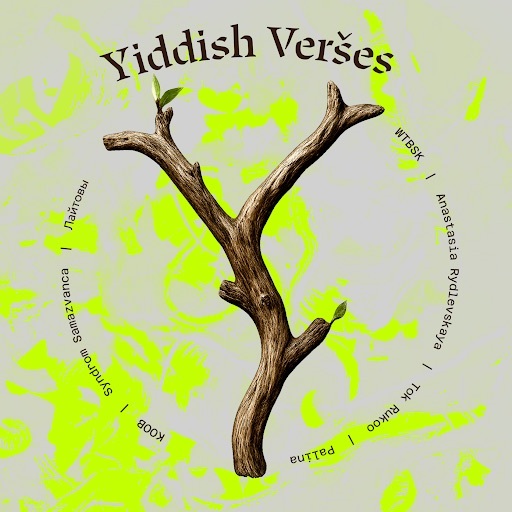
Yiddish Veršes, produced and curated by Maya Katznelson; music curation by Aliaksandr Karneychuk; with expert support from Mikhail Krutikov and Siarhei Shupa, May 30, 2025
Yiddish Veršes, released in May 2025, is one of the most ambitious projects to bring Yiddish-language literary heritage back into contemporary Belarusian culture. Accomplished through a partnership between the Belarusian-Jewish Cultural Heritage Center and music label Radio Plato, the album consists of seven songs, all based on poems by one of four Yiddish-language authors (Moyshe Kulbak, Leyb Naydus, Izi Kharyk, Avrom Reyzen) who lived in Belarus in the first half of the twentieth century. The songs are performed by contemporary Belarusian artists in a wide variety of genres, from rap to electronica and post-punk. In this review, I discuss not only the musical and compositional content of the album, but also the unique significance of Yiddish culture to modern Belarus and the Belarusian language.
Jews first appeared in the cities of modern Belarus (then the Grand Duchy of Lithuania) in the fourteenth century. For six centuries, Jews were an important part of urban and rural culture, and by the nineteenth and twentieth centuries, Jews often constituted a significant part or even the majority of the population in large cities (more than half the population in Witebsk, Minsk, and Mahilou, and almost half in Hrodna). Before the 1917 revolution, there were many Jewish schools and yeshivas in Belarus; one of the poets included on the album, Moyshe Kulbak, studied at such an institution, the famed yeshiva of Valozhyn. 1 1 To read more about Jews in Belarus, see The Belarusian Shtetl: History and Memory, edited by Irina Kopchenova and Mikhail Krutikov and translated by Bela Shayevich and Sebastian Z. Schulman (Indiana University Press, 2023); Gershon David Hundert, Jews in Poland-Lithuania in the Eighteenth Century: A Genealogy of Modernity (University of California Press, 2004). To read specifically about the yeshiva in Valozhyn, see Shaul Stampfer, “Yeshiva of Volozhin” in The YIVO Encyclopedia of Jews in Eastern Europe.
In the early twentieth century, Jewish and Belarusian communities and cultures were often depicted as neighboring cultures, each borrowing from the other’s language, literature, and worldview. In 1918, Jewish author Shmuel Plaunik, who wrote under the more “Belarusian” pseudonym Zmitrok Byadulia, published a chapbook entitled Жыды на Беларусі (Jews in Belarus), in which he briefly described the history of interaction between Jews and Belarusians and insisted on their common culture and folklore. Plaunik did not, however, identify himself as Jewish in this booklet, instead referring to Jewish people as “they” and writing from the perspective of the Belarusian national revival:
За увесь час суместнаго жыцця беларусау і жыдоу на Беларускай зямлі гэтыя дзьве нацыі псыхічна шмат перанялі адна ад аднэй. У мовах, у звычаях у легэндах, у будоуніцтве, у будзенным жыцці — у іх формы так перамешаліся, што (болей усяго у жыдоу) прынялі новую самабытную акрасу. Есьць агульныя жыдоуска-беларускія народныя меледзіі, прыказкі, дзе жыдоуская і беларуская мовы перамешаны паміж сабою.
Throughout the entire period of coexistence between Belarusians and Jews on Belarusian soil, these two nations have absorbed much from one another psychologically. In language, in customs, in legends, in architecture, in everyday life—their forms became so intermingled that (especially among the Jews) they acquired a new, distinctive ornamentation. There are common Jewish-Belarusian folk melodies and proverbs in which the Jewish and Belarusian languages are mixed together. 2 2 Byadulya, Zmitrok. Zhydy na Belarusi. Mensk, 1918. In my translation.
The early Soviet project was favourable toward Yiddish; along with Polish, Russian, and Belarusian, Yiddish was one of the official languages of the Byelorussian SSR. Books were published in Yiddish, and the literary magazine Shtern (1925–1941) was launched. The Belarusian intelligentsia in this period was largely Yiddish-speaking or Jewish; in addition to the authors mentioned above, Yuli Taubin, Zelik Akserold, poet Sore Kohan, and others gained popularity. But when the Soviet project changed its policy, the resulting repression of the intelligentsia would affect both Christians and Jews. On the night of 29–30 October, 1937, more than one hundred poets, translators, and journalists writing in Belarusian and Yiddish were shot. In Belarusian national memory, this night became known as the “Night of the Executed Poets” (Ноч расстраляных паэтаў), an event with clear parallels to what Yiddish speakers know as the “Night of the Murdered Poets” in 1952. 3 3 “The Night of the Murdered Poets” refers to August 12, 1952, when thirteen Jewish citizens of the Soviet Union were executed by the state after having been convicted of “nationalist activity” and espionage. Five of those killed were among the most prominent surviving Yiddish writers in the Soviet Union, and so for many people their deaths came to mark an end of Soviet Yiddish culture and a final proof of Stalin’s murderous anti-Semitism. For a highly teachable account of this history, and further resources, see Madeleine Cohen’s resource kit for the Yiddish Book Center, “The Night of the Murdered Poets,” n.d., accessed March 16, 2026.
“The Night of the Executed Poets” took on special significance in the late 1980s and early 1990s, when bones were found during archaeological excavations in Kurapaty, a tract of land near Minsk. Later, based on bullet traces found on the bones and personal items recovered from the pit, archaeologists concluded that these individuals had been executed by firing squad. Unaware that they were being led to their execution, the victims had brought their valuables with them. 4 4 From the famous article “Kurapaty is a path of death,” translated from the Belarusian by the author: “On May 5, 1988, the archaeological team of the Institute of History of the Academy of Sciences of the BSSR excavated one of the graves. The actual depth of the grave pit was 2.8 m, and the size was approximately 3 x 3 m. The boys carefully, like archaeologists, selected half of the pile (23 people). Among the corpses, they found porcelain and enamel cups, a leather wallet with Soviet kopecks from the 1930s (the last date on the coins was 1936), a toothbrush in a case made by a Vitebsk factory, many empty cartridges from a revolver with a diameter of 7.5 mm, and round broken glasses in thin metal frames. All rubber galoshes had the stamps of domestic factories and the date of manufacture—1937. Leather men’s boots were found, as well as women’s shoes. Bullet holes in skulls are usually on the back of the head, where two holes are often visible side by side. There are several skulls with holes in the temple, forehead and top of the head (they were shot in a pit). All entrance holes are 7.5 mm in diameter. What do these finds say? The grave was ‘shot’ in 1937–1938, they were killed with rifles.” The full article: Позняк, Зенон; Яўген, Шмыгалёў. Літаратура і мастацтва.
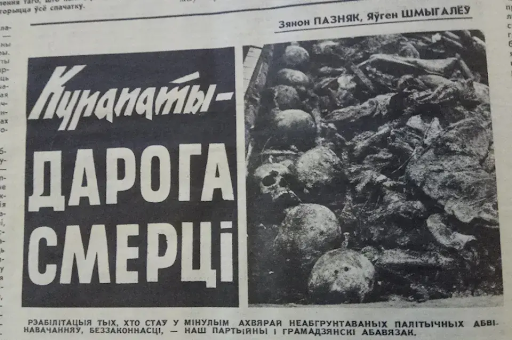
“Kurapaty is a path of death.” The newspaper Literature and Art (Літаратура і мастацтва), 06/03/1988.
Living people were called upon to preserve the memory of the dead. On Dzyady, a Belarusian folk holiday for cleaning the graves of dead ancestors, people gathered in Kurapaty in groups with crosses and flags. The celebration of the national Belarusian holiday, along with its political appeal to bring the victims of Stalin's terror back into the public eye, made Kurapaty a vital place of remembrance and a symbol of national revival. However, the fest itself was pagan, and crosses were aimed to present a Christian identity, suppressed by the Soviet regime. The Jewish component of this tragedy was left in a shadow.
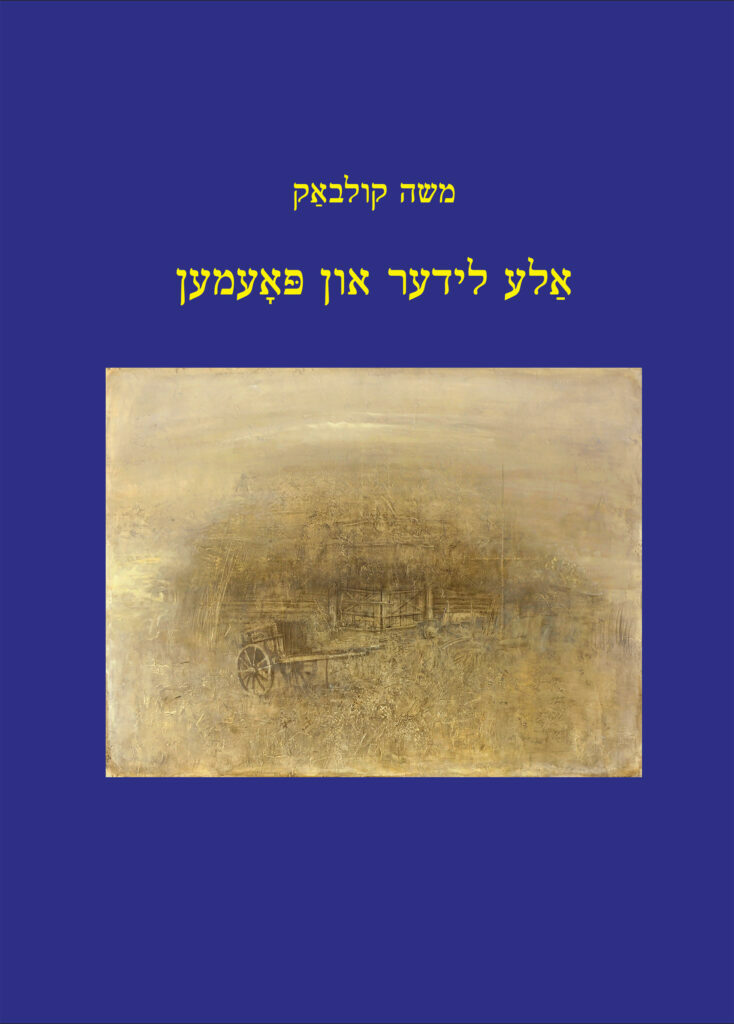
Still, for some, the issue of preserving the memory of the Jewish experience remained important, even though the Jewish community in Belarus was already small by that time. As Yiddish translator Siarhei Shupa (Šupa) has said, “the Soviets destroyed the [Yiddish] writers, and the Nazis—their readers.” Although Shupa himself is not Jewish, he taught himself Yiddish in order to make Yiddish literature from Belarus visible to Belarusian readers. Yiddish-language literature was restored as unjustly forgotten. 5 5 An important example of this restoration is his translation and publication of Moyshe Kulbak’s full collection of poems, presented in a bilingual Yiddish-Belarusian edition in 2022. See Claire Le Foll, “Review of Moyshe Kulbak’s Ale lider un poemen, edited by Siarhej Šupa,” In geveb: A Journal of Yiddish Studies, April 29, 2024. Shupa’s translations demonstrated to readers, through the vivid existence of Yiddish within Belarusian literature at the beginning of the twentieth century, that multilingualism is a key component of Eastern European literature. Shupa adds: “Can Belarusians become the heirs of that [Yiddish, multilingual] literature?”
It seems that Yiddish Veršes was designed to do just that—to restore and honor the contribution of Yiddish-language authors to Belarusian literature and culture, recognizing a lost poetic generation that, to Belarusian readers, was experienced as an unread, undiscovered, and forcibly suppressed variant of Eastern European modernism. Although the poets featured in Yiddish Veršes are well known in Yiddish circles, they have been to some degree neglected in Belarusian culture, and this album situates Yiddish within the Belarusian cultural context, arguing that it belongs there. To unite both scholarly and artistic efforts, Shupa and another specialist in Jewish studies, Mikhail Krutikov, were brought in as experts on the project.
The musical compositions work closely with the original texts, but do not lose the style of the musicians. The album opens with “Leib Najdus,” a musical arrangement of Naydus’s poem “I Drink The Nectar Of The Sun With My Heart,” performed by the singer KOOB. 6 6 Thomas Varrall, London-based musician, became a co-producer of this track. Her music is an avant-garde multidisciplinary project that moves across different genres, including R&B. The singer herself is also a songwriter and producer.
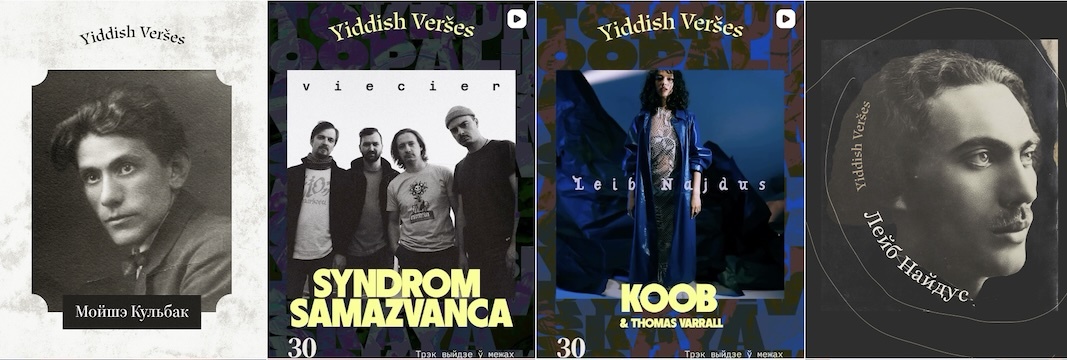
Screenshot, Yiddish Veršes Instagram page (KOOB second from right)
“I Drink The Nectar Of The Sun With My Heart” plays with modernist orientalism, imaginary geography, and the exploration of the self. In the musical adaptation, the muffled drums, the singer's high, soulful voice, and the fading sound of birds help the composition to build up and then slow down, creating a trance-like effect. The hero of the poem and the song—a king without a crown—can be read both as a parody of power and as a theatrical mask that can be tried on at a party.
The second track on the album, “Niemata,” is a sensual, vulnerable rap adapted from Moyshe Kulbak’s poem “Silence.” The performer of this track is a hip-hop Belarusophone artist and skateboarder, лайтовы, who lives and performs in Minsk. In an interview about the song he said that when choosing the text, he sought universality, and therefore specifically chose a text devoid of temporal and national characteristics. This poem is about the hero’s attempt to come to terms with loneliness and darkness, and it sounds, unexpectedly, like a recitative about loneliness and a broken heart, a lack of hope and inspiration. Even the cry to God, familiar in Kulbak's poems, bursts out here unexpectedly (нечакана). Muteness (нямата) is both the absence of the word and its source.
The next song, “Maladym,” from Izi Kharyk’s “Don’t Live in Despair,” is by electronic and dance music artist Palina, one of the most famous singers from Belarus. But here there is no self-aggrandisement or pleasure in dancing—here Palina appears in her usual heart-rending, desperate, and painful role. Dancing brings pain, and at the same time, it is impossible to stop. Palina's sensual voice, her attempts to find the right words and find “the strength to be happy,” the heavy, steady rhythm and hopelessness amid monotonous reality—if Sveta Ben, the soloist of the band, joining forces with Kulbak, gives young people happy poverty, then Palina can only wish for young people to remain behind words, to escape from reality. Perhaps this is why, between the heavy choruses, the light, slow bridges sound like beams of light, rays of sunshine between the clouds.
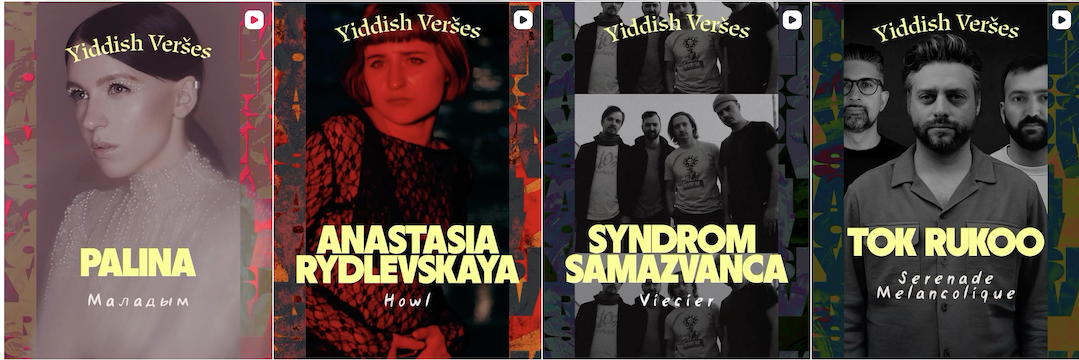
Screenshot, Yiddish Veršes Instagram page (Palina far left)
“Howl,” the only song on the album performed in English, was recorded by electronic artist Anastasia Rydlevskaya. It adapts Avrom Reyzen’s “Howl, Howl, Raging Winds.” Originally titled “Tsum vinter” (To the Winter), the poem is dedicated to the sharp change of weather but also carriesa social connotation: the evil winds that are breaking windows and looking for the weak birds can be compared to the powerful ruling class. Winter is depicted as a time of impunity and fear. Published in 1916, this poem was written in anticipation of the imminent revolution and rise of the labour movement—but it is unclear whether this is what Anastasia Rydlevskaya has in mind. The captivating rhythms compel us to hope and wait—but for what? Low voices that work with the musicality of the text, howls in the bridges create a gothic, frightening atmosphere. A motif of nature oppressed by winds and winter cold helps to build an almost apocalyptic atmosphere where no one is protected from evil powers. The pulsating rhythms keep one on edge in front of a world frozen in fear of the long cold.
The post-punk band Syndrom Samazvanca, who recorded a song, “Viecier,” based on Izi Kharik’s “Wet, Lost Wind,” seems to explore a “brighter” urban picture than the lost paradise of nature, Raysn, in the poems of Moyshe Kulbak, or the automated everyday life of Palina. The tram, an object of interest, fear, and love for modernists (for example, Nikolay Gumilev’s poem “The lost tram”), no longer seems so special—but the melodic bass guitar and relaxed drums make you follow the wind and the tram bells like the movement of the stars.
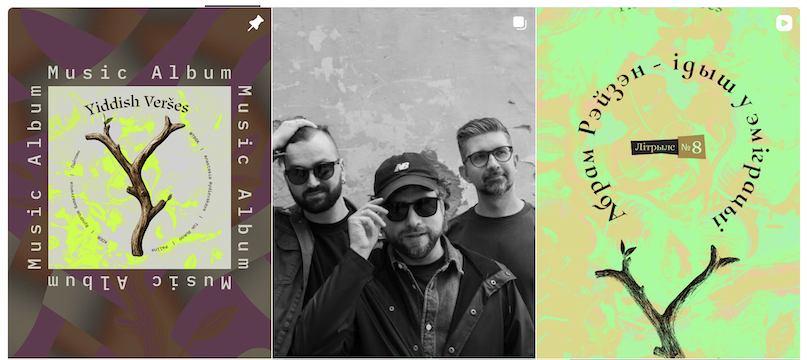
Screenshot, Yiddish Veršes Instagram page (Syndrom Samazvanca center)
The “melancholic serenade” recorded by the band Tok Rukoo, based on Leyb Naydus’s “Sérénade Mélancolique,” is included in the second part of the album, and is more ballad-like and calm. Its hero is searching for the source of a soothing sound; it seems as if it is being played by the earth itself. Paradoxically, the music plays in silence—the very silence from which everything is born, as лайтовы sang in “Niemata.”
The album ends with the song “Heler Papir / Light paper” (“Cветлая папера” in Belarusian), based on Moyshe Kulbak’s “Song of the Beggar (3).” It is performed by the famous artist Sveta Ben as a vocal leader in the music band WTBSK (referring to the city Witebsk—a homeland for Sveta). This is one of the few songs that is performed in both Belarusian and Yiddish; the verses repeat, mirroring each other and creating new meaning. A gentle, insinuating song that lights up like night lights, it gradually accelerates into a danceable and tremulous song. It is light, playful, and almost childishly naive. The Yiddish poem reflects the poor social conditions of the working class of its time and the author's attention to poor people and their hopes. An ascetic material existence is reflected in a simple desire: to be simply a piece of bright piece of paper for God, a blank slate. The poem then suggests that this blank slate can be filled with new poems dictated to the poet, in a very un-Soviet manner, by God. Jews and Belarusians are left with nothing but hope. And that alone is already a great deal. Additionally, Sveta Ben herself is also fond of Jewish culture and Yiddish poetry, as she says:
I find Belarusian Jewish culture in general very interesting, because it is such a strong, vivid colour that makes our culture diverse, interesting and distinctive. Jewish poets—Izi Kharik, Yuli Taubin and Moshe Kulbak—had a huge influence on poetry in Belarus in the 1920s and 1930s. They became like brothers to my heart. And it seemed to me that I had to repay a certain debt.
The main question that remains for me is: what do these songs say about contemporary Belarusian culture? What themes do they address and who are they speaking to? The beauty of the wind in the midst of changing times, the anticipation of change, and the pain of youth are experiences shared by more than just Belarusians, but for them this album may have a special significance in troubled times of political insecurity, the spread of repression, and isolation. The fact that artists on this album work in different countries, both in Belarus and abroad (for example, Germany in the case of KOOB and Poland for Syndrom Samazvanca) also demonstrates the power of a diasporic community that agrees to look at the common past together, no matter what living conditions they are experiencing now.
How can one listen to these lyrics without thinking about what happened to their authors? Or, on the contrary, is that what one should think about? Can these lines hang in the air, supported by music, or should they remain in their own time and with their own pain? Is this memory the price of believing in utopia? Or, on the contrary, is it a prerequisite for it?
Even though this album explores the specific experience of Belarusians reactualizing their country’s past for themselves and finding how colorful and diverse this past is, I am sure that this album is for everyone. Yiddish heritage exists for the broader community, for the experience of pain and struggle for the future. Just as a community exists for it—to experience it physically, dancing, singing the words, and making them accessible throughout the world.