Oct 14, 2024
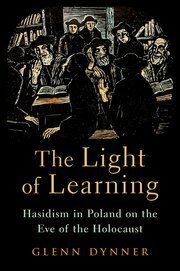
Glenn Dynner. The Light of Learning: Hasidism in Poland on the Eve of the Holocaust. Oxford University Press, 2023. 320 pp. $39.95
Against the fraught intersections of emancipation, acculturation, assimilation, and colonization, institutionalized Torah education emerged as a form of Hasidic cultural resistance powerful enough to survive the Holocaust.
In November 1928, a grand Hasidic wedding was held in Warsaw. Unusually, neither the bride nor the groom had ever called the city home. The bride, described in one Yiddish press report as “elegant and modern,” was Musyah Schneersohn, daughter of the then Lubavitcher Rebbe, Rabbi Yosef Yitzchak Schneersohn (“Rayatz,” 1880–1950). At the time, he and his family were residing in Riga, Latvia, having recently been extracted from crushing repression in Soviet Russia. Safe passage had also been secured for the groom, though not for his parents, and in the intervening months he had enrolled at the University of Berlin—in the faculties of “Chemistry and Philosophy” according to the newspapers.
1
1
“Grandoyeze khasunah fun lubavitcher rebin’s tokhter,” Unzer ekspres no. 276 (November 28, 1928), 6. “Di grouse khasunah fun lubavitcher rebi’ns tockhter un yekaterinaslaver rav’s zuhn,” Haynt no. 279 (November 29, 1928), 6. The latter article notes that “the bride … also has higher education.” Also see Yehoshua Mondshine, “Haḥatan hirshim et ha’alafim.”
So why was this wedding held in Warsaw, rather than Riga or Berlin?
Having read Glenn Dynner’s recent book, The Light of Learning: Hasidism in Poland on the Eve of the Holocaust, the answer to this question now seems obvious. In 1928, Warsaw was the epicenter of what Dynner calls the “pedagogical revival” of Hasidism in Poland. “As organized Jewish life became untenable in the Soviet Union,” he writes, “the relatively democratic and tolerant Second Polish Republic … became the natural center of the Hasidic world” (5).
In Poland, on the eve of the Holocaust, Dynner argues, Hasidism did not simply endure in gloomy decline, but thrived with expansive ascendance on the rising wave of institutionalized Torah study. New networks of Hasidic educational institutions cultivated intense intellectual effort and prowess, exhilarating spiritual experiences, deep friendships, social and communal comradery, and also political power. Indeed, Dynner writes, “the Hasidic yeshiva rapidly supplanted the court as the locus of power, prestige, and recruitment” (77).
Chabad had pioneered this new model for the institutional construction of Hasidic identity with the 1897 establishment of the Tomkhei Temimim yeshiva in Lubavitch (Lyubavichi, today in Russia near the border with Belarus), a market town that had been the dynastic seat of the Schneersohns since 1813. 2 2 On Tomchei Temimim as the first Hasidic yeshiva of this sort see, Ilia Lurie, Milḥamot lubavitz: ḥasidut ḥabad berusiyah hatsarit (Jerusalem: Shazar, 2018), 66-9 and 86-107, and additional sources cited by Dynner, 245n175. As World War I and the Russian Revolution transformed the geopolitical map, the Chabad yeshiva was first displaced and then transfigured into an underground dissident network in the Soviet Union. 3 3 See the brief discussion in Dynner, 126-7, and more extensively, David E. Fishman, “Preserving Tradition In The Land of Revolution: The Religious Leadership of Soviet Jewry, 1917-1930” in The Uses of Tradition: Jewish Continuity in the Modern Era ed. Jack Wetheimer (Cambridge, MA: JTS / Harvard, 1992), 89-119; idem, “Judaism in the USSR, 1917-1930: The Fate of Religious Education” in Jews and Jewish Life in Russia and the Soviet Union edited by Yaacov Ro’i, (London and New York: Routledge, 1995), 251-262. In newly independent Poland, meanwhile, the enfranchisement and emancipation of the Jewish population intensified the threat of secularization. But, Dynner emphasizes, this “proved more galvanizing than demoralizing.” Many Hasidic rebbes now emulated the Chabad model, reinventing themselves “as educators charged with rescuing the wavering youth” (5). In 1921, graduates of Tomkhei Temimim opened a new branch of the Chabad yeshiva in Warsaw (87, 127).
By 1928 Rayatz had endured more than a decade of displacement, and had also suffered arrest, imprisonment, and forced exile. Unable to return to his ancestral home in Lubavitch, his arrival at Warsaw’s Tomchei Temimim yeshiva for the celebration of his daughter’s wedding was a surrogate homecoming. Eliyahu Chaim Althoiz, a member of Rayatz’s inner circle, described the celebration in a letter brimming with emotional fervor. 4 4 See “Reshimei ḥasunah,” in Kovets leḥizuk hahitkashrut #23 (yud-daled kislev 5770 / 2009), 11-31. As soon as he walked into the Tomkhei Temimim yeshiva, he wrote, “the great question … Why is the wedding being held in Warsaw?” was resolved. Five large electric chandeliers illuminated the large hall. At the high table, Rayatz was dressed in Sabbath finery and flanked by the rebbes of Radzin, Petrikov, and Zlatopol, together with the renowned talmudist Rabbi Menachem Ziembe and other notables. On either side of the hall, the yeshiva students stood “squeezed together in two rows, one higher than the other.” When their “sweet voices” sang the haunting melody famously composed by Chabad’s first rebbe, “silent tears” appeared in Rayatz’s eyes, and the effort he exerted to restrain them from pouring down his cheeks was palpable. 5 5 Ibid., 20-22.
Taking all this in, Althoiz wrote,
Everyone understood and saw with open eyes that only Warsaw is worthy of this. She alone was readied from the six days of creation to receive this great light. And I too was unable to restrain myself from saying to those close to me, who came with me from Riga, “now I know,” and everyone unanimously agreed that the great and mighty question had been resolved. 6 6 Ibid., 22-23.
The story of Chabad’s Polish era is but one prominent thread in the many stranded tapestry woven by Dynner, and the Warsaw wedding of Rayatz’s daughter isn’t mentioned at all. But from my vantage point as a historian of Chabad, this episode provides a micro example that vividly confirms the macro thesis so eloquently advanced in The Light of Learning. Across the border, the antireligious Soviet regime had decimated the Chabad heartland, but in interwar Poland the former glory of the Lubavitcher yeshiva would rise like a phoenix from the ashes.
This episode also highlights the relevance of this book to Hasidism’s larger trajectory through the twentieth century and into the twenty-first. It would be impossible to overstate the consequentiality of the wedding celebration that Althois observed. Some two decades later, the groom, Rabbi Menachem Mendel Schneerson, would succeed his father-in-law as rebbe and lead Chabad’s “worldwide campaign” of Jewish renaissance in the aftermath of the Holocaust (192). The prescience expressed by Althois is remarkable: “Do I not already know that on the trajectories of this praiseworthy young man depend the trajectories and deeds of our children, grandchildren, and great-grandchildren?” 7 7 “Reshimei ḥasunah,” 24.
Likewise, the continuing consequentiality of the educational renaissance so vividly described by Dynner can’t be overstated either. Chabad is but one case in point: When Rayatz arrived in New York in 1940 he immediately announced the reestablishment of Tomkhei Temimim on American soil. 8 8 See Shalom DovBer Levine, Toldot ḥabad be’arṣot habrit (Brooklyn, NY: Kehot, 1988),178-180. A year later, when his son-in-law arrived, Rayatz appointed him executive director of the Center for Educational Affairs (Merkos L'inyonei Chinuch), which remains the umbrella organization for official Chabad institutions to the present day. 9 9 Ibid., 271ff. Also see https://www.lubavitch.com/head.... Questions about how institutional models developed in interbellum Poland were replicated and expanded in post-war America and Israel are opened in The Light of Learning’s conclusion, but they need more thoughtful scrutiny before they can be closed.
***
Rather than focusing on a single Hasidic group or a narrow cast of characters, The Light of Learning gives us a kaleidoscopic picture, composed of many vibrant vignettes. Necessarily, these are incomplete excisions from larger stories that could not be fully told within the scope of this book. Yet they are successfully combined in a chronological and thematic survey that is both coherent and persuasive. The book’s robust scholarly underpinnings, arguments, and interventions are visible but unobtrusive. It’s rare for a book to combine critical research, clear-eyed analysis, and historical data with such masterly storytelling and spiritual pathos.
Dynner’s deft use of autobiographical literature and newspaper reports are key to the readability of this volume. A diverse array of personal perspectives and experiences endows the larger historical narrative with compelling intimacy and depth. On the opening page we meet the Gerrer Rebbe (Rabbi Abraham Mordecai Alter, 1866–1948), as seen through the eyes of the modernist novelist and essayist Alfred Döblin, on the day preceding Sukkot in 1924. Döblin was born in Germany to assimilated Jewish parents, and Dynner quite deliberately begins with his disconnected gaze (1–3, 195n1). The starting point of this book is outside of the Hasidic realm, closer to the academies of Berlin than the yeshivas of Warsaw. Within a few paragraphs, however, Dynner pivots to overcome the initial disconnect, seamlessly bringing the reader to inhabit the perspective of a hasid named Peretz Weissman, who recalls the transcendent experience of hearing the same rebbe teach Torah: “When the Rebbe said something I felt it was spoken by an angel, because when he spoke he wept like a child” (3).
Döblin might be seen as an avatar for a large segment of the audience to whom this book is addressed. In Hasidism he sees a pre-modern and primitive relic, something fascinatingly strange and otherworldly, yet also alluringly soulful and mysteriously splendid. “How proud,” he muses, “were the things I saw among the poor scorned Hasidim.” Dynner shows us that there was something else at play in interwar Hasidism, which the likes of Döblin are otherwise unlikely to recognize: an intellectual revival, driven by pedagogical innovation and fueled by institutional modernization. “Hasidic leaders like the Gerrer Rebbe,” he writes, “were placing most of their energy into conceiving new school systems … sustained by means of transregional and transnational philanthropic institutions and novel political parties” (3–4).
Structurally, the book is framed by the chronological bookends of World War I (Chapter 1) and the Holocaust (Chapter 6). The center of the book is organized on a more thematic basis covering the overlapping topics of pedagogy (Chapter 2), politics (Chapters 3 and 4), and the intensification of anti-Jewish agitation and violence in the mid to late 1930s (Chapter 5).
It was during World War One, while Warsaw was occupied by German troops, that the Gerrer Rebbe brought pedagogy and politics together through Agudat Yisrael (or simply “Aguda”), an Orthodox-Jewish umbrella organization whose offshoots remain prominent to this day in Israel, Europe, and the United States. Other hasidic rebbes set up their own parties, or argued that party politics was a divisive distraction. Rayatz, following a precedent set by his father, eschewed associating with Aguda, which nevertheless retained wide institutional dominance up till the outbreak of World War Two.
"Polish Aguda supporters,” Dynner writes, “would come to include, in addition to prominent Polish and Galician rebbes, ‘Lithuanian’ [i.e. non-Hasidic] rabbinical leaders and prominent journalist-scholars like Hillel Seidman and, intermittently, Hillel Zeitlin" (96). The array of Aguda representatives included spiritual leaders, writers, educators, youth-leaders, and many elected officials, from local city councilmen to Sejm deputies with national platforms. Aguda even had a spin-off workers party, Poalei Aguda, which competed directly with the secularist Bund and decried “Marxist psychosis,” while also flirting with the possibility of joining the International Socialist Party (105).
Perhaps Aguda’s boldest move was the 1919 “adoption” of Bais Yaakov, the pioneering network of girl’s schools, which was originally launched by the independent initiative of Sarah Schneirer in 1915. Paraphrasing Naomi Seidman’s argument, Dynner writes that “possessing a female founding figure was embodied in Bais Yaakov’s very identity and critical for its ongoing success” (49). But he locates this phenomenon within a larger story about educational innovation and expansion driven forward by a sense of “cultural embattlement” (57, 75).
Dynner prefaces his discussion of Bais Yaakov’s establishment with a close reading of the wartime diary of a tavernkeeper’s daughter named Jula Wald. Her positive interactions with the local non-Jewish intelligentsia introduced more than a little ambivalence into her self-identification as a “Hasidah” (chusyta or female Hasid), and Dynner sensitively highlights the thick complexity of her feelings, inclinations, and aspirations (42–45). When the Bobover Rebbe (Rabbi Ben Tzion Halberstam, 1874–1941) visited her town she reluctantly went to hear him recite “kiddush,” the blessing over wine that proclaims the Sabbath’s sanctity:
While standing and listening, a strange feeling pulled at me. I had not expected that the vision of Jews gathered respectfully around a single rabbi would awaken my dormant feelings so much! Against my own will I began to tremble, recalling the numerous times I had been urged to get baptized, and might have voluntarily deprived myself of this vision that so moves me. Oh no, never! (43).
In the following section, Dynner interweaves an account of Sarah Schneirer’s visit to the Belzer Rebbe (Rabbi Issachar Dov Rokeach, 1854–1926) with a parallel account by Franz Kafka, who visited the same rebbe during the same period (47–48). 10 10 Also see Samuel J. Spinner, Jewish Primitivism (Stanford, CA: Stanford University Press, 2021), 85-88. Thereby, the cultural gap between male and female Hasidim is indicated with equal measures of effectiveness and subtlety. Between the wars, Bais Yaakov and Bnos (the women’s youth movement of Aguda) managed to reduce that gap considerably while never intending to close it entirely.
***
At the heart of this book is a deep dive into the lively and varied world of Hasidic “higher education,” which blossomed during this era. Different institutions at once complemented one another and overlapped, competing for students, resources, and prestige.
Aguda’s flagship yeshiva for boys was Mesivta, which provided a minimalist general studies curriculum in exchange for government subsidies and state recognition of the institution’s rabbinic graduates. But “purist students,” Dynner writes, “who were not motivated by ordination, gravitated to other yeshivas” (109). The most famous and “ambitious” of these institutions was Yeshivat Hakhmei Lublin, inaugurated in 1930 by Rabbi Meir Shapira. While many yeshiva students eked out meager wages as watchmen, sleeping on the cold floors of warehouses, he envisioned “a royal palace” that “would raise the image and dignity of yeshiva studies and serve as the symbol of a renewed Orthodoxy” (81).
Earlier, in the aftermath of World War I, the aforementioned Bobover Rebbe had established the Etz Hayyim yeshiva network, which would grow to at least thirty-three branches. These institutions, according to Dynner, “would vie successfully with iconic, non-Hasidic yeshivas, secularist Hebraist and Yiddishist schools, and even universities.” They were not simply traditional yeshivas run by Hasidim. Rather, he writes, “the intensive study regimen was enhanced by” Hasidic spiritual teachings and practices such as “prayers and chants (niggunim)” that “transported students into a state of divine communion (devekut)” (57–59).
For the Radomsker Rebbe (Rabbi Solomon Henoch Hakohen Rabinowicz, 1882–1941), Torah was not only a matter of scholarship, identity, community, and politics. It was also intertwined with an economic and industrial vision. In 1926, he announced plans to launch a yeshiva system backed by a 160 member strong society of financial supporters. The Rebbe himself “had prospered in business,” and when called to succeed his father in 1911, he acquiesced “on the condition that he would not curtail his studies or his business pursuits.” In the end, he found a way to advance business and scholarship in tandem: “He purchased real estate, established textile, brick, and glass making factories, and appointed trusted Hasidim as managers.” The Radomsker yeshiva network was thus easily able to expand to “at least thirty-six branches,” and enrollment swelled to three or four thousand, “exceeding Poland’s other elite Hasidic yeshivot” (88–89).
Tomkhei Temimim, by contrast, was sometimes forced to turn away prospective students due to insufficient financial resources. Nevertheless, eight branches were ultimately established in Poland, enrolling nearly seven hundred students, including “many from non-Lubavitcher Hasidic homes.” As Dynner notes, Rayatz achieved “a remarkable expansion in unfriendly territory” partly because his international renown and contacts allowed him to draw support from constituents in distant America (87–88).
One example of the unfriendliness Rayatz contended with unfolded in Glubok, then in the North-East corner of Poland. The town (currently Hlybokaye in Belarus) had long had a Chabad population but also had a sizable contingent of non-Hasidim whose allegiances lay with Mizrahi, the Religious-Zionist party. Dynner devotes much of Chapter 4 to a conflict between these two groups that began in 1929 and stretched well into the 1930s without ever reaching a complete resolution. Rayatz’s “grandiose” visit to Glubok in the summer of 1934 is described by Dynner as part of “a disciplined campaign” that also involved “a steady flow” of petitions, delegations, bribes, and alliances (126).
“In the process of winning back the post of assistant rabbi,” which had been the Chabad community’s primary objective, Rayatz “managed another victory, as well: the establishment of a new branch of the Tomkhei Temimim yeshiva in Glubok” (126). As Dynner shows, Rayatz found ways to defuse the fractious struggle without losing face, and emphasized that Torah learning is analogous to “the healing light” of the dawn. It isn’t as powerful and all-consuming as the midday sun, but is ultimately greater because it “steadily grows and intensifies from a place of darkness” (138).
***
Dynner frames The Light of Learning’s sweeping historical narrative with a crucial theoretical intervention. To think about interwar Polish Hasidism is also to think about the ongoing construction of modern Jewish identity, and the fraught intersections of emancipation, acculturation, assimilation, and colonization. One point of continuation between the nineteenth and twentieth centuries, Dynner points out, is that “the ruling classes” of Eastern Europe “were particularly ambivalent about their Jewish populations,” and implemented colonialist policies of “coercive acculturation amid ongoing discrimination.” Hasidism’s survival, development, and success therefore depended on “repudiating state civilizing projects by means of a vibrant traditionalism” and “embrace[ing] an alterity that approached cultural sovereignty but which was never impervious to outside influences.” Hasidism’s new educational institutions are accordingly seen as incubators of Hasidism’s counter-colonial “culture of resistance,” and as bastions against the “eradication of Jewish distinctiveness” (6–7).
This is a more complex notion of colonialism than the one we are used to. Jews were not native to Poland but had lived there as a diaspora-minority for centuries. At the start of the 1920s it seemed that they were acquiring more rights rather than less. Yet, if the nationalist-colonialist inclinations of the majority population ever softened into mere ambivalence towards the Jews, it soon hardened into an increasingly violent upsurge of fascism. The pogroms of the 1930s, according to Dynner, were waged both against Jewish bodies and against Jewish souls. Rationalized “on allegedly humanitarian grounds,” he writes, kosher slaughtering bans and restrictions (imported from Nazi Germany) imperiled Jewish dietary observances, and thus assaulted “Jewishness itself” (152).
Against the stereotypical representation of Hasidic and Orthodox Jews as passive victims in the face of murderous aggression, The Light of Learning highlights a diversity of responses through a range of examples. Some indeed argued that Jews should sometimes submit to martyrdom rather than compromise their role as bearers of the commandment “Thou Shall Not Kill.” Others took up arms, organized to defend themselves, lobbied politicians, wrote articles, interceded with officials, or promoted immigration to the Holy Land, which became an increasing preoccupation of some Aguda leaders.
But just as the spiritual threat was always more acute for Hasidim than the physical one, so were the spiritual responses all the more urgent and significant. These included public fast days, prayer gatherings, and a “dramatic journey” undertaken by the rebbes of Pabianice and Sochaczew to the graves of saintly rabbis, where they “recited psalms that reached the heavens” (155). In the aftermath of an “unrestrained pogrom” in Brześć nad Bugiem (today Brest, Belarus), Hillel Seidman proclaimed that “establishing a new yeshiva would be the ultimate refutation of the reigning barbarity” (159).
Indeed, one of the primary contributions of this book is to center spiritual activity with the same degree of seriousness that Hasidim themselves did. In 1937, when the youthful Slonimer Rebbe (Rabbi Solomon Weinberg, 1914–1943) proclaimed that what was needed more than ever was “deeds, deeds and again, deeds,” he was referring to the advancement of Torah education. “Education,” he said, “is always the most important task” (163). Just two years later, a political situation that had merely seemed dangerous and unpredictable was replaced with the “routinized, sadistic, and fatal” violence perpetrated by the German invaders. Amid chaotic attempts at flight, amid survival, fortitude, and death, Torah learning would remain the enduring link to eternal life (168ff).
Sixty-one students of Yeshivat Hakhmei Lublin successfully fled to Vilna. There, a survivor testified, “they immediately resumed their life’s calling … the sound of Torah was heard there all day and all night” (171). Forty-five remained behind, fortified themselves in the yeshiva building, and fired at the Nazi troops through windows and holes in the walls. Those who survived the assault were arrested and shot (174). Students from yeshivas closer to Poland’s northern border escaped and stayed together in greater numbers, and Hasidic leaders and yeshiva heads quickly enlisted international support to secure financial resources and visas to aid their onward flight and survival. “If the tradition of Jewish learning is to go on,” an American Joint Distribution Committee memorandum urged, “everything should be done to save them” (170–74).
In the Nazi Ghettos yeshiva boys and Bais Yaakov girls “sustained” themselves with the “penetrating words” of their teachers. Sarah Selver-Urbach attended classes in the Lodz Ghetto, and recalled a teacher named Fajga Zelicka exhorting her students “to feel the pain of reality.” Pain, she said, is “a sign of life. … The greatest danger is apathy!” (179). Rabbi David Bornstein of Sochaczew (1876–1942) was sympathetic to those who hoped the tribulations heralded the Messiah’s arrival: “True, the Messiah may come at any moment,” he agreed, “but in the meantime we should study a page of Talmud” (181).
This final chapter of Hasidism in Poland, and of Dynner’s Light of Learning, is a heartbreaking one. Yet its placement in this book suggests a continuity. Even before the Holocaust, “there was little room to hope that Polish Jews would ever gain acceptance as Jews” (63). Some secularized Jews even attributed Polish antisemitism to the Hasidic insistence on maintaining their distinctive attire (143). 11 11 Dynner is referring here to the American Yiddish writer Sholem Asch. With the Holocaust, however, the “murderous potential” of “Western culture” was “fully exposed” (169). In the post-Holocaust era, whether in America, Europe, or Israel, Hasidim continue to struggle for acceptance as Hasidim. It should therefore come as no surprise that the question of cultural autonomy and perpetuity remains central in the shaping of Hasidic communities and institutions. We should not rush to the conclusion, so abruptly reached in the very last line of this book, that government civilizing agendas should now be unquestioningly regarded as “reasonable civic demands” (194).
We would do better to recognize that, in 2024, Hasidism remains a minority diaspora within dominant cultures that often regard it as “exotic” and even “medieval,” much as Alfred Döblin did in 1924 (1). In the current context, Hasidism’s sense of cultural embattlement is not merely a matter of “memory” and construal, as Dynner suggests (5, 193). In fact, the so-called “culture wars” currently playing out in society at large, together with subversion of communal boundaries through new media and technology, have further intensified and complicated the ongoing struggle of Hasidim for autonomous ideology and cultural identity. Dynner’s call to combine “respect [for] Hasidic perspectives” with critical evaluation should apply not only to historical questions, but also to contemporary ones. Now as then, spiritual-intellectual endeavors and politics cannot easily be disentangled. Now as then, “Hasidism’s primary tactic for subverting the civilizing projects of the state and its perceived secularist Jewish allies” is “the mobilization of Torah education” (15). 12 12 In Dynner’s book, the quoted phrases appear in reference to interbellum Poland.