Oct 22, 2025
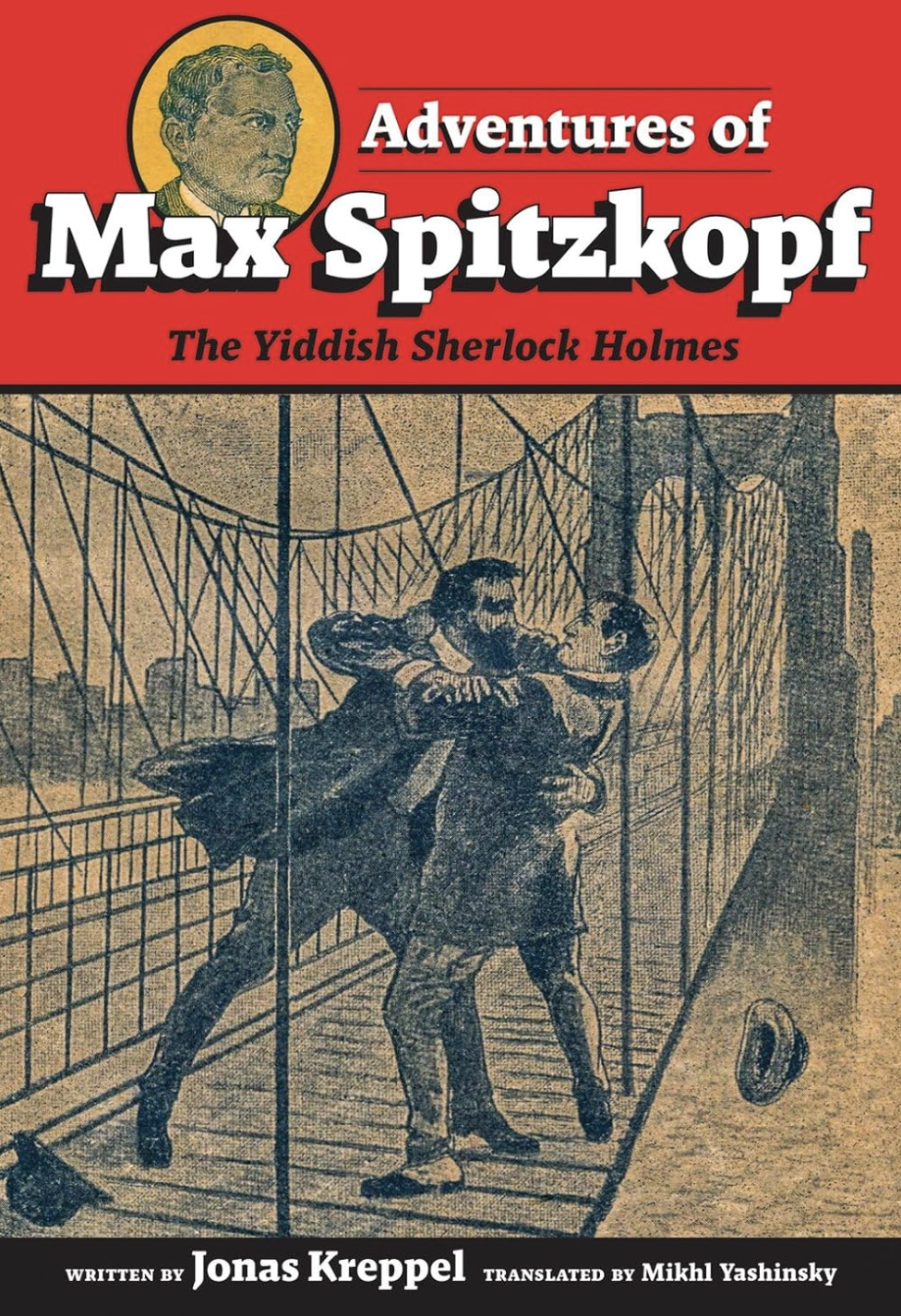
In the shadowed alleyways of eastern Europe, a man in clever disguise watches and listens. Each passerby, each word, each gesture, he considers with great thought. Later that night, he will return to the inn where he has rented a room, reconvene with his trusted assistant, and hatch a plan to uncover the truth. He will ultimately succeed, and the cycle will begin again the following evening. Detective Max Spitzkopf, the Yiddish Sherlock Holmes, is an unstoppable force for good.
Background
The Adventures of Max Spitzkopf: The Yiddish Sherlock Holmes was written by Galician writer Yoyne (Jonas) Kreppel and published in the early twentieth century. Kreppel, who was born into a middle-class Hasidic family in 1874, was active in Jewish politics throughout his career, even editing Jüdische Korrespondenz, the journal of the Agudas Yisroel movement. He was committed to imbuing his extensive public service with religious values, working to be a supportive voice for the Jewish population of Galicia. Aside from the Spitzkopf stories, Kreppel wrote about Jewish pulp fiction, humor, politics, and Hasidic legends. As a prominent Jewish intellectual, he was targeted by Hitler’s regime and was eventually murdered in the Buchenwald concentration camp in 1940, just a few years into World War II.
Setting the Scene
Each story about Max Spitzkopf, dubbed the “Viennese Sherlock Holmes” by those who know of his fame, unfolds in essentially the same way: Detective Spitzkopf learns of an impossible case and is certain that he can solve it; he tasks his assistants with gathering intel while he investigates on his own; he cracks the case in the nick of time; the true criminals are exposed due to Spitzkopf’s impeccable detective work; and Spitzkopf receives praise (and often a hefty reward) from the community.
It’s a classic detective novel format, boasting the impressive nature of Spitzkopf’s wits and his pursuit of truth and justice. Spitzkopf is sharp as a knife (as his name would suggest), wildly observant, a master of disguise. He heroically saves the day on multiple occasions; he is quick on the draw and quick to comprehend criminals’ plans. At times, Spitzkopf’s character feels predictable, maybe even a little bit cliché, but it serves him well: He is an easy character to admire, and the reader cannot help but root for him.
There are many aspects of these stories that are just as frustrating as they are entertaining—perhaps an important quality of all engaging mysteries. I found myself groaning (and laughing) each time Spitzkopf’s assistant Fuchs got himself into a sticky situation, often receiving “a terrible blow to the head” (Kreppel 2025, 144) and ending up in some cellar with his limbs bound. Fuchs ventures headfirst into danger, only informing Spitzkopf of his plans about half the time, and miraculously makes it out alive after being rescued by his employer. (All I can say is that Fuchs’s workers’ comp plan must be extremely generous.) Another motif is Spitzkopf’s apparent omnipotence: While his process in uncovering the truth is eventually explained to the other characters (and hence the reader) at the end of each story, it is rare that the reader gets to follow along with Spitzkopf’s detective work in real time. Even when we do get his perspective, so much is still hidden from us. Perhaps this is just a product of the genre of detective fiction, but I do wonder why the reader is not given the chance to solve the mystery for themself. Is it easier to know that the story will always end in Spitzkopf’s victory, the criminals behind bars? Is this easy reading a result of the political moment that Kreppel’s primary audience—Jews in a changing Europe—were experiencing? Perhaps Jewish readers turned to predictable stories in order to quell the sense of anxiety they were feeling in that period.
Max Spitzkopf, Defender of the Jews
As entertaining as the Spitzkopf stories are, they also represent the moment that Jonas Kreppel was living through. These tales highlight an important element of the time in which they were conceived: the rampant anti-Jewish sentiment that plagued much of Europe. Many of Spitzkopf’s cases center on crimes against the Jewish community. For instance, in “The Blood Libel,” the Jews of Dorokhov are accused of killing a Christian child ahead of Passover to use her blood to make matzah, ultimately inspiring a series of violent pogroms from the other townspeople. In another story, a rabbi’s daughter is kidnapped by the schoolmaster, who intends to convert her to Christianity so that he can marry her against her will. The list goes on. These stories demonstrate the vulnerable position of Jews within their communities at the turn of the twentieth century due to many factors, including pogroms, modernization that upended traditional ways of life, and international political unrest. Kreppel’s Max Spitzkopf is the hero that the Jews of eastern Europe wished they had: someone who would stand up for them, who had the natural ability to solve any crisis without hesitation or fear, who wouldn’t blame them for the world’s ills. Spitzkopf often believes a Jew’s innocence long before the rest of their community and is determined to sniff out the true culprit before another Jew is made the scapegoat for a crime they did not commit.
At a time when many Jews felt powerless, Max Spitzkopf symbolized strength in the face of persecution. He is a Jew who fights back, who refuses to let public opinion—and all of the bias it holds—steer him away from the truth. Though this is a work of fiction, and an often comedic one at that, this collection ofMax Spitzkopf stories raises the questions of How do we fight back? How do we resist in service to our community? Such questions resonate not only for Kreppel’s early twentieth-century readers but also in the devastating years that followed. Writers like Isaac Bashevis Singer, who was famously inspired by the Spitzkopf stories as a young person, documented everything they witnessed as twentieth-century Jews, from violence and destruction to daily life and questions of how to move forward. These questions still resonate today, as we consider how to stand up for ourselves and others in a world, once again, leaning into fascism and into the persecution of marginalized groups.
Max Spitzkopf's Impact on Jewish Life Today
As I read, I asked myself why this translation matters—why translate Yiddish Sherlock Holmesian stories when so many similar ones already exist in the English-speaking cultural lexicon? What do Kreppel’s stories add to the conversation? I believe that this book is a wonderful example of a “layperson’s Yiddish text,” so to speak. This is not a lofty text one might recover for the scholarly purpose of informing our comprehension of Jewish history. Instead, this work of genre fiction is part of a broader spectrum of Yiddish texts that made up a vibrant culture catering to an array of readers—and not only those whose tastes aligned with academics who might be researching the literature today. Detective stories such as Kreppel’s were meant to appeal to ordinary readers, and this translation serves to remind us of the ordinariness of the Yiddish reader rather than placing them in some kind of exceptional, nostalgic frame of reference. Even in the book’s dialogue, we see class divides: Many of the criminals often speak in slang, which, as I learned upon speaking to the translator, Mikhl Yashinsky, was originally written in a kind of colloquial Yiddish rather than Spitzkopf’s more formal and “correct” use of the language. Yashinsky told me that there was often a “rough underworld feeling in their language and atmosphere” that he worked to capture through his translation process. Yashinsky’s playful use of grammatical alterations and old-fashioned colloquialism helps these stories read with the same vintage, curious voice as Arthur Conan Doyle’s work. The reader is transported to the streets of twentieth-century Vienna and the surrounding towns.
Another interesting element of note is the name of our detective himself: Although he is known as “the Yiddish Sherlock Holmes,” the name Max Spitzkopf is, decidedly, not very Yiddish sounding (he is not “Max Shpitskop”). One might wonder why this is—did Kreppel write the name differently in the original, and was it translated to sound more Germanic for an English-speaking audience? Yashinsky gave me some insight into this as well: “Max Spitzkopf’s name [reflects] his grounding in the world of Austrian Jewry and German language while still allowing him to shine as the distinctly Jewish hero that he is, and as a defender and friend of his Yiddish-speaking brothers and sisters.” He noted that Kreppel did not write in the standardized YIVO Yiddish that we engage with today, reminding the reader that Spitzkopf and his team are often and intentionally described as Viennese throughout the book. The use of a Germanic name for a Yiddish-speaking hero demonstrates that Ashkenazi and especially Yiddish-speaking Jewish identity, though often thought of as distinct from western European culture, does not have to be completely separate. Max Spitzkopf bridges this perceived distinction, working to defend the Jewish people so that they may live safely and in congruence with the rest of their community.
Through the translation of this work, we are exposed to a more complex use of the Yiddish language than we’d typically get in a classroom. Kreppel and Yashinsky demonstrate variations on the use of Yiddish that transform our collective understanding of Jewish language and life in the twentieth century.
As a student of Jewish studies, I think that the themes Kreppel explores in his work are quite thought-provoking. I consider the moment he was living through, a moment in which my own family members were planning their exit from Galicia and their immigration to the United States, thereby narrowly avoiding the horrors of the Second World War. I was fascinated by this snapshot of what life could have been like for them, as seen through the eyes of Max Spitzkopf. This genre is not typically what I read, and at times I found the structure of the stories to be a bit repetitive in nature. But I think that this book (and those like it) holds an important space in the Yiddish literary canon. I personally felt more drawn to the context than I was to the stories themselves; Spitzkopf has a strong grasp on the class concerns, social relationships, and geographic landscape of the day. He seems to see everything play out before it happens. And, through his eyes, I can see the world my family, and so many others, once inhabited.
One can only hope that this trend of translating lay books from Yiddish will continue—that we will begin to see more examples of daily life and pop culture. Our perception of Jewish history must be malleable, capable of nuance and change, and broad enough to include this kind of ordinary, popular fiction. Through accessible and entertaining tales, this book creates a space for the discussion of so many aspects of Jewish life past and present.