Jan 05, 2026
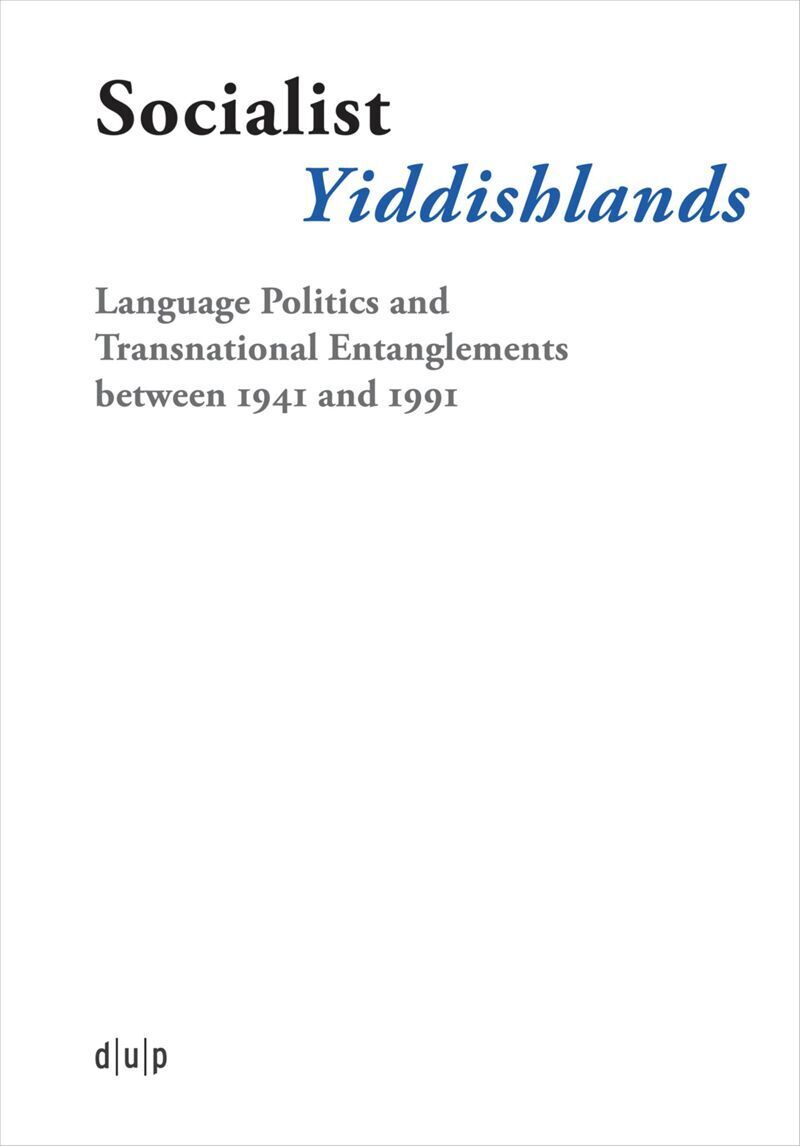
Miriam Chorley-Schulz and Alexander Walther, eds. Socialist Yiddishlands: Language Politics and Transnational Entanglements between 1941 and 1991. Düsseldorf University Press, 2025. 404 pp. $45.99.
I started to read this volume shortly after returning home from Colorado, where I was attending a conference and workshop dedicated to David Shneer’s memory. I had not known that this book, which features research articles alongside translations and interviews, was also dedicated to him. It makes perfect sense, however, since some of David’s final publications and research topic, the Art as My Weapon project, were indeed focused on the topic of Yiddish culture behind the Iron Curtain, specifically, on the DDR/East Germany. This volume is also not just dedicated to Shneer, it begins with an overview of his career and academic legacy, written by Gregg Drinkwater, Shneer’s husband. So, that was how I began reading this book, and that is what frames my approach to understanding the tremendous contribution that this edited volume makes.
The fruits that Socialist Yiddishlands bear come from seeds planted at a 2021 POLIN conference. The volume gives the reader the opportunity to both travel back to that conference’s virtual venue and benefit from the time and effort that the authors and editors put into crafting this collection. The essays are on the shorter side, but that is not a drawback. In fact, their length is one of the elements of this volume that makes it so approachable and engaging. The volume carries within it an overarching argument, too: that we need to reconceptualize what “Yiddishland” means. To this end, Miriam Chorley-Schulz writes, in the insightful introduction, “‘Yiddishland’ refers to a transnational cultural entity linked through diverse and dynamic local intellectual, literary, cultural, and political practices in Yiddish” (24). For those working on the pre-war years, this is an unsurprising definition. But this volume focuses on the postwar years, which allows Chorley-Schulz to add “As a world unto itself, linked by Yiddish but connected to and overlapping with many other languages, this entity was reshuffled and reconceptualized by wars and genocides, revolution, and decolonization in the 20th century” (24). This is all stated in order to deliver what seems to be the primary crux of this volume, which is that in the postwar years and in the socialist lands, borrowing from Shmuel Charney, Yiddishland took on a “polyterritoriality,” meaning that while still global and linked (albeit differently because of the geopolitics of the Cold War) the parts of Yiddishland “figured as more distinct, locally demarcated Yiddishlands that both cross-fertilized and competed against each other for ideological supremacy in a world that was gradually decolonizing and globalizing” (26). It is this thinking in the plural that shapes this evaluation of this historically imagined community. For this collection, however, it is the local that is key. The articles attempt to situate “Yiddish speakers as active members of state-socialist societies who shaped and were shaped by the societies in which they lived” (34). There was agency at play.
The core feature of this edited volume is the articles that comprise its bulk. Several of the articles speak to each other in important ways, and a number of them seemingly set the course for new directions in scholarship and research. For example, the articles that feature Poland build to develop a rich new base from which to understand the place of Yiddish in the emerging post-war Polish socialist state. Katharina Friedla’s contribution, which focuses on how in Poland “the Yiddish language was used as a marker of ethnic identification” (52), “demonstrate[s] that Yiddish regained immense power in the wake of the Second World War, [and] was not only used as a communication tool, but furthermore…shaped and influenced the relationship between Polish and Ashkenazi Soviet Jews” (52). Ultimately, Friedla highlights how Yiddish was a tool of unity that “brought Soviet and Polish Jews together” (61). Kamil Kijek’s article on daily culture in post-khurbn Poland emphasizes that the “khurbn did not spell the end of the Yiddish language and culture and Poland” (65) and shows how “the Polish Jewish community was able to reconstruct many institutional features of prewar Yiddish cultural life: press, book publishing, theater companies as well as Yiddish cinema” (67). (I should note that “khurbn” is deliberately used over “Holocaust” throughout this book.) Kijek is keen to tell the reader, however, that despite these efforts, there were barriers impeding a full-blown Yiddish cultural rebirth. Agnieszka Żółkiewska’s chapter shows why the postwar Yiddish cultural revival was so short-lived in Poland. Initially, Polish authorities gave Jews “the right to pursue a free cultural policy within their own cultural institutions” (123), but this moment was brief, and Jews, after 1950, would be “under the constant threat of being accused of ‘national deviation’” (136).
Not all the articles are about Poland, though. The remaining contributions cover a wide range of activities, from theater to memorializing efforts, in several locales, including Romania, Argentina, Soviet Ukraine, East Germany, and Israel. Malena Chinski’s contribution focuses on efforts in Buenos Aires to memorialize the Warsaw Ghetto Uprising between 1944 and 1955 and highlights how the Cold War “affected and transformed Latin American immigrant communities” (147). It is a fascinating tale of how the Cold War deepened the rift between communists and Zionists in Argentina. Gennady Estraikh’s essay, which reconstructs the life of the overlooked poet Rive Balyasne, “affords fresh insights and a woman’s perspective…on the Soviet Yiddish literary environment, initially heedfully formed and then violently deformed by the regime” (208). In her essay, Corina Petrescu tracks the development of Romania’s Teatrul Evreiesc de Stat (Jewish State Theatre [TES]), which began in 1948, to show how this theater “embodied the dichotomy of simultaneously preserving Jewish identity behind the Iron Curtain and representing Romania’s political regime” (356). Specifically, Petrescu highlights the group’s first international tour, which took it to Israel in 1968, to illustrate how Romanian authorities, who were trying to distance themselves from the Soviet Union in how they actualized their state-socialism, “used TES in their efforts to introduce themselves to the Western world in the most positive light, which also meant projecting the superiority of their worldviews…[and how the theater’s tour] made apparent that the Iron Curtain was not impenetrable and that integrated nonconformism…could be, at times, more beneficial and effective than taking a stand” (372).
One of the true strengths and accomplishments of this volume is its successful attempt to make its topic “come alive,” as it were. How does one make “Socialist Yiddishlands” come alive, you may ask? Interspersed among the scholarly articles are interviews with postwar Yiddish culture-makers and translations of travelogues of some of the spaces featured in other chapters. There are interviews with Jalda Rebling, the daughter of the East German Yiddish singer Lin Jaldati (Jaldati was the focus of Shneer’s aforementioned Art is My Weapon project), in which she discusses her mother as well as Yiddish in the DDR broadly. It is a fascinating chronicle of what was going on alongside Jaldati’s cultural efforts.
Another interview in the volume is a translation of a 1983 conversation with Sholem Rubinger, the Yiddish broadcasting editor on Romanian radio. By way of the interview, we learn that Romanian radio broadcast Yiddish programming beginning in 1949 and that it ran for about twenty-five years. This interview is published side-by-side with the original Yiddish and Chorley-Schulz and Binyamin Hunyadi’s translation.
The translation of Arn Vergelis’s “Journeys: Poland” is published similarly (including its original Soviet Yiddish orthography), and it is also brought to us in English though another translation by Chorley-Schulz and Hunyadi. These travel notes, which were published originally in 1965 in Sovetish heymland, provide a fascinating snapshot and would make for a good addition to any class seeking to utilize primary sources related to this post-khurbn/Holocaust world. Interestingly, too, in the introduction to this translation, Chorley-Schulz argues that these travel diaries help us re-frame how we understand postwar antifascism. Vergelis “gets to introduce the memory regime of Soviet Yiddish antifascism he practiced by way of his reflections on Auschwitz, Treblinka, and the Warsaw Ghetto,” writes Chorley-Schulz, and “[h]is insights are testament to an active Soviet Yiddish memory culture that coupled a socialist critique of capitalism with the examinations of fascism and its spawns – racism and genocide – and mobilized the dialectics of primarily Jewish, but also non-Jewish, suffering as resistance to Nazism as a political weapon in the ongoing united revolutionary struggle of the oppressed” (236).
Socialist Yiddishlands sets the stage for what could be a shift in how scholars think about the relationships among Yiddish, the Cold War, the effects of the Cold War on Jews around the world, the Soviet Bloc countries, and the lived realities of those who actively participated in the development of state socialism. This edited volume also serves as a model for ways to curate scholarly articles, translations, and interviews together in one source to help develop the argument of a volume. The inclusion of the interview with Rebling and the translations of Vergelis and Rubinger’s texts serve only to deepen the overall contribution that this book tries to make. Yes, adding an “s” to Yiddishland is a meaningful and thought-provoking effort, especially in the context of the deepened Jewish transnational realities of the postwar world.