May 07, 2025
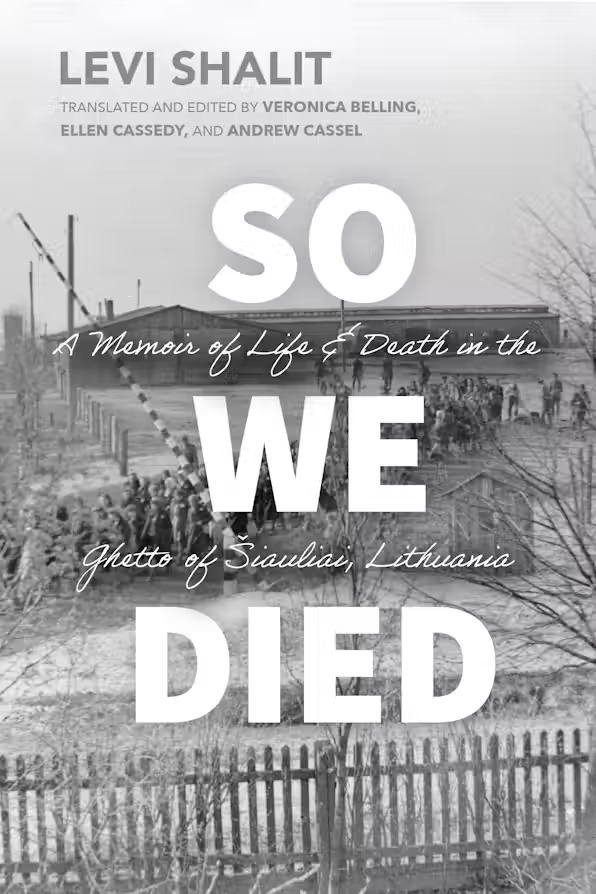
Shalit, Levi. So We Died: A Memoir of Life and Death in the Ghetto of Šiauliai, Lithuania, transl. Veronica Belling, Ellen Cassedy and Andrew Cassel, with an afterward by Justin Cammy. University of Alabama Press, 2024. pp. 292. $34.95.
It would have been around 1946 or 1947 when Levi Shalit saw Dovid the carpenter, a fellow survivor of the Shavl (Šiauliai) ghetto, testify before the historical commission in Munich. Dovid’s eyes, Shalit recalled, “burned like fire and seemed to exude death” (32). Several years prior, Dovid had stood with other Jews at a killing pit, but he somehow survived the hail of bullets, ran naked through the city, and found his way to the ghetto. Dovid tried to impress upon others what he had witnessed, but Jews with whom he conversed thought him mad. Incredulous, they clung to any signs that their loved ones were alive.
In Shalit’s 1949 Yiddish account of the Shavl ghetto, Dovid the carpenter appears in a flash and then fades from view. He speaks at an unspecified time and bears witness to an undated massacre. But for Shalit, Dovid’s brief, haunting testimony underlined a key facet of wartime Jewish experience: the perennial agony of uncertainty. The ghetto was a wildfire of rumor and a hotbed of disinformation, and seeing through that fog was a labor bound up in Jews’ very survival. In So We Died, Shalit collects fragments: a name, a spark of news, a letter thrown from a moving train. Blending reportage, vignettes, and intimate character studies, he illuminates how Shavl’s Jews responded to an unfolding communal catastrophe.
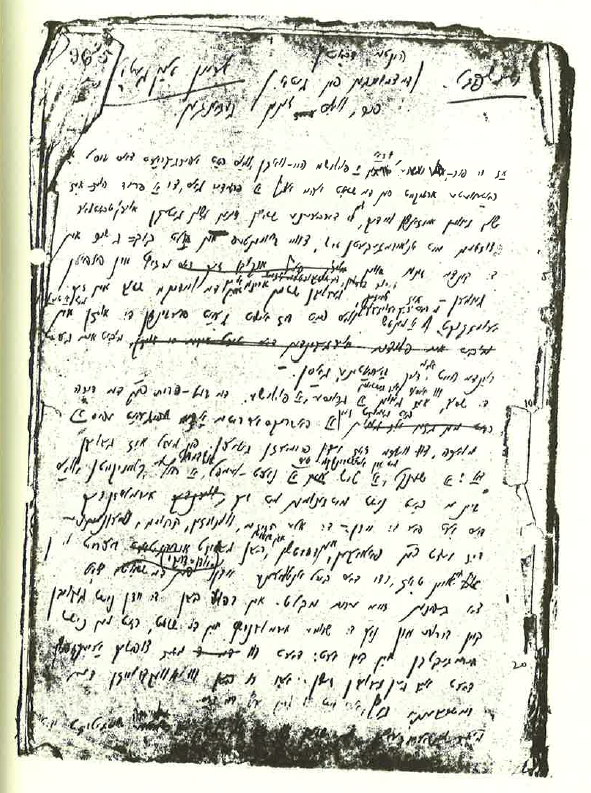
Shalit was as much a zamler as he was a chronicler. When he arrived in Munich around 1945, he no longer held his ghetto diary. But he stood at the nerve center of information gathering and exchange. A prolific journalist before the war, Shalit edited the early issues of the newspaper Undzer veg (Our Way), the official organ of the Central Committee of Liberated Jews in Bavaria, where he wrote under his given name, Levi Shalitan. 1 1 Shalit covered international affairs as well as happenings in the DP camps in the American zone of postwar Germany, among other subjects. See, as an example, Levi Shalitan, “Fun undzer seyder-hayom,” Undzer veg 13, 28 December 1945, p. 2. In the Yiddish DP press, he absorbed the recollections of his townsfolk—the few who survived—and began to map out his text. 2 2 For instance, Levi Shalit, “Dos ‘masada’ bukh,” Undzer velt 84(2), 16 January 1948, p. 4. Per Justin Cammy’s afterword to So We Died, sections of the book also appeared serially in Yidishe tsaytung in 1947. Cammy provides helpful context on the first edition of Shalit’s book, which was published in German in 1945. Surviving drafts of his book chapters suggest that Shalit engaged in an iterative process of writing and revision. Over months and years, he sculpted the stories that would later animate his 1949 manuscript, Azoy zenen mir geshtorbn. 3 3 For drafts of Shalit’s chapters, see YIVO Archives, Record Group 104 (Eyewitness Accounts of the Holocaust Period), Series I, Folders 243-249. Shalit’s marked-up typescripts are undated but appear to have been fashioned between 1946-1948, roughly the span of the accounts held in RG-104. This collection holds early iterations of two of Shalit’s most searing stories, “A misphet iber der yidisher froy” and “Tamare (geto-mame).”
Skillfully translated into English for the first time as So We Died, Shalit’s text reads less like a memoir than a mosaic of memory—a composite of voices that traces the lost world of Shavl Jewry and its fate during the Holocaust. Shalit’s narrative unfolds in four acts. In Part I, “O Israel, People of Faith,” he covers the early weeks of the German occupation of Shavl, a city in northern Lithuania that was home to some 8,000 Jews in the interwar period (roughly twenty percent of the total population). Rather than reconstruct the early spate of massacres or the process of ghettoization, he observes as Shavl’s prewar Jewish society – full of quirks, mores, and idiosyncratic characters – mutates in conditions of extremis.
For one, the widowed, impoverished Tamara, whom Shalit describes as physically disfigured, a woman who moved “like a wagon with its shafts askew,” suddenly emerged as the “mother of the ghetto.” Tamara had a wild temper but instantly softened at the sight of children. Long an outcast, she had become an object of envy: unlike most Jews forced to vacate their homes, she did not have to uproot her family, as her hut already lay within the borders of the designated ghetto. Tamara was virtuous in that she relinquished her newfound privilege. Instead, she wandered the cemetery where the uprooted Jewish masses had assembled and sprang into action to care for the orphaned and bereaved. Tamara, who “used to foam at the mouth as she stumbled along with curses and shouts,” now moved silently, “swaying as if with broken wings,” issuing directives (39).
The ghetto, too, was a laboratory of social transformation. In Part II, “So We Lived,” Shalit explores how Shavl Jews adapted to the asphyxiating conditions of the ghetto, which comprised two areas, Ežero-Trakų and Kavkaz (Kaukazas). Facing dire hunger, some Jews broke away from their work sites in the city, ventured to the houses of peasants, and begged for food—excursions that were termed “going schnooring” in ghetto parlance (geyn af shnorite in Shalit’s original). Shavl Jews began to innovate their language. 4 4 Shalit’s sensitivity to the metamorphosis of the Yiddish language may have partly been due to his close relationship with historian and Kovne survivor Israel Kaplan, who compiled a dictionary of Khurbn Yiddish. See Hannah Pollin-Galay, What the Holocaust Did to Yiddish (Philadelphia: University of Pennsylvania Press, 2024), pp. 74-92. There was no theft in the ghetto but rather “labern” (lifting), and lifting was an imaginative art that offered material reprieve as well as a taste of revenge. The butchers, Shalit recalls, “would wrap their whole bodies with intestines, like a second layer of skin” to sneak them past the ghetto gate (50). Others used rope to tie “lifted” wood to their bodies and pull it like a sleigh.
Shalit’s title, So We Died, encapsulates his argument: Shavl Jews fought tooth and nail to outsmart their murderers. They fashioned room for maneuver where none existed. They fought to live—and so they died. When Gedalye Trakhtenberg’s family was suffering from hunger and dysentery, the eighteen-year-old boy sold his mother’s wedding ring for a sack of potatoes that he tried to smuggle into the ghetto in a briefcase—before he collapsed and died. “So we lived—and even worse,” Shalit explains. “So we died—and sometimes death was easier, sometimes harder; sometimes beautiful, sometimes ugly; sometimes profane and sometimes holy—just so” (74).
Through Shalit, we also meet Saneh Shulman, Shavl’s pious cantor, as he leads Kol Nidre in a cemetery house. During the prayer service, Saneh grows disconsolate. He remembers his murdered daughters and begins to argue with God, demanding answers about the suffering of the ghetto Jews. His faith quivers. But moments later, it spurs him to act. Saneh learns that danger had descended on the ghetto after a group of Jews failed to report for work at the aerodrome. He rushes out to give them cover, proclaiming that it is a mitzvah to save lives, and dies in the process from the backbreaking toil.
Evidently, Shalit was moved to enshrine Jews’ tenacity, but he rarely lapses into sentimentality. The ghetto was a stratified ecosystem where those who did not venture to work were envied. Class inequality reigned. The Jewish administration, Shalit submitted, was a “demon dance” that “made the ghetto appear to be a Jewish autonomous region.” The men of the Jewish council and the Jewish police were multifaceted and occasionally callous. Burgin was both a “ruler over the ruined ghetto dwellers” and someone who brought food to the sick. Tsherniavski, of the labor office, “decided who lived and who died” and taunted Jewish workers.
Shalit’s criticism would be easier to weigh had he substantiated his account or revealed his sources. But notably, he seldom locates himself on the page. Shalit first references his family members when he recounts being separated from them at Stutthof in 1944, in what reads as a postscript. The absence of his first-person voice feels especially glaring in Part III, his foray into “Masada,” the underground Zionist organization to which he—and only some one hundred people in all—belonged. As an insider, Shalit provides singular details on the group without divulging the nature or extent of his participation: how “Masada” advocated for Shavl’s aerodrome workers, fought bribery, and promoted Jewish cultural activity. Later the group acquired weapons, attempted to make bombs, and established contact with partisans in the forest. Shalit’s “The Masada Book,” complete with a veritable rolodex of names, locations, and dates, invites further research on Shavl’s resistance networks.
Still, Shalit’s voice repeatedly pierces the page as he registers his disbelief at the very episodes he describes. Indeed, his biting, rhetorical questions reveal a related, though distinct, tale of a survivor peering back at the abyss, at once agonizing over his words and mulling their implications. In a coda to his chapter on health, marriage, and epidemics in the ghetto, for example, Shalit wondered how one can “talk of joyous love behind barbed wire, of lives bound together in marriage, about the joy of charming childish eyes, about the fight against fatal epidemics—when all were annihilated by bestial death?” The dissonance unnerved him. Elsewhere, he reflected on what he felt defied representation: the battle against extreme hunger, for instance, was incommunicable to those who had not waged it. But he was particularly distraught by the plight of Shavl’s children.
No event permeates Shalit’s text more than the kinder-aktsye of 5 November 1943, in which hundreds of Jewish children were torn from their parents, rounded up, and later murdered. Shalit chronicles this event only in Part IV of his manuscript, “The Community Dies,” but it creeps into his writing, foretelling the end. Much like Saneh, the holy cantor, Shalit searched his faith for answers. He wondered, referencing Rabbi Chanina’s statement in the Talmud, whether a person’s injuries on earth are indeed decreed from on high. “Why were so many pure, gentle bodies shattered that day, the fifth of November, and for what reason?!” (96) This question, for Shalit, was the point of rupture—and a breaking open of his literary frame. Later, when detailing the aktsye itself, he turned to address the perpetrators directly: “Murderers! May the looks of the children follow you unto your last generation, poison your life, twist your thoughts, drive you to madness” (186).
Shalit’s reckoning on the margins of So We Died may well be ancillary to his documentary effort to center the victims. But as in Shalit’s reportage, death and life are inextricably bound: the tiles of Shalit’s memory mosaic were laid by witnesses like Dovid the carpenter, a man who escaped the shooting pit but who later stood with a deathlike stare as he attempted to testify. Shalit attunes us to the grief of survival and, consciously or not, to the harrowing labor of bearing witness.
The silences in Shalit’s account also gesture to new avenues for research on wartime life in Shavl and German-occupied Lithuania writ large. Shalit was an especially trenchant observer of intimacy and sexuality. He reported that, in the peat bog camp outside the ghetto, “a silent, haunting longing echoes in the hearts of inmates, a longing for home, for rest, for a woman—and then the men steal into the women’s barracks” (138). He opined that for many ghetto inmates, “money, women, and wine became the only threads to life,” though over time, they also longed for “a spiritual Jewish existence” (152). Shalit’s language reveals his intrinsic identification with men and male desire, highlighting the need to incorporate women’s perspectives into a future social history of the ghetto.
Indeed, the historiography of Jewish life in occupied Shavl has largely rested on three male voices: the meticulous diary of Eliezer Yerushalmi, 5 5 Eliezer Yerushalmi, Pinkas Shavli: Yoman m’geto lita’i, 1941-1944 [Pinkas Shavli: A Diary From a Lithuanian Ghetto] (Jerusalem: Yad Vashem Press and Bialik Institute, 1958). who served as Jewish council secretary, published in Hebrew in 1958; the physician Aharon Pick’s journal, 6 6 Aharon Pick, Reshimot mi’ge ha’haregah: Zichronot ktuvim b’geto ha’shavli b’shnot 5702, 5703, 5074 (Tel Aviv: Association of Lithuanian Jews in Israel, 1997); Notes from the Valley of Slaughter: A Memoir from the Ghetto of Šiauliai, Lithuania, trans. Gabriel Laufer and Andrew Cassel (Bloomington: Indiana University Press, 2023). which appeared in Hebrew in 1998 (and in English in 2023); and Shalit’s original Yiddish text, which historians have cited for decades. 7 7 For instance, Christoph Dieckmann and Joachim Tauber have engaged extensively with Shalit’s Yiddish text. See Christoph Dieckmann, Deutsche Besatzungspolitik in Litauen 1941–1944 (Göttingen: Wallstein Verlag, 2011) and Joachim Tauber, Arbeit als Hoffnung: Jüdische Ghettos in Litauen 1941-1944 (Berlin: De Gruyter Oldenburg, 2015). These publications have greatly illuminated our understanding of Shavl Jewry in its final hour. But what insights might we glean by foregrounding women’s testimonies, be they the handwritten accounts DPs submitted to historical commissions, or, in later decades, the oral history interviews women gave to memorial institutions? After all, Shalit himself struggled with the recognition that his text had failed to convey what had befallen his community. If, as he averred, “no pen could ever describe” these events, perhaps a multiplicity of voices, and a diversity of pens, could inch us closer to historical understanding.
So We Died shines a timely spotlight on everyday life in the ghettos of Lithuania and on the extraordinarily vibrant, though little-known, Jewish community of Shavl—a city that has long lurked in the shadow of Vilna and Kovne. Shalit’s eclectic text will prompt further discussion on the agency of Holocaust victims, the emotional lives of Jewish displaced persons, and the corpus of early postwar testimonial literature.

In geveb is turning t(s)en! If we want In geveb to continue to grow and thrive and remain a central address for the study of all things Yiddish online, we need your help to launch our second decade. Our goal is to raise $20,000 by our official tenth birthday: August 15, 2025. We invite you to donate to support In geveb and to honor everyone who has got us this far.