Jan 26, 2022
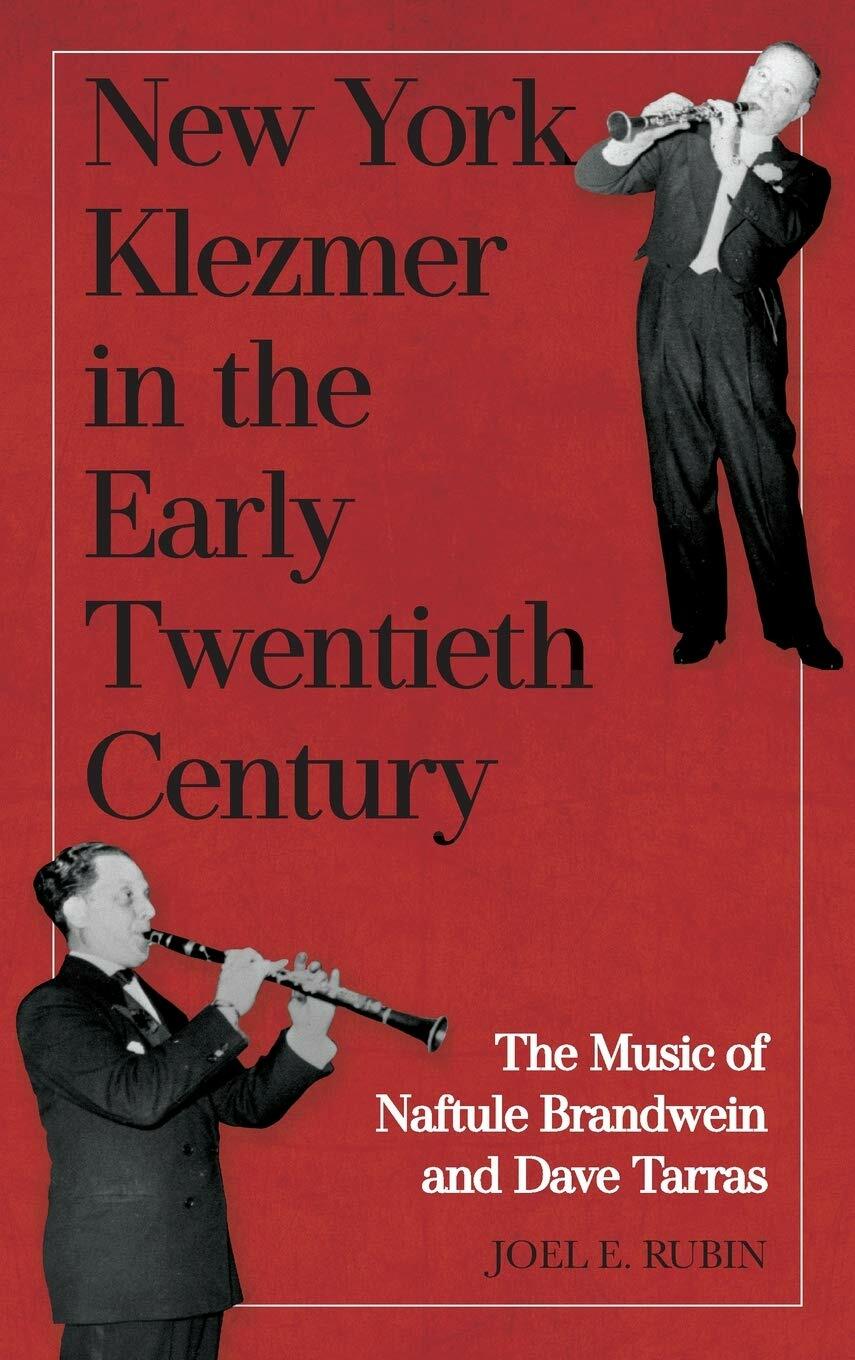
Joel E. Rubin, New York Klezmer in the Early Twentieth Century: The Music of Naftule Brandwein and Dave Tarras. (Boydell & Brewer, 2020). 483 pp. Hardcover, $61.75.
The twenty-first century has seen increasing amounts of scholarly ink directed towards klezmer music. A significant amount of this work has focused on the 1970s onwards—perhaps inevitably, given the lively identity politics that have in different ways and at different times framed the expanding geographies of the klezmer revival. Indeed, the political and ideological ambiguities that attach to the term revival itself are instructive, with increasing numbers of practitioners and scholars preferring the more nuanced ‘revitalization’ or ‘resurgence’.
New York Klezmer centers on a time before these particular etymological and semantic differences were relevant, at least as far as klezmer was concerned. This is not to say that terms and usage did not matter to Jewish musicians of earlier eras. The changing implications of the word “klezmer” itself—from musical instrument, to musician, to musical genre—are well-covered here, but perhaps more revealing is the changing reputation of klezmorim, nicely parsed in clarinetist Max Epstein’s memorable 1991 quote: “If you called me a klezmer thirty-five years ago, I’d hit you with something!” (6).
Despite the shifting status and popularity of this Ashkenazi instrumental music and its musicians, Joel Rubin is, surprisingly, the first researcher to devote serious and sustained attention to one of its most important and productive periods: New York in the 1920s, and in particular the remarkable—and nowadays canonical—recordings of its two best-known and most influential figures, Dave Tarras (1895/7-1989) and Naftule Brandwein (1884-1963).
Rubin’s book, based on his 2001 PhD research but comprehensively updated, will doubtless stand as one of the defining scholarly pillars in this occasionally messy field. Not only does it provide the most detailed and fine-grained musical analysis of klezmer’s stylistic and structural elements seen to date, but the fact that this analysis is based upon a particular and clearly-defined corpus reduces guesswork and in fact allows larger conclusions to be more effectively drawn. And as Rubin makes clear, Tarras’s and Brandwein’s strong connections to the Eastern European klezmer tradition, their high status within the New York Jewish community, and the centrality of their recordings to the klezmer revival, means that to look closely at their recorded legacy is to connect directly to all stages of the development, continuation, and adaptation of klezmer as the music and its musicians migrated westwards to the United States.
Given the particular and traumatic trajectories of twentieth-century Ashkenazi life, the study of its klezmer music inevitably embraces both performance practice and social history. Perhaps as a result, many of the most important revival-era musicians have also been—to a greater or lesser degree—researchers and historians. Rubin’s biography as both performer and scholar is well-known. Along with other key figures such as Zev Feldman and Hankus Netsky, he has trodden the line between practitioner and academic skillfully and creatively. It is of course not unusual for ethnomusicologists, following Mantle Hood’s appeal to “bi-musicality”, to become highly competent—even expert—performers in their field. The immersive processes of participant observation can be sharpened and given direction through learning an instrument, while the close relationships formed between teacher and pupil (and amongst fellow pupils) brings a grounding intimacy and intensity to fieldwork. With klezmer music, however, this process has more regularly happened the other way around, with established international performers going on to make significant scholarly contributions. Somewhere between the emic and the etic, it is a productive space that Rubin dubs the “Zwischenwelt” (3).
Rubin’s study began out of necessity. As a young clarinetist captivated by the sound of Brandwein and Tarras but faced with a lack of materials, he quickly grasped the need for his own research in order to have something new to play. And although neither Tarras nor Brandwein was alive by the time Rubin began his work, his own position as a respected klezmer musician led to musical and personal relationships with older figures who had worked closely with both, such as Sid Beckerman and Max Epstein. The many comments, opinions, recollections, and spoken expertise of these older musicians dot the text throughout, lending the narrative a vibrant level of historical detail and also an infectious and stylish tone of voice. This handing-down process also grounds Rubin’s own role in the development of American klezmer: as a vital link between first or second generation Eastern European immigrant musicians and the ongoing development of the music on an international stage, as well as within academia.
The combined recorded legacy of Naftule Brandwein and Dave Tarras remains one of the major sources of inspiration, repertoire, and performance knowledge for today’s klezmer musicians. Most players have listened to these recordings repeatedly, attempting to translate ornamentation, phrasing, rhythmic push-and-pull, and the elusive quality of interpretation to their own instruments (this process of course by no means limited to clarinetists). Foregrounding these recordings as primary source material is a markedly different approach to other klezmer scholarship covering the prewar period, in particular Moshe Beregovski and more recently Walter Zev Feldman. Where both Beregovski and Feldman concentrate on written or transcribed scores, Rubin’s focus on actual sound—albeit within the limits of recording technology of the time—allows his study to unfold at the intersection of structure and performance, of langue and parole. It is a recognition that, ultimately, music cannot exist outside performance, indeed outside time. Thus, while Rubin makes an analytical distinction between formal rules and playing style, he also acknowledges that this distinction (as with much traditional material) is harder to pin down in practice: very Jewishly, creativity is revealed first through praxis, with theory following after.
While strongly rooted in Eastern European Ashkenazi community ritual celebration, klezmer has often been a music of mobility. Successful klezmorim of the Pale traveled widely (although the myth of the wandering klezmer is just that—a myth), and many of the younger ones such as Tarras and Brandwein were part of the great waves of east-west migration in the first decades of the twentieth century. To study klezmer music is necessarily to reveal a transnational story, and 1920s New York, despite changing performance contexts and radical slimming of repertoire, was still dominated by European-born klezmorim working with traditional European melodic and structural materials. This is a narrative that spans continents, temporalities, and histories, and consequently Chapter 1 surveys the social, economic, musical, and religious frameworks that characterized the working lives of nineteenth- and early twentieth-century klezmorim in Eastern Europe. Chapter 2 picks up the story in New York, where the lives of immigrant musicians meet head-on with twentieth-century modernity and new world heterogeneity. Klezmer still thrives, but it must also learn to adapt: to the catering hall, to radio and the phonograph, to landsmanshaftn and to the Yiddish theater. The guild-like structures of eastern European kapelyes give way to the life of the freelance musician, and repertoire changes to accommodate a more secularized American Jewish identity.
Chapters four to six, the central part of the book, are where the author gets to flex his musicological muscles to greatest effect. Rubin resists the ethnomusicological temptation to classify the music according to genre and function—an understandable choice, given the large degree of melodic, formal, and functional overlap across different genres. Instead, he works on the basis of musical characteristics such as melodic figure, ornamentation and performance practice, and expressive range. And unlike many other writers on Jewish music from Idelsohn onwards, he also avoids drawing direct parallels with modal terminology outside of klezmer such as synagogue shteyger or church modes. Klezmer music exhibits a great deal of context-dependent flexibility in its use of modal language, and Rubin deals with this instead by breaking the raw musical material down into two sets of four tetrachords (four note groupings). Not only does this allow him to theorize various synthetic modal constructions that are fundamental to klezmer, but it also gives a robust yet flexible basis from which to discuss tonal variation, melodic direction, modulation, and modal relationships.
Loosely based around Benjamin Harshav’s Yiddish polylingualism model, Rubin’s argument turns on the idea that although klezmer music can be seen to draw on multiple sources, it can and should nevertheless be understood as one single field, susceptible to formal and content analysis. Following the native-speaker analogy (backed up in recent work on the language of jazz improvisation), this is a field within which different units—mode, melody, phrase, ornamentation, and structure—can be continually recombined and developed according to a mix of compositional flair and performer individuality, while still retaining a characteristic and recognizable musical coherence (there are rules). In another linguistic parallel, this time with Noam Chomsky, individual iterations of cadential formulae are positioned as “surface structures,” understood at a basic level as transformations of a simpler “deep structure” shape (133). In Brandwein’s and Tarras’s recordings, these cadential figures function somewhat independently of the tune, existing as transferable melodic and even rhythmic units and—in a restricted version of jazz competency—further blurring the boundaries between composer and player.
Although Rubin never claims to be writing a how-to manual, Chapter six offers the clearest rewards to any musicians looking to expand and solidify their klezmer performance knowledge and technique. It is here that we get a breakdown of the specifics of characteristic klezmer ornamentation, melodic decoration, and tonal variation, including how Tarras and Brandwein applied variety in some choices while exhibiting notable consistency elsewhere. Once again, the fundamental inseparability of musical material (form, melody, genre) and its real-time iteration in actual performance is crucial—alongside the pitfalls of overdoing it in the hope of “sound[ing] Jewish,” as clarinetist Danny Rubinstein pithily observes: “It’s like salt and pepper. You put too much salt and pepper on a steak, you’ve destroyed the steak” (180). Variants of the same tune as recorded at different times by the same performer, as well as the same tune as recorded by both performers, bring out the idiomatic and formal variables with which each player approached similar material. What we find, very broadly, is that their styles (and also the perception of their styles) were largely in line with their opposing “Apollonian” (Tarras) and “Dionysian” (Brandwein) personalities. In Sid Beckerman’s appraisal: “Tarras was wonderful; beautiful playing, but when Naftule played, it was more hot, more fire” (255).
New York Klezmer also includes the ubiquitous companion website. But unlike many similar offerings, this one is maintained by the author and has clearly been given a great deal of thought. Boasting complete transcriptions and audio recordings, along with a discography and appendices of variant performances, transcriptions, and sheet music, it yields plenty of material that will be new to even the best-resourced klezmerphiles. And while the majority of the book is clearly aimed at those with specialist musical knowledge, there is plenty that will be usable to anyone concerned with historical Yiddish culture more generally, whether as a teacher, a tuer, or an interested observer. The centrality of music to Yiddishkayt means that the historical moment colorfully captured here reveals not only the musical networks that sustained it, but also the wider—and changing—social, cultural, and ritual patterns that structured immigrant Jewish life in early twentieth century America.
Inevitably, however, no single book can cover everything, and one or two notable items stand out for further study. Rubin’s focus is almost exclusively on lead melody, and thus he does not discuss accompaniment patterns, rhythms, harmonies, and textures. While these are rarely as dazzling and rich as the melodic work of the two central figures, they would nevertheless reward detailed consideration, in particular for those musician-researchers interested in the more granular elements of historically-informed performance practice. Secondly, the particularities and peculiarities of klezmer rhythmic phrasing are not covered in any detail—the characteristic way of ‘squashing’ triplets, and stretching or contracting groups of notes within running semiquaver lines, for example. These two important areas stand tantalizingly in the wings for future research by those of us sufficiently inspired by the commanding scholarship displayed here.
In its simultaneous breadth and attention to detail, Rubin’s work reminds us of the necessity of the basic tools of ethnomusicology: fieldwork, interview, transcription, analysis, and from all this the drawing of meaningful conclusions. To return to the linguistic paradigm: Tarras and Brandwein represented a particular historical musical moment, the point at which the Eastern European klezmer tradition resettled in North America. These two musicians are no longer around to answer questions about their musical language, and those who came after inevitably spoke a slightly different musical dialect. The next best thing, therefore, is to examine their documented legacy in the closest possible detail, to break it down and see how it fits together, and in that way make intelligent and grounded assumptions about their music, its rules, and their application. For every single thing that Tarras and Brandwein did with their instruments, every structural element and combination, every characteristic ornament, reminds us that this was a musical language that they spoke creatively, fluently, and with style.