May 23, 2025

Eli Rubin. Kabbalah and the Rupture of Modernity: An Existential History of Chabad Hasidism. Stanford University Press, 2025. 446 pp. $70.00.
In one of Carl Braude’s paintings, the imagined history of Chabad-Lubavitch collapses into a single moment.
1
1
Image source: https://onegshabbat.blogspot.c....
The five rebbes stroll together down a street in what appears to be a European town. At the right end of the group, walking slightly apart, is the seventh rebbe, Menachem Mendel Schneerson (1902–1994). With his face turned and one hand slightly raised, he gestures toward his companions—rebbes three, one, five, and six in the Lubavitch dynasty. Rebbes two and four are absent: no images of Dov Ber Shneuri (1773–1827) and Shmuel Schneersohn (1834–1882) have come down to us. Yet those who look closely may find these two symbolically present as well. Menachem Mendel, the Tzemach Tzedek (1789–1866), and Shalom Dovber Schneersohn (1860–1920) carry books, alluding to the spiritual heritage left by their otherwise invisible predecessors. From the windows and balconies, the seventh rebbe’s parents, wife, and some Hasidim look on as the rebbes pass by, followed by more Hasidim and surrounded by curious children.
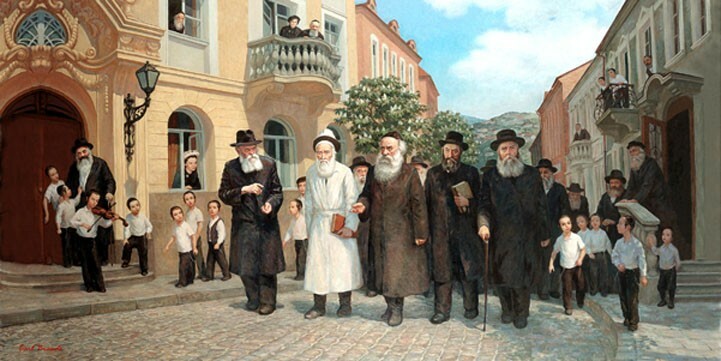
Five (out of seven) Chabad Rebbes. Drawing from a painting by Carl Braude.
This motif recurs in Braude’s paintings, which—while perhaps of dubious artistic quality—seem to capture a sentiment common among followers of the Chabad-Lubavitch dynasty.
2
2
See Maya Balakirsky Katz, “On the Master-Disciple Relationship in Hasidic Visual culture: The Life and Afterlife of Rebbe Portraits in Habad, 1798-2006,” Images: A Journal of Jewish Art and Visual Culture 1 (2007): 55-79; “Carl Braude’s New Painting,” Collive 11 March 2009 (https://collive.com/carl-braudes-new-painting/, accessed 11 April 2025); “The 5 generation[sic!] of Lubavitch Rebbe[sic!],” D&D Judaica (https://dndjudaica.com/product/the-5-generation-of-lubavitch-rebbe/, accessed 11 April 2025).
Defying time and space, these paintings place all the rebbes in direct conversation with one another, portraying the Chabad-Lubavitch tradition as a unified, atemporal whole. At the same time, they suggest that the movement’s earlier generations inevitably culminated in the leadership of the seventh rebbe, traditionally referred to simply as “the Rebbe.”
This wholesome (and anachronistic) vision of a well-rounded, harmonious, and teleologically oriented Chabad tradition stands in stark contrast to how it has been approached in academia, which has generally examined Chabad generationally, treating each rebbe and his legacy separately. These studies tend to focus either on the mystical teachings of the founding generations or on the messianism of the seventh rebbe.
3
3
For an essential bibliography on Chabad, see my “Lubavitch Hasidism,” in Oxford Bibliographies Online, Jewish Studies, https://www.oxfordbibliographies.com/view/document/obo-9780199840731/obo-9780199840731-0153.xml (accessed 28 April 2025). Published in 2017 and updated in 2022, this bibliography has already become outdated, with a number of new doctoral dissertation and books, published mostly in Israel, exploring elements of Chabad history, predominantly from the point of view of intellectual history and phenomenology of religion.
If Braude were to depict Chabad leaders based on academic scholarship, he would need to assemble them into a fragmented collage. Some rebbes (Shmuel, for example) would appear barely visible, as very little has been written about them. Few houses or Hasidim would be seen in the background, since intellectual history still heavily outweighs the social and cultural history of Chabad communities.
Against this backdrop, Eli Rubin’s attempt to write a comprehensive history of Chabad is particularly commendable. While not the first, Rubin’s book is among the very few that aim to address the history of the Chabad movement as a whole, placing its major figures in dialogue with one another. Kabbalah and the Rupture of Modernity does so not in a devotional or ahistorical manner, but by exploring the rebbes’ writings as conscious and strategic efforts to forge a distinct Lubavitch tradition, construct the legitimacy of their leadership, and respond to the complex challenges of modern times. 4 4 For earlier attempts at presenting the whole of Chabad-Lubavitch history, albeit from quite different perspectives, see Avrum M. Ehrlich, Leadership in the HaBaD Movement: A Critical Evaluation of HaBaD Leadership, History, and Succession, Northvale, NJ: J. Aronson, 2000; Dov Schwartz, Mahashevet Habad: me-reshit ve-‘ad aharit, Ramat Gan: Bar Ilan University Press, 2010.
The book centres on tsimtsum, the Lurianic concept of God’s contraction that made creation possible. Rubin proposes that the Chabad rebbes’ engagement with the mythical rupture of tsimtsum reflects their theological and philosophical way to confront the ruptures of the modern era. In his telling, the intellectual explorations of Chabad’s leaders become an existential struggle, in which successive reinterpretations of tsimtsum shaped and sustained Chabad culture as an alternative form of Jewish modernity.
The effect is indeed impressive. Over twenty-one short chapters, arranged in five chronologically organized parts, the book weaves a history of Chabad thought, beginning with its Lurianic prehistory in Safed and concluding with the death of the seventh rebbe in 1994 in Brooklyn. The erudition on display is extraordinary. Chabad-Lubavitch has produced a corpus of texts numbering in the hundreds of volumes—sermons, letters, and talks of its leaders—and Rubin navigates this thicket with eloquence and passion. At times, however, the historical narrative gives way to Hasidic hagiography (see xxi and 90–91), and passion turns into pathos. Occasionally, the reader may feel that the book seeks less to explain Chabad teachings than to inspire admiration for their “radical sophistication and blinding luminosity” (89), and reverence for Chabad texts, in which “[s]wirling strata of orderly abstraction are presented with dizzying coherence” (196). Yet if the reader can overcome this feeling, they will find that the book’s deep engagement with the Chabad corpus offers much to appreciate.
In the Preamble (pp. xxi–xxv), Eli Rubin explains that his intimate knowledge of the Chabad intellectual tradition and his particular approach to it have developed in two ways: he is both a Lubavitch follower and a university-trained scholar. (This is where I must disclose that I graduated from the same department and wrote my Chabad-themed thesis under the same supervisors.) The book’s most valuable moments emerge where these two perspectives meet. Rubin’s holistic approach to the Lubavitch tradition enables him, for example, to recover Shmuel Schneersohn from relative obscurity and present him as an exemplar of Hasidic doctrinal and literary creativity during a period that scholarship still often constructs—consciously or not—as one of intellectual and spiritual stagnation. In doing so, Rubin applies fairly straightforward philological tools, but for him, philologia ancilla philosophiae est. He highlights the introduction of a new genre—the serialized sermon—by Shmuel Schneersohn, and demonstrates how the generic characteristics of serialization shaped the sermons’ content (128–36). More broadly, Rubin shows how subsequent rebbes’ commentaries, addenda, and various editorial revisions of their predecessors’ texts served as tools for creative tradition-building. He identifies these practices as the locus of originality in each rebbe’s thought and as mechanisms that helped forge what is now recognized as the Chabad literary canon and its cohesive model of spirituality.
Overall, the book presents Chabad intellectual history as a process of perpetual renewal through the writing, rewriting, and re-editing of existing sources by successive generations of rebbes—a process in which profound engagement with inherited traditions gave the movement the tools to survive and thrive through the trials, upheavals, and calamities of the past three centuries.
I could end here with this appraisal of Kabbalah and the Rupture of Modernity, but the editors of In geveb have generously given me license to think with the book about its broader implications for the field. I’d like to use this opportunity to reflect on how the book’s methodological choices bear on the study of Chabad and Hasidism more generally. Though the book raises many important questions—and this is certainly one of its strengths!—I will, for the sake of brevity, focus on three issues that I see as most significant. These interconnected issues concern the book’s definition of Chabad as philosophy; its treatment of aspects of the Hasidic past that transcend intellectual history; and the construction of Chabad’s imagined intellectual and spiritual geography.
5
5
I borrow my subheadings from the titles of three important books: Emmanuel Levinas, Totality and Infinity: an Essay on Exteriority, Pittsburgh: Duquesne University Press, 1969; Louis Jacobs, Their Heads in Heaven: Unfamiliar Aspects of Hasidism, London: Vallentine Mitchell, 2005; Ariella Aïsha Azoulay, Potential History: Unlearning Imperialism, London: Verso, 2017.
While I will refer to the book’s treatment of its subject, I shall consider it as representative of a broader trend perpetuated to a different degree throughout Hasidic scholarship, in particular by intellectual historians. It is not so much, therefore, a criticism of Eli Rubin’s book, as it is a critique of a pervasive methodological paradigm in Hasidic studies.
Totality and Infinity
First, the definition of Chabad as systematic philosophy. This intervention is evident in both the book’s focus and its language. It examines excerpts from Chabad teachings that, in expounding on the kabbalistic notion of tsimtsum, engage with the philosophical question of the existence of the world. This focus is reinforced by the book’s rhetoric, which frames the Lubavitch rebbes as philosophers. They never simply think or say something; instead, they theorise. They rarely instruct their followers in divine worship; rather, they orchestrate “a thoroughgoing reconceptualization of ontology (being), epistemology (knowledge), and psychology (soul), which is philosophically systematic and robust” (36).
I do not seek to disavow the intellectual contribution made by Hasidic writers, and I support Eli Rubin’s efforts to integrate Hasidic thought into broader philosophical debates of its time. But rather than stretching the conventional boundaries of philosophy to accommodate Hasidism in all its idiosyncrasy, Rubin reshapes Hasidism so that it may pass as systematic philosophy. The book recasts the rebbes of Chabad-Lubavitch as academic philosophers—not only in contradiction to the at times ambivalent attitude toward philosophy held by some of them, but more significantly, at the cost of a forceful erasure of the vibrant messiness and ad hoc nature of Hasidic culture.
6
6
See Yosef Stamler, Hiyuv ha-sekhel u-sheliluto be-haguto shel R. Shneur Zalman mi-Ladi, Ramat Gan: Bar Ilan University Press, 2019.
This is a culture in which many, not always consistent, theological or philosophical statements are woven into sermons on the weekly Torah portion or topical pastoral letters. Even its arguably most systematic work, Likute amarim: Tanya, was written as a substitute for the rebbe’s personal instruction to a Hasid in divine worship.
7
7
See, for example, Immanuel Etkes, Rabbi Shneur Zalman of Liady: the Origins of Chabad Hasidism, Waltham, MA: Brandeis University Press, 2015, 93-95.
The discursive and fluid nature of these teachings—unfolding in response to the lived spiritual lives of flesh-and-blood followers—is largely lost in the portrayal of Chabad as a philosophical system.
This is by no means the only possible mode of writing Chabad-Lubavitch intellectual history, even if it has become the dominant one in academia. For instance, Eli Rubin cites Roman Foxbrunner’s description of the written legacy of Shneur Zalman of Liady (1745–1812) as an “unsystematic synthesis,” only to dismiss it as “a reflection of the unsystematic nature of [Foxbrunner’s] own methodology” (313, n. 31).
8
8
See Roman A. Foxbrunner, Habad: The Hasidism of Rabbi Shneur Zalman of Lyady, Tuscaloosa, AL: University of Alabama Press, 1992.
While Rubin’s critique may be justified—Foxbrunner’s unsystematic method likely did shape his portrayal of the Chabad founder’s thought—Rubin engages in a similar act, but in reverse: his totalizing approach constructs Chabad thought as a cohesive, robust, and internally consistent body of knowledge. Kabbalah and the Rupture of Modernity consciously chooses the totality of a philosophical system over the infinity of mystical teachings that unfold in fragmentary moments of rebbe–Hasid encounters. Ironically, in doing so, the book echoes a maskilic trend: the rehabilitation of Chabad as a more refined, cerebral, and philosophical stream of Hasidism—a trend later adopted by Chabad authors themselves, who presumably believed that the prestige of philosophy would lend Chabad spirituality legitimacy and respectability in the marketplace of ideas.
9
9
On the maskilic portrayals of Chabad, see Jonatan Meir, “Reform Hasidism: The Image of Habad in Haskalah Literature,” Modern Judaism 37.3 (2017): 297-315. As far as I know, there has been no scholarship which would track the transformation of Chabad-Lubavitch’s self-portrayal, and when it began to identify itself as “philosophy.” I would tentatively point at volume 2 of Nissan Mindel’s book Rabbi Shneur Zalman of Liady, entitled The Philosophy of Chabad (Brooklyn, NY: Kehot, 1973), as the major turning point.
Their Heads in Heaven
The choice to portray Chabad as a school of philosophy has consequences. Chief among them—and the second topic on my list—is the marginalization of the movement’s social and cultural history. The conventional bifurcation of Hasidic research into social and intellectual history has long been noted and criticised.
10
10
See Yohanan Petrovsky-Shtern, “Hasidei de’ar’a and hasidei de-kokhvaya’: Two Trends in Modern Jewish Historiography,” AJS Review 32.1 (2008): 141-167.
Ada Rapoport-Albert and Naftali Loewenthal, both my and Eli Rubin’s supervisors at University College London, sought to bridge these two poles. Kabbalah and the Rupture of Modernity explicitly claims to address this issue as well (xxv, 123). However, the book’s a priori methodological choices render this reconciliation impossible, pushing anything outside the bounds of “ontological theorisation”—to borrow the book’s own terminology (158)—to the margins of the discussion.
“Evaluations of Hasidism that consider sociological, anthropological, or historiographical factors alone will remain woefully incomplete,” the book explains. “As [Elliot R.] Wolfson has written, in the case of Chabad ‘the phenomenological explains the historical, not the other way around’” (p. 158).
11
11
Elliot R. Wolfson, “Achronic Time, Messianic Expectation, and the Secret of the Leap in Habad,” in Habad Hasidism: History, Thought, Image, edited by Jonatan Meir and Gadi Sagiv, 45*-87*, Jerusalem: The Zalman Shazar Center, 2016, 46*.
Wolfson’s original claim referred specifically to Chabad messianism. In his article, he argued that the development of Chabad ideas (the “phenomenological”) informed the emergence of messianic activities (the “historical”). Kabbalah and the Rupture of Modernity extrapolates this argument to the entirety of Chabad history. Drawing on Wolfson’s authority, the book rewrites Chabad as an unfolding philosophical discourse, which in turn shaped the institutional and communal realities of Hasidic life in Eastern Europe and the United States. All social, political, and cultural transformations are thus treated as derivative of theoretical interventions by successive leaders of the Lubavitch branch of Chabad.
Given this framework, it is no surprise that the book’s narrative rarely strays beyond the conceptual worlds of its intellectual protagonists. One of its stated goals—to reintegrate “phenomenological methodology with [...] historiographical work” (xxv), and to bring the “star-struck” and the “earth-bound” Hasidim into dialogue—is ultimately undermined by the very paradigm it adopts from the outset.
12
12
The description of historians of ideas and social historians of Hasidism as, respectively, “star-struck” and “earth-bound Hasidim” comes from Petrovsky-Shtern, “Hasidei de’ar’a and hasidei de-kokhvaya’.”
Potential History: Unlearning Imperialism
Finally, the interpretative strategies the book employs to present the history of Chabad philosophy—and to incorporate it into broader philosophical and cultural canons—operate on pre-existing assumptions about what those canons are. Unsurprisingly, given the context of Anglo-Saxon Jewish Studies academia, these canons are quietly assumed to be those of Western philosophy and thought. So, although the book states in the Preamble that “in purely conceptual terms, East and West were never as far apart as might conventionally be assumed” (xix), what it means is simply that Kabbalah and Hasidism (East) should be reintegrated into the framework of modern European philosophy—from Descartes to Freud to quantum physics (West).
This attitude is not only anachronistic—reflecting the positionality of contemporary Anglo-American Jewish Studies scholars who seek to grant their historical subjects legitimacy through inclusion in today’s dominant intellectual discourse—but it also reinforces the balance of power encoded in the imperial map of the world. A reader of Kabbalah and the Rupture of Modernity—as with the vast majority of studies in Hasidic intellectual history—may forget that the intellectual and cultural powerhouse of the Chabad community for most of its history was in Lubavitch, a market townlet in Russia. Instead, the reader may come away with the impression that the rebbes’ court was located on the stone-paved streets of Cambridge, Vienna, or Berlin.
I sympathize with Rubin’s effort to counter the no-less-colonial image of Hasidic rebbes as half-saints, half-yurodivye, cut off from all things modern in their mythical, mud-caked shtetls. I agree with his assertion that the rebbes—especially Shalom Dovber and Yosef Yitshak Schneersohn (1880–1950)—were worldly men of the Russian-Jewish bourgeoisie, well-travelled and at home in the cities and spas of Western Europe (209-211, 220).
13
13
See also Ada Rapoport-Albert, Hasidic Studies: Essays in History and Gender: Liverpool: Liverpool University Press, 2018, 220.
However, I object to the deeply ingrained imperial prejudice, which bisects its field Cold War–style into “Western” and “Eastern,” and then seeks to elevate Hasidism from its supposed “Eastern-European” obscurity to its “rightful” place among “Western” ideas.
14
14
See Wojciech Tworek, “The Eastern European Problem of Hasidism,” Jewish Quarterly Review 112.2 (2022): 256-259.
This prejudice is reflected in the book’s (and much of the field’s) imagined geography, in which the West is conceptualized as intellectual and generative, while the East is portrayed as political and oppressive—the former positively shaping Chabad’s history as a site of intellectual exchange, the latter negatively defining it as a space of persecution and constraint.
I do not claim to know precisely how Chabad traditions interacted with their immediate intellectual environment. But if we are genuinely embarking on a quest for “alternative modernities,” it may be crucial to acknowledge that Chabad’s two centuries under the Tsars and Soviets coincided with a profound spiritual and philosophical ferment there. Like Chabad, much of this ferment was deeply rooted in Neoplatonism. Some thinkers exhibited overtly mystical tendencies (Vladimir Solovyov), and some were Jewish (Semyon Frank, Lev Shestov). Some were quite familiar with kabbalistic concepts.
15
15
See Marina Aptekman, Jacob’s Ladder: Kabbalistic Allegory in Russian Literature, Boston, MA: Academic Studies Press, 2011.
Messianic thinking was widespread, prompting Nikolai Berdyaev—another towering figure of the early twentieth century Russian intellectual revival—to quip that “Messianic consciousness is more characteristic of the Russians than of any other people except the Jews.”
16
16
Nicholas Berdyaev, The Russian Idea, New York: Macmillan, 1948, 8.
Berdyaev, like the Chabad rebbes, wrestled with the rupture of modernity, and he too foresaw its exhaustion and the coming “re-enchantment” of a “new Middle Ages.”
17
17
See Nicholas Berdyaev, The End of Our Time, New York: Sheed & Ward, 1933.
Like Yosef Yitshak Schneersohn, he was expelled from Russia—only a few years earlier.
I have mentioned here only a few better-known names, but on Chabad’s area of influence in East-Central Europe many authors of various ethnicities and religions were reinventing modernity in a kaleidoscope of languages, shapes, and forms. Were the Schneersohns exposed to these or similar thinkers? Eli Rubin tells us that Shmuel Schneersohn subscribed to various journals (113-15), and we know that his successors built an expansive and diverse library. 18 18 On the library, see Shalom Dovber Levine, Sifriyat Lyubavitsh: sekirat toledoteha ‘al pi mikhtavim te’udot ve-zikhronot. Brooklyn, NY: Kehot, 1993; Ekaterina Oleshkevich, “Lyubavicheskiye rebe i ikh knigi: knizhnaya kul’tura i formirovaniye biblioteki.” Tsaytschrift (2020): 61-75. If the neo-Hasidic thinker and ex-Chabad writer Hillel Zeitlin could be influenced by Shestov, why not Yosef Yitshak Schneersohn, whose vast literary production is in many respects no less neo-Hasidic? 19 19 On Shestov and Zeitlin, see Lee Bartov, “‘Elilim mudahim u-mikdashim netushim’: behinah mehudeshet le-zikah she-ben Hillel Zeitlin le-Lev Shestov,” Da’at 85 (2018): 229-268; on Schneersohn’s literature as neo-Hasidism, see Wojciech Tworek, “Nostalgia, Canonization and the Messianic Renewal: The Case of the Chabad Hasidic Movement.” History & Memory 34.2 (2022): 172-199. If we decolonize Hasidic studies, we may begin to uncover multiple potential histories: histories of alternative modernities far more proximate to Chabad than the early modern philosophers of Cambridge or even Shalom Dovber’s physician, Sigmund Freud.
Back to the beginning, onwards to the end
Kabbalah and the Rupture of Modernity begins and ends with a piece of art—although, arguably, of much higher quality than the one I began my essay with. It only makes sense, then, that I conclude by returning to Carl Braude’s colourful mashups of Chabad personalities. One of his paintings presents the Lubavitch dynasty, surrounded by prominent Hasidim, at the entrance to “770,” the headquarters of the Chabad-Lubavitch movement in Brooklyn, New York.
20
20
Image source: https://collive.com/carl-braud....
The viewer’s attention is drawn entirely to the presence and relevance of the Lubavitch tradition in the contemporary world, symbolized by the red-brick walls of the Brooklyn mansion—nothing shtetl-ish or Eastern-European about it.
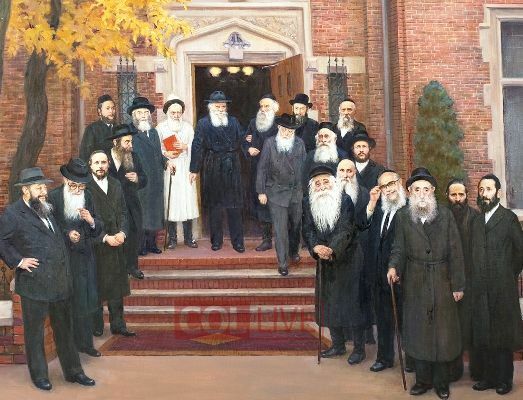
painting by Carl Braude. (https://collive.com/carl-braudes-new-painting/, accessed 11 April 2025)
While Braude’s paintings aim to intensify the follower’s devotion to the Schneersohn dynasty and the Chabad-Lubavitch movement, they also capture certain assumptions and a teleology often shared, consciously or not, by many works on Chabad. Those of us who examine Hasidic history—not only its intellectual aspects—often do so from the perspective of Lubavitch’s role in today’s Jewish community. The questions we pose to the Lubavitch past are, in fact, attempts to answer our implicit queries about Lubavitch (or the Jewish community at large) in the present. The stories we tell may indeed be interesting and important, but we should at least acknowledge and reflect on the potential histories we erase when we inscribe Hasidic history and teachings within the frameworks of our current worldviews and agendas.
Kabbalah and the Rupture of Modernity is an important work. It compellingly grapples with the complex intellectual legacies of successive Chabad-Lubavitch rebbes, avoiding the temptation to simplify or conflate them into a single, harmonious whole. It offers many valuable insights, especially concerning the late nineteenth century developments in Hasidic mysticism. At the same time, the many achievements of Kabbalah and the Rupture of Modernity become entangled in the conventional biases of Hasidic scholarship, producing a usable history of Chabad for the modern Western reader—a history that secures a respectable place for Chabad masters not only in the Eastern European Jewish past, but also in the American present.
In short, Eli Rubin’s book is a brilliant piece of research, but its potential impact is limited by the very paradigm within which it operates. One can only wonder what an existential history of Chabad might look like if it were not required to follow the trajectories of Western modernity, or to culminate in the reintegration of Chabad into the Western canons of philosophy and culture.

In geveb is turning t(s)en! If we want In geveb to continue to grow and thrive and remain a central address for the study of all things Yiddish online, we need your help to launch our second decade. Our goal is to raise $20,000 by our official tenth birthday: August 15, 2025. We invite you to donate to support In geveb and to honor everyone who has got us this far.