Jun 26, 2025
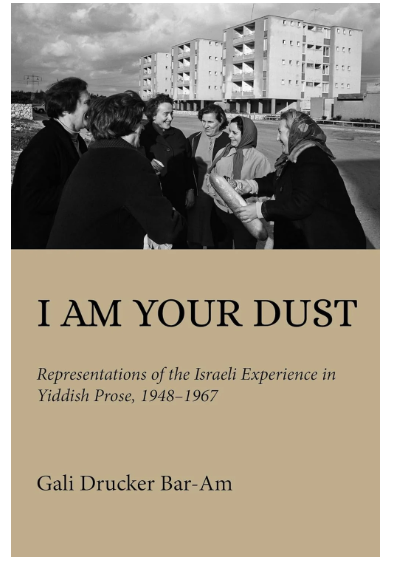
Gali Drucker Bar-Am, I Am Your Dust: Representations of the Israeli Experience in Yiddish Prose, 1948-1967. Translated by Natalie Meltzer. Indiana University Press, 2024. 394 pp. $39.00 [paperback].
Let’s imagine a scene – a talented writer who sought, around the year 2000, to write a great novel or a script for a film or TV series about Yiddish in Palestine/Israel. Our diligent writer approached scholars and experts to ask for advice but was disappointed with the discouraging response. “It’s better to avoid the topic,” the experts said. “There isn’t much to write about, either in terms of characters or plot. Not much happened and there are very few worthy protagonists to write about. It’s a sad story anyway, so you better look elsewhere.”
This is not just a figment of my imagination. I’ve had a similar conversation myself, and Gali Drucker Bar-Am reports about such conversations with several people in her book. But fast forward twenty-five years, and we are discovering that the story of Yiddish in Palestine/Israel is vast, complex, and utterly fascinating, and it’s being written not (yet) by a novelist or filmmaker, but by a group of scholars, librarians, archivists, and translators who stitch the narrative together like a patchwork. Gali Drucker Bar-Am’s book—published in Hebrew in 2021 and in English translation in 2024—adds an important chapter to the story.
The book, based on meticulous research, is both a work of literary scholarship and a socio-cultural history. The first part of the book makes the case for Tel Aviv as a new post-World War II Yiddish center, with a focus on the press, publishing houses, and other cultural institutions; particular attention is paid to how the Holocaust was commemorated by the local Yiddish-speaking community and press. The second part turns to Yiddish prose. After delineating the relevant literary history and laying out the challenges facing Yiddish writers after the Holocaust, there is a lengthy chapter that analyzes what Drucker Bar-Am calls “the Israeli spaces” in Yiddish prose. These spaces are depopulated Palestinian neighborhoods and villages, ma’abarot (transit camps), shikunim (public housing projects), Kibbutzim, and Tel Aviv.
The choice to focus on the period between 1948 and 1967 and on Yiddish prose that represents the “Israeli experience” is far from obvious. As Drucker Bar-Am acknowledges, there is a certain artificiality in defining the temporal framework and the textual corpus that is the basis of the study. She explains that the book constitutes “a chapter in the history of the Yiddish-speaking surviving-remnant refugees in Israel,” but it is also “a study of its literary products, and especially those literary works that describe the encounter with Israel in the first two decades after its establishment” (10).
What can the book teach us about Yiddish? What can it teach us about Palestine/Israel, especially in the present crisis-ridden moment? What can we learn from reading it in a time of calamity, amid the mass atrocities that have taken place in and since October 2023 and that have caused so much destruction, pain, rage, and fear, as well as a desperate sense of impasse in political and emotional life? It might be too much to expect that any book will give us answers to these difficult and pressing questions. And yet, I believe that the book – and learning about and from Yiddish in Palestine/Israel writ large – should provide us with some new perspectives on the time we live in. It should contribute to a more fruitful conversation between Yiddish studies and a rich and eclectic body of writing from the fields of memory studies, affect theory, trauma theory, literary studies, and political thought. More than anything else, I suggest, it should provide invaluable materials and tools for analyzing what Tamir Sorek and Honaida Ghanim recently identified as Palestine/Israel studies, the “emerging cross-disciplinary understanding that Palestinian and Israeli societies are both intertwined and interdependent and that, in many cases, our analysis of social, political, and cultural processes suffers when we examine them separately.” 1 1 Tamir Sorek and Honaida Ghanim, “Palestine/Israel Review: Carving Out a New Intellectual Space,” Palestine/Israel Review 1:1 (2024), 1-20. doi: https://doi.org/10.5325/pir.1.....
One way to think about the potential contribution of the book and the entire subfield of Yiddish in Palestine/Israel is to attend to the unique Yiddish terminology that orients us in a different way than, for example, Hebrew or English. As Hannah Pollin-Galay has shown in her recent book Occupied Words: What the Holocaust Did to Yiddish, we should pay close attention to how Yiddish language and its culture and literature changed during and after the Khurbn, the multilayered Yiddish term used to refer to what came to be known as the Shoah or Holocaust. 2 2 Hannah Pollin-Galay, Occupied Words: What the Holocaust Did to Yiddish (University of Pennsylvania Press, 2024).
In Drucker Bar-Am’s book introduction, we learn that “[t]he surviving-remnant refugees, or olim…are the protagonists of this book.” (9) Although there was much Yiddish cultural activity by people in Mandatory Palestine, as well as by people like Sholem Asch, Dovid Pinski, and Itzik Manger, who immigrated to Israel in the 1950s toward the end of their lives, the bulk of Yiddish cultural activity in Palestine/Israel was indeed created by the people we came to call in English “Holocaust survivors” and in Hebrew as “nitsoley Shoah.” But Yiddish has different terms, and by attending to them one can gain a better understanding of the social and cultural identity and subject position of the people who survived the devastation of World War II, migrated to Palestine/Israel, and were the creators and consumers of Yiddish culture there. They understood themselves as sheyres hapleyte, a Yiddish moniker of loshn-koydesh origin that came from the Hebrew Bible and literally means “remnants of the escape.” The term, which also entered Hebrew and became common in Israeli-Hebrew discourse, is related to the Yiddish word polet (refugee). Although polet and sheyres haplyete had been used to refer to anyone fleeing calamity, the unique situation of the largely Yiddish-speaking refugees in post-war Europe cemented a specific meaning. To think about this meaning, which is so central to the social, cultural, and political world of these people, one should turn to Hannah Arendt, who was a refugee herself and wrote the sharpest (self) analysis of the new condition.
In winter 1943, just after she arrived as a “stateless” person in New York City, Arendt published in The Menorah Journal a short essay on what it meant to exist as one who had “no country,” entitled “We Refugees.” 3 3 Hannah Arendt, “We Refugees,” The Menorah Journal, 31:1 (January 943): 69-77. Arendt would only later become known as one of the twentieth century’s great political thinkers, but the early “We Refugees” remains one of her most beautiful, revealing, and incisive essays. It begins with the sentence that immediately calls into question the collective designation of “we” in the title: “In the first place, we don't like to be called ‘refugees.’” Instead, writes Arendt, there are preferred but inadequate names such as “newcomers” or “immigrants.” Arendt explains that “[a] refugee used to be a person driven to seek refuge because of some act committed or some political opinion held. Well, it is true we have had to seek refuge; but we committed no acts and most of us never dreamt of having any radical political opinion. With us the meaning of the term ‘refugee’ has changed.” 4 4 Ibid, 69. This is also true of the Yiddish speaking refugees who fled Europe after the Khurbn. Throughout Arendt’s essay, the tone oscillates between irony and compassion, but it is also an original analysis. In the last and crucial paragraph Arendt writes: “Those few refugees who insist upon telling the truth, even to the point of ‘indecency,’ get in exchange for their unpopularity one priceless advantage: history is no longer a closed book to them and politics is no longer the privilege of gentiles. They know that the outlawing of the Jewish people in Europe has been followed closely by the outlawing of most European nations. Refugees driven from country to country represent the vanguard of their peoples - if they keep their identity.” 5 5 Ibid, 77.
Arendt’s invocation of refugees as vanguard is one of her most enigmatic statements. The vanguard refers to European Jewish refugees, but their position as a “vanguard” distinguishes refugees from their “peoples.” As Hadji Bakara explains, Arendt assigns new meaning and importance to the refugees as subjects disconnected from original political affiliations or group identifications after the “outlawing of most European nations,” and this is their historical and political novelty. In 1943, Arendt imagined how the postwar future could change if refugees were viewed not as hopefuls to enter existing political structures, but as creating new ones.
6
6
Hadji Bakara, “Time, Sovereignty, and Refugee Writing.” PMLA/Publications of the Modern Language Association of America 137:3 (2022): 442–57. https://doi.org/10.1632/S00308....
Can we think of the East European Yiddish speaking refugees, the sheyres hapleyteh, who were marginalized as “human dust” in what became the new nation-state of Israel, as the “vanguard of their people” because they kept their identity? Instead of being “representatives of a rejected exilic culture, shameful and contemptible…whom the founders of the prevailing Israeli ethos wished to repress, to forget and cause others to forget so as to enable Israeli culture to be established,” Drucker Bar-Am suggests that we should consider them as tricksters. “Their literature,” she writes, “forces its reader to reexamine dichotomous perceptions that were received and became fixed among the general public and in scholarship about Israeli society in the first decades of its existence.” (9)
As Drucker Bar-Am explains, the group of Yiddish authors and journalists that are at the heart of the book are not unified in any way. They were born in different places in Eastern Europe. They belonged to different political and ideological movements, although most of them belonged firmly to the left – Zionist, Bundist, and Communist. They lived through very different war experiences: refugeehood in the Soviet Union, but also imprisonment and forced labor in the ghetto, labor camps, concentration camps, and death camps, or under a fake identity in the city, fighting as partisans or as soldiers in the Russian or Polish armies. After the War, most of them were in DP camps and from there they arrived in Palestine/Israel. (45-46) Reading their Yiddish prose provides us with a rare vantage point to understand what happened when these Jewish refugees encountered the unfamiliar and difficult environment in which they tried to rebuild their life at a crucial moment in the history of the modern Middle East, which still affects us today.
Here is how the Yiddish writer Yitschok Perlov describes, in the preface of his engrossing novel Jebeliya (1955), the people who arrived in Palestine/Israel and settled in the depopulated Jaffa neighborhood of Jebeliya (or Jabaliya) after it was conquered by the right-wing Irgun in 1948: “Who are these residents of Jebeliya? They are Jews from different countries, survivors of all the world’s catastrophes, delivered from pogroms and massacres, from ghettos, concentration camps, prisons, and places of exile. People from the partisans’ forests and the ‘Aryan side’ of Nazi-occupied cities and towns.”
7
7
Yitschok Perlov, Jebeliya (Yidbukh Farlag, 1955), 8.
The novel – which I co-translated with Yael Chaver as part of the Yiddish Book Center's Translation Fellowship and is discussed in the fourth chapter of Drucker Bar-Am’s book – zooms in on Zecharye Karlsbach, the first resident who settled in Jebeliya in the middle of the 1948 War, and on his family that was scattered during World War II. Perlov wrote about a reality he knew well; he lived in Jebeliya for a few years with other Yiddish-speaking refugees after enduring the ordeal of trying to escape Europe on the SS Exodus ship, which became the basis for Leon Uris’ famed novel and the film Exodus starring Paul Newman. In the forward to the novel, he explains that “‘Jebeliya’ is an Arabic name that means ‘hill.’ Later, the Arabic name of the town was officially changed to the similar sounding…Hebrew name Givat Aliyah... Ordinary people, on the other hand, continued to call the town by its old Arabic name, ‘Jebeliya’.” 8 8 Ibid, 7. What does it mean that the Yiddish speaking refugees continue to call their new place of residence by its Arab name and resist the new Hebrew name of Givat Aliyah?
The novel shows the complexity of what Hagar Kotef has analyzed as “the transformation of spaces of violence into spaces of home.” 9 9 Hagar Kotef, The Colonizing Self: Or, Home and Homelessness in Israel/Palestine (Duke University Press, 2020). Zecharye arrives in the country on his own and learns that his son Azriel, who had arrived earlier in the country, is already a soldier in the elite military unit Palmach. Azriel meets his disoriented father at the immigration center and brings him to Jebeliya, which is full of “abandoned” houses following the flight or the active removal of Palestinian families. However, Jaffa is not entirely empty of its Palestinian residents. On the way to his new “home,” the father and son encounter a strange sight:
“And here, behind barbed wire, is the Arab ghetto.”
“What do you mean, ‘the Arab ghetto’?”
“Oh, I see: you’re only used to Jewish ghettos, aren’t you, Papa. Here, Jews have enclosed an Arab ghetto.” 10 10 Perlov, Jebeliya, 21
Here we see the shock of the recognition that the trauma of Jewish displacement in and after the Khurbn is imbricated with the Palestinian Nakba (“catastrophe”). What connects these different events is the experience of refugeehood. This is something that Arendt recognized in 1951, when she wrote: “After the war it turned out that the Jewish question, which was considered the only insoluble one, was indeed solved— namely, by means of a colonized and then conquered territory— but this solved neither the problem of minorities nor the stateless. On the contrary, like virtually all other events of our century, the solution of the Jewish question merely produced a new category of refugees, the Arabs, thereby increasing the number of the stateless by another 700,000 to 800,000 people.” 11 11 Hannah Arendt, The Origins of Totalitarianism (Harcourt, Brace, 1951), 290.
The same recognition of the parallel experience of Jewish and Palestinian refugees is at the heart of Mendel Mann’s novel In a farvorloztn dorf (“In a Deserted Village,” 1954), and many of his short stories.
12
12
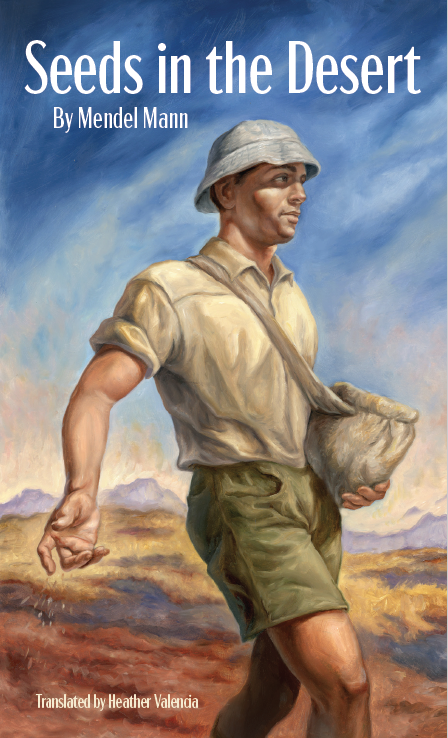
Mendel Mann, In a farvorloztn dorf (Farlag Kiem, 1955). For a selection of Mendel Mann’s stories in English translation, see Seeds in the Desert, translated by Heather Valencia (White Goat Press, 2019).
Like Perlov, Mann was also on the SS Exodus and arrived in Palestine/Israel as a refugee from the DP camps. He settled in Yazur, a Palestinian village a few miles from Jaffa that fell to forces of the Haganah in April 1948 and that was depopulated and repopulated with refugees. The novel’s main protagonist, Moyne, was uprooted from his native village in Poland by World War II, and he attempts to put down roots in Yazur, which the novel calls “Mosque Hill,” thus retaining the fact that it was just emptied of its Palestinian Arab population who became refugees. The novel thus creates an analogy between two “abandoned,” depopulated villages, the Jewish Polish and the Palestinian Arab.
On October 1, 1949, the 77 year old Yiddish playwright Dovid Pinski, who had settled in Palestine/Israel in the same year, wrote in Der tog an article with the title “Yidn vos hobn rakhmones oyf araber” (“Jews who have compassion for Arabs”) in which he reported on Mendel Mann and other Yiddish-speaking refugees living in houses and orchards formerly inhabited by Arab families. Mann told Pinski about his life in Yazur, where despite having a place to live and to grow vegetables, he “feels a sorrow and heavy heart about the Arabs owners of the houses and orchard who are new refugees, wandering with no home or a place to put their head on.” Mann wondered whether his neighbors are sensing the injustice or are intoxicated with a sense of victory, and about the mood and feeling of “Jewish compassion.” Pinski also mentions a young mother whose children came across a closet full of toys. The mother was suddenly struck by the thought that her children were playing with the toys of Arab children who were now exiled.
13
13
Dovid Pinski, “Yidn vos hobn rakhmones oyf araber,” Der Tog, October 1, 1949, 4.
In the middle of Mann’s novel, there is an extraordinary scene of an encounter between the new Yiddish-speaking residents of “Mosque Hill” and one of the village’s original residents, an old Palestinian man seeking to return to his home. The encounter in the novel shows a range of affects, both a deep identification with the Palestinian refugee, and a resistance to this identification. As Drucker Bar-Am explains, the “resistance to the Jewish refugees’ identification stems from shock at the possibility that they might have to be uprooted again, and for that reason they regard the Palestinian as a threat…On the one hand, their suffering is too great to contain the suffering of the Palestinian refugee; on the other hand, more than anyone else, they, refugees from the worst of all wars, understand his predicament—whether or not they want to, they are his brothers in refugeehood.” (197-198).
Drucker Bar-Am’s reading of Mann’s novel is anchored in Melanie Klein’s psychoanalytical approach, as well as in what Dominick LaCapra has called “empathic unsettlement”—that is, “the ability to put oneself in the place of the other and at the same time to recognize his otherness.” (199). I would suggest that the novel and other Yiddish texts written in the 1950s and 1960s must be considered in the context of what Michael Rothberg calls multidirectional memory, as a way of conceptualizing what happens when different histories of extreme violence confront each other. We can see how Yiddish literary and cultural production in Palestine/Israel illuminates what Rothberg calls the implicated subject: “neither a victim nor a perpetrator, but rather a participant in histories and social formations that generate the positions of victim and perpetrator, and yet in which most people do not occupy such clear-cut roles.”
14
14
Michael Rothberg, Multidirectional Memory: Remembering the Holocaust in the Age of Decolonization (Stanford University Press, 2009); Michael Rothberg, The Implicated Subject: Beyond Victims and Perpetrators (Stanford University Press, 2019).
Furthermore, novels such as Jebeliya and In a farvorloztn dorf, like much of post-1948 Yiddish literature in Palestine/Israel, should be studied, side by side with literature written in Hebrew and Arabic such as S. Yizahr’s Khirbet Khizeh (1949), Ghassan Kanafani’s ʿAʾid ila Ḥayfa (Returning to Haifa, 1969) and Emil Habibi’s The Pessoptimist (1974). These texts are notable in the way they map affect – a way of understanding political and cultural life through the individual and collective experience of emotions, moods, and feelings, something that scholars such as Eve Kosofsky Sedgwick, Sara Ahmed, Lauren Berlant, and Jonathan Flatley have taught us in recent decades. The Yiddish texts written by refugees in Palestine/Israel expose readers to an affective map that oscillates between guilt, rage, despair, compassion, empathy, love, hope, and other emotions, and this is why they are so riveting and relevant many years after they were written.
“The slogan ‘One people, one country, one language’ is nationalist and harmful,” wrote Y. Artuski, the editor of the Bundist Yiddish journal Lebns fragn published in Tel Aviv in 1957, “and it is also anti-democratic in essence.” Drucker Bar-Am mentions this quote in her conclusion as embodying the Yiddish speakers’ resistance to nationalism, their defiance against the legislation that circumscribed Yiddish activity – Israel was the only state in which, at least for a while, a daily newspaper in Yiddish could not be published and Yiddish theater could not be performed legally after World War II – and the “unofficial quiet regulations that expressed the state institutions’ sense of threat from this linguistic pluralism.” (271). Part of the insistence on linguistic pluralism also meant engagement with Arabic and with Palestinians. The Bundist Yiddishists and Lebns fragn consistently showed solidarity with the struggle of both the Palestinians and the Mizrahim. The Yiddish communist newspaper Fray Yisroel, which was really part of an Arabic, Hebrew, Yiddish media outlet, translated from Arabic texts by Emil Habibi, Tawfiq Zayyad, and Tawfik Toubi. Even the highbrow literary journal Di goldene keyt, edited by Avrom Sutzkever, published Yiddish translations of the Egyptian Naguib Mahfouz and the Palestinian woman writer and poet Najwa Kawar-Farah.
What would it mean to think about the Yiddish-speaking refugees in Palestine/Israel as “the vanguard of their peoples” in today’s atmosphere of revenge, violence, and utter disregard for human life? Perhaps it’s enough if we learn from those refugees who kept their language, identity, and consciousness of the deep meaning of being human – an “ordinary person” – in dark times, beyond the limits of the nation-state.
In geveb is turning t(s)en! If we want In geveb to continue to grow and thrive and remain a central address for the study of all things Yiddish online, we need your help to launch our second decade. Our goal is to raise $20,000 by our official tenth birthday: August 15, 2025. We invite you to donate to support In geveb and to honor everyone who has got us this far.