Apr 08, 2026
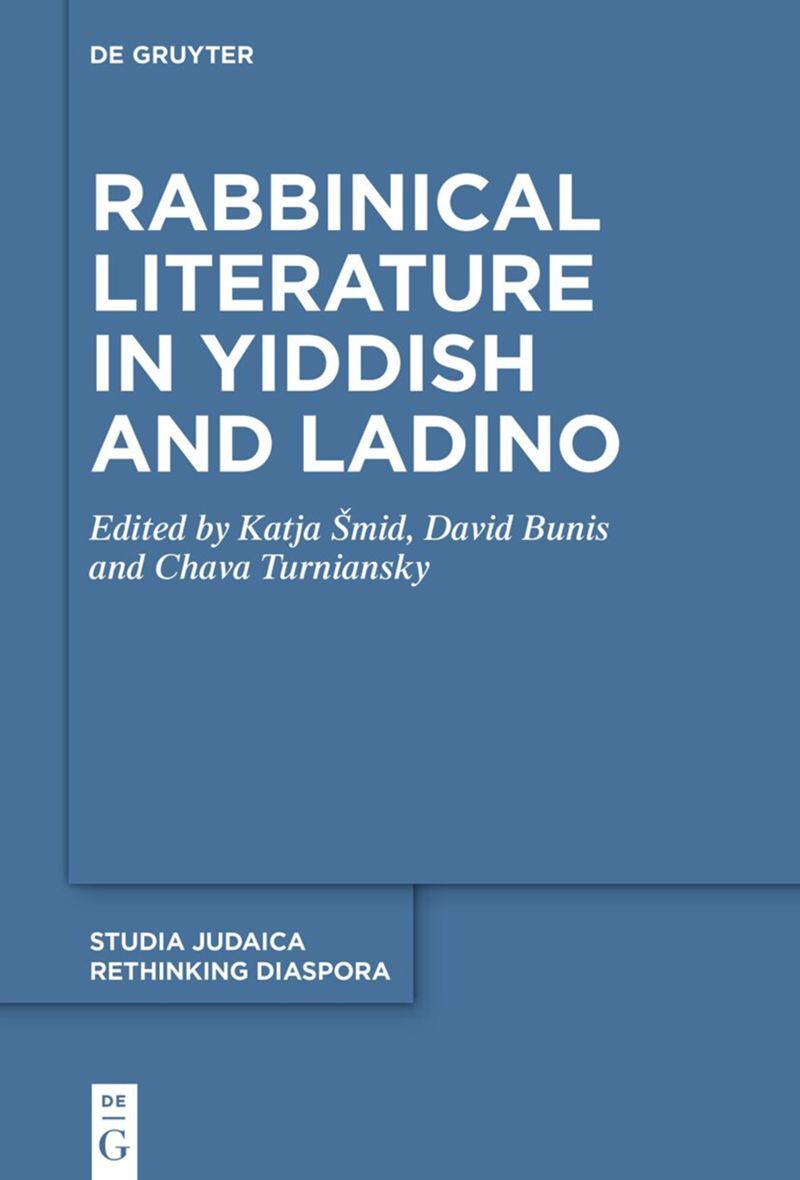
Rabbinical Literature in Yiddish and Ladino, edited by Katja Šmid, David M. Bunis, and Chava Turniansky. De Gruyter, 2025. 388 pp. $129.00 [hardcover].
The anthology Rabbinical Literature in Yiddish and Ladino, edited by Katja Šmid, David M. Bunis, and Chava Turniansky contributes to the ongoing scholarly discussion on the relationship between vernacular and learned literatures in Jewish communities. The tension between Hebrew rabbinic literature and Jewish vernacular writing has occupied scholars for more than a century. Already in his first volume of Di geshikhte fun literatur bay yidn (The History of Literature by the Jews, 1929) the Yiddishist Israel Zinberg portrays the history of Jewish literature as built of two main streams: literature written in Hebrew and literature written in different Jewish vernaculars. For example, for Zinberg, the Babylonian and the Palestinian Talmud, the pinnacles of rabbinic literature, should be seen as part of Jewish vernacular literature. The Aramaic of the Talmudic literature is just one chain in the history of literary creation in Jewish languages, just like Yiddish literature. 1 1 Israel Zinberg, Di Geshikhte Fun Literatur Bay Yidn, vol. 1 (1929; Alveltlekh yidisher kultur-kongres, 1972), 23–26. Interestingly, a similar account of the history of Jewish literature can be found in Rabbi Moshe Frankfurter’s Yiddish translation of Itzhak Abuhav’s Menorat ha-ma’or (The Menorah of Light), a medieval anthology of aggadic materials from the Babylonian Talmud, first translated into Yiddish in 1722. For Frankfurter, the Babylonian Talmud was created in the spoken language of Jews in Babylon, just as Yiddish literature is written in the language of European Jews. 2 2 Isaac Aboab, Menorat Ha-Ma’or, trans. Moshe Frankfurt (Amsterdam, 1722), 1v–2r.
Although the connection between vernacular Jewish literature and rabbinic literature has a long history, most rabbinical texts, especially the Talmudic literature, were not translated into Ladino or Yiddish for many years. The first known translation of a Talmudic tractate into Yiddish was made by Yaakov Meir Zalkind in 1922. 3 3 Yaakov Meir Zalkind, trans., Talmud Bavli (Gemore in Yidish): Brokhes (B. Weinberg, 1922). The Talmud was never translated into Ladino. However, the fact that the Talmud itself was not really translated into the main Jewish vernaculars of the early modern period does not mean that other kinds of rabbinic literature and rabbinic knowledge were not transmitted in Yiddish or other vernaculars. Adaptations of rabbinic aggadic and halakhic materials are an inseparable part of both the Yiddish and the Ladino bookshelf. Often, these translations and adaptations changed fundamental features of the rabbinic sources. The Yiddish and vernacular adaptations of rabbinic literature are usually seen as acts of popularization, in which knowledge is simplified into shorter literary pieces that are easier to digest by a less learned audience. In its twelve chapters, the anthology under review presents different examples of the dynamics between rabbinical learned literature and Jewish vernacular cultures. The case studies it describes do indeed reflect the tendency towards simplification mentioned above. However, they also highlight a variety of other interesting characteristics of the multilingual nature of pre-modern Jewish cultures.
The volume is a result of a two-day workshop that occurred in March 2016. Though the articles in the volume have since been updated, they can nevertheless function as a representation of the main questions that were at the center of the research almost a decade ago. The volume also includes articles from important scholars who, unfortunately, recently passed away: the late Tamar Alexander and Eleazar Gutwirth. It is heartwarming to read relatively recent studies of these scholars. Additionally, the book is dedicated to the late Shlomo Berger, whose scholarship deeply influenced many of the scholars involved in the volume.
In many respects, the term “rabbinical literature” in this volume is not used just to refer to specific known rabbinical texts, but as a category in Jewish literature and society: that of knowledge being learned in the formal, traditional Jewish educational systems. It is mostly non-vernacular, meaning written in Hebrew, and therefore could stand in contrast to the vernacular aspects in Jewish cultures. Therefore, the volume does not refer only to classic rabbinical pieces but also to genres such as court records or piyyut literature.
Many scholars who have studied either Yiddish or Ladino can recall the impact of the moment when they discovered the scholarship devoted to the other vernacular language. Suddenly, they find that there are many parallels between the two languages—in their cultural role, the intended audience of the texts in Yiddish and Ladino, and also the basic mechanisms of translation and adaptation of literary materials into these languages. Therefore, thematic volumes like this one, which examine phenomena in both languages, are extremely valuable. They have the potential to highlight not only the similarities, but also the distinctiveness and differentiation in the history of each language. They can thus open a door for a more nuanced approach and move away from general assumptions regarding the dynamics between both vernacular languages and the “learned” Jewish languages, Hebrew and Aramaic. And indeed, Rabbinical Literature in Yiddish and Ladino contains scholarship that is useful for anyone interested in both languages, and the relationships between vernacular and learned languages in the Jewish world. It also includes other Jewish vernacular languages, such as Judeo-Italian and Judeo-German, that portray an even richer image of the linguistic world of Jews in the early modern and modern periods.
Although the book is divided into two main parts, one dedicated to Yiddish and one to Ladino, I believe it is actually more fruitful to highlight the main themes and questions that are repeated throughout the volume. Doing so easily reveals several themes that recur both in the Yiddish and the Ladino sections. The first is the role of rabbinic literature and knowledge within vernacular Jewish literature. In that context, the volume includes analyses of different forms of transmission and adaptation of rabbinical knowledge into the vernacular. From translations of canonical rabbinic texts into the vernacular, such as Meza da Alma, the Ladino translation of Rabbi Yosef Karo Shulchan Aruch (Ora Schwartzwald), rabbinical texts published in bilingual editions in Yiddish and Hebrew (Avriel Bar-Levav), adaptations of rabbinical literary genres into the vernacular, such as the Ladino musar literature (Katja Šmid) and translations and adaptations of aggadic materials in different contexts (Tamar Alexander, Anabella Esperanza). In this context, Claudia Rosenzweig’s article in the volume adds new nuances to the discussion by examining the Judeo-Italian translation of the halakhic Yiddish manual Miṣwot Našim. These studies all highlight the various transformations that rabbinic materials undergo during translations into vernacular languages. They add new, valuable details to our knowledge of the vernacularization process in Jewish literature. In the discussed case studies, we can see new examples of the translation dynamics, meaning, the tendencies towards adapting rabbinical materials for different potential audiences, usually by preferring simpler and, in many aspects, more practical discussions over heavily detailed theoretical ones.
However, examining the transmission of rabbinical knowledge in vernacular languages is only one aspect of the relationship between rabbinical literature and Yiddish and Ladino. Another theme that recurs through the book is the information about vernacular Jewish languages that can be found in rabbinical literature. The articles of Moshe Taube and David M. Bunis both discuss the traces of spoken Yiddish and spoken Judezmo (or Ladino) in legal and rabbinical genres such as responsa literature and court testimonies. Both articles give important linguistic information about the development of Yiddish and Ladino in early periods. However, they are also valuable for historians and cultural and literary scholars, as they discuss the potential and limitations of different literary genres, as well as the role of language in these genres. Both articles are concerned with the freedom of language editing in different genres, distinguishing between legal literary genres that aim to record the words of people as closely as possible and other genres that allow more free adaptations rather than accurate records.
The third issue discussed in many of the articles in the volume is the social and cultural relationships between learned languages (Hebrew and Aramaic) and vernaculars in Jewish lives. Eleazar Gutwirth discusses the use of Judeo-Spanish in the Jewish ritualistic practices in the Early Modern Ottoman Empire. Eliezer Papo, on the other hand, discusses vernacular not only as a linguistic aspect per se, but also as a representation of the economic daily lives of Jews in the Ottoman Empire. Papo shows how the financial reality of Jews was translated into rabbinical discussions. A special place in the volume is dedicated to the role of Yiddish in nineteenth-century ultra-orthodox Jewish communities in Hungary (Michael K. Silber, Binyamin Hunyadi). The articles focus on the use of Yiddish (or Jüdisch-Deutsch) as an ideological tool in rabbinical books and journals. Although the articles are not necessarily related, both of them refer to the character of Rabbi Akiva Yosef Schlesinger and his perception of the importance of distinguished Jewish tongues (such as Yiddish and Ladino).
Each of these issues could easily stand at the center of a dedicated workshop or an individual volume. Taken together, however, they transform Rabbinical Literature in Yiddish and Ladino into a work whose whole far exceeds the sum of its individual parts. Reading the articles together creates a detailed and nuanced image of the literary, linguistic, and cultural-historical aspects of the relationships between Hebrew and Aramaic and Jewish vernaculars. All of the contributions show how vernacular and non-vernacular elements are interwoven. These studies highlight the importance of the study of vernacular languages for a general understanding of pre-modern Jewish history, literature and culture.
However, the relevance of the studies in the volume outside of Yiddish or Ladino studies also reveals a minor, but crucial problem in the volume. While some of the chapters in the book include full English translations of the sources being presented, other sources are presented only in their original language. The choice not to translate all the discussed sources into English makes some of the chapters a little bit more difficult to follow. As a scholar of Yiddish literature with limited knowledge of Ladino, I felt that such translations would have helped me fully comprehend the sources discussed. Such translations are important, especially given the contribution of these chapters to broader discussions of early modern Jewish culture.
Although this slightly technical flaw may distract some potential readers, Rabbinical Literature in Yiddish and Ladino is still an impressive volume that sheds light on different angles of the linguistic and cultural relationships of learned rabbinical knowledge and vernacular cultures. The many eye-opening cases discussed in the volume reveal how complicated and multilayered the relationships between languages are, and how a deeper understanding of these relationships is important for our field. The volume begs for continuation. Perhaps it could be in a form that gathers all known case studies into a more theoretical and holistic discussion. But another international workshop would be welcome as well.