Feb 06, 2026
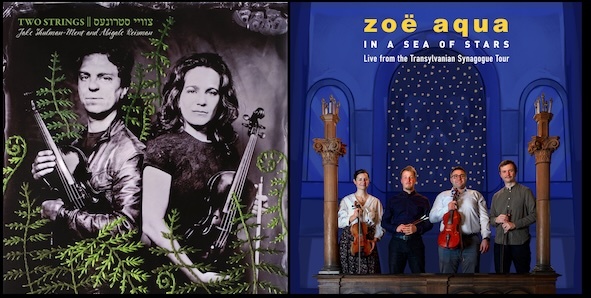
Jake Shulman-Ment and Abigale Reisman, Two Strings/צװיי סטרונעס. Borscht Beat, 2025.
Zoë Aqua, In a Sea of Stars: Live from the Transylvanian Synagogue Tour. Adhyâropa Records, 2025.
If the American klezmer revival/revitalization movement can be spoken of in terms of a first and second wave—one in the late twentieth century, the second an early twenty-first-century iteration—then two new releases, Two Strings/צװיי סטרונעס (Borscht Beat, 2025) by Jake Shulman-Ment and Abigale Reisman, and In a Sea of Stars (Adhyâropa Records, 2025) by Zoë Aqua, stand out as shining achievements of the second wave. These two records are formally and aesthetically distinct but share a singular philosophy of sound that inclines towards contemporary East European folk dance scenes. Their musical orientation is expressed through reference to the contemporary musical life of the lands where Yiddish-speaking Jewish communities once lived. Both projects contribute to new pedagogies for klezmer revival that eschew old recordings as the singular source for reliable knowledge about Yiddish musical life. Instead, these klezmorim expand the aesthetic terrain of the genre through reference to the worlds of fiddlers and string bands in Eastern Europe, especially the multi-ethnic territory of Transylvania, with its rich history of Jewish life at the borderlands of the old empires of Europe.
As has been often discussed, Yiddish music and culture are troubled by a history of discontinuity, the result of the Holocaust, American cultural assimilation, Soviet oppression, and Zionism in Israel. The klezmer revival of the 1970s and '80s, buoyed by the spirit of Bay Area freak folk anti-conformity and the counter-cultural formal explorations and musical eclecticism of the New York downtown music, generated new answers to the old question, What does a Jew sound like? These potent musical experiments created a worldwide musical movement that posited the existence of a Jewish culture able to regenerate itself, like an amputated limb regrown. Klezmer revival addressed a need in the Jewish American zeitgeist that clamored for the presence of ancestors and knowledgeable ghost cousins still observing European Jewish life cycle events in small towns made of paper and ink. The imaginary “old world” of the klezmer revival was populated with literary phantasms, characters heard on a handful of old records, and an even smaller number of old time Jewish-American wedding musicians who were drafted to teach acculturated Americans how to dance and sing. The revivalists sought to speak in forgotten idioms of a fancifully recreated Yiddish village, its set pieces constructed of one part hiss of old shellac records, one part Fiddler on the Roof song and dance numbers, one part dutiful academic research, and one part folksy wisdom imparted by elderly grandparents. Absent from this mix (for the most part, and with some important exceptions) were the parallel worlds of living non-Jewish folk musicians who had once shared geographies and customs with Jews in Europe.
Shulman-Ment, Reisman, and Aqua are fiddlers in a second-wave klezmer movement that focuses its aesthetic in historically informed performance. The players draw deeply on the roots music scene in Romania, with its multiple linguistic groups, musical subgenres, and dance forms. Working independently of each other, Aqua and Shulman-Ment both spent years in Romania playing with and learning from elder fiddlers and younger folk revivalists. Their experiences have been touchstones in the project of generating new approaches to the role of the fiddle in klezmer.
The historically informed East European turn within American klezmer looks to the contemporary scene of living folk music traditions in Europe—this movement is already several decades old. Both Shulman-Ment and Aqua are friends of Bob Cohen, an American klezmer fiddler who has been living in Hungary since the 1980s, traveling and conducting ethnography in Transylvania and other regions in the area. Cohen has served as a mentor to and cultural connector for these younger musicians, introducing them to important elder musicians in Roma professional music families as well as to revivalists in Romanian and Hungarian folk dance scenes. These connections have proven pivotal in the careers of both Shulman-Ment and Aqua, helping them to develop personal pedagogies and musical connections that have shaped their respective approaches to their instruments. Romanian musical cultures are audible on these new records, both as a source of musical techniques and repertoires, and as a foundation for conceptions of string bands as a social force that can drive dance experience.
The title of Two Strings/צװיי סטרונעס makes reference to a violin tuning heard on a handful of early twentieth-century Jewish fiddle records. While the tuning and its striking octave doubling effect is exceedingly rare in the klezmer recorded music archive, it has become something of a signifier of deep knowledge and authenticity in the world of klezmer aficionados. The special tuning appears on the extremely beautiful title track of the album, played by Shulman-Ment with stunning sensitivity and a knowledgeable reliance on records by immigrant-era klezmer band leaders Abe Schwartz and Art Shryer. Shulman-Ment shines on this album, his expressively bright tone and penetrating sense of dynamics shimmering across the record.
Beyond the specific technical reference, two strings refers here to the blending of the two violinists, Reisman and Shulman-Ment, as a “double lead” front of the string band. Ably backed on the album by cellist Rafi Boden and tsimblist Pete Rushefsky, with special guests clarinetist Zoe Christiansen and percussionist Richie Barshay, the album is a showcase for an innovative texture in the klezmer string band ensemble. Throughout the album the two violins weave together in a rich heterophonic ensemble, by turns delicate and intimate, thrashing and tumultuous. The violins hit their stride again and again, finding new energy in their variations on klezmer folk dance pieces. Rather than the banal structure of melody alternating with improvised solos (as in the normative jazz format that was embraced by first wave klezmer revivalists), variation occurs within the structure of melody, expressed in terms of timbre, dynamic, and ornament. This variation serves to heighten the energy of the performance in a manner that feels attuned to the social dynamics of dance. The two fiddlers each sing a song they composed, set to lyrics by two Yiddish poets, Anna Margolin and Zishe Weinper. These songs, sung with delicate charm and sensitivity, thoughtfully connect the musical undertaking to the sounds of the Yiddish language and the cultural field of Yiddish modernist aesthetics and politics.
A Two Strings live performance
Two Strings makes reference to the world of contemporary East European folkdance scenes through its energies and timbres while remaining geographically located in the New York klezmer scene. In a complementary move, Zoë Aqua’s In a Sea of Stars offers a more complete translation of a klezmer concept into the vocabulary of Transylvanian music, in particular the Hungarian táncház folk music revival movement. Aqua’s album is conceptually rich on multiple levels. It is a record of all original pieces, composed in a thoroughly traditionalist style, rich in citations of Hungarian fiddle music and old klezmer numbers. On the album she is accompanied by young Hungarian táncház players—Gergely Réman on cimbalom, Kálmán Szopos on brácsa (three stringed viola), and Károly Dénes on bass—with British klezmer fiddler Anna Lowenstein also appearing on most of the tracks. The record was recorded live on a tour of Transylvanian synagogues, structures which, in the absence of living Jews, serve as markers of the once-upon-a-time presence of Jews in the region. They mark a time before the Holocaust and the later emigration of most of the remaining Jews of Romania during the Ceaușescu regime. The technical accomplishment represented by the production of this site-specific art piece is an achievement in its own right.
Aqua’s playing is focused and technically brilliant as she moves through a collection of pieces carefully crafted to showcase her virtuosity. On display throughout the album is the impressive collaborative energy that she has cultivated with her Hungarian collaborators, particularly felt in the sense of swing characteristic of the regional style. Her compositions employ the harmonic language of táncház, with its expressive chromatic shifts, at times reminiscent of the high romanticism of Chopin or Liszt. Aqua’s audacity in creating a work of art in this highly specific regional idiom to which she is foreign by birth and upbringing is remarkable and successful. Her impulse to create a version of Jewish instrumental folk music within the parameters of the Transylvanian style offers a sonic counterpoint to the symbolism of the performance in the old synagogues. In the absence of a living Jewish community, Aqua has created a symbolic space of Jewishness in der alter heym, using the fluidity of the experience of sound to create a world where fantasies can live.
A live performance from Aqua’s 2024 Transylvanian synagogue tour
The cultural geography of Transylvania has its own mythology, its own structures of feeling that provide meaning to the violent and torturous past of the region. The basic structure of this myth: here in the remote borderlands of empire, an economically undeveloped and culturally isolated peasant culture retains access to the immediacy of face-to-face encounter, in which the past is spontaneously regenerated as a set of cultural practices in the present. Multiple nationalist groups have found it useful to stake claim to this mythology as the basis for political and aesthetic movements. But Jews fit jaggedly into this mythos, at once a reminder of the primordial history of the region and an impediment to claims of ethnic purity. For American klezmer musicians like Shulman-Ment, Reisman, and Aqua impurity is read reparatively as a key element, able to open the mythology of Transylvania up to Jewish mediation. In contrast to projects of nation-building, the diasporist perspective of klezmer musicians makes no claim on territory or sovereignty. Instead, the claim of these artists on Transylvanian traditions invokes the living present of the region as a structure that can offer a balm to the rupture of memory in American Jewish life. This imaginative leap depends on aesthetic achievement and the intangible relationships that occur in the experience of dance, and especially in the relationship of performing musicians to dancers—but for the klezmer musicians, the dancers may, in fact, no longer be among the living. The pedagogy that these artists build relies on the formal musical structures embraced by Hungarian nationalist folk musicians, but with a more politically ambiguous, even mystical goal. As in other areas of American Jewish life, the not-so-secret undercurrent of achieving social transformation through communication with dead ancestors lies just beneath the surface of these music-making projects.