Apr 21, 2023
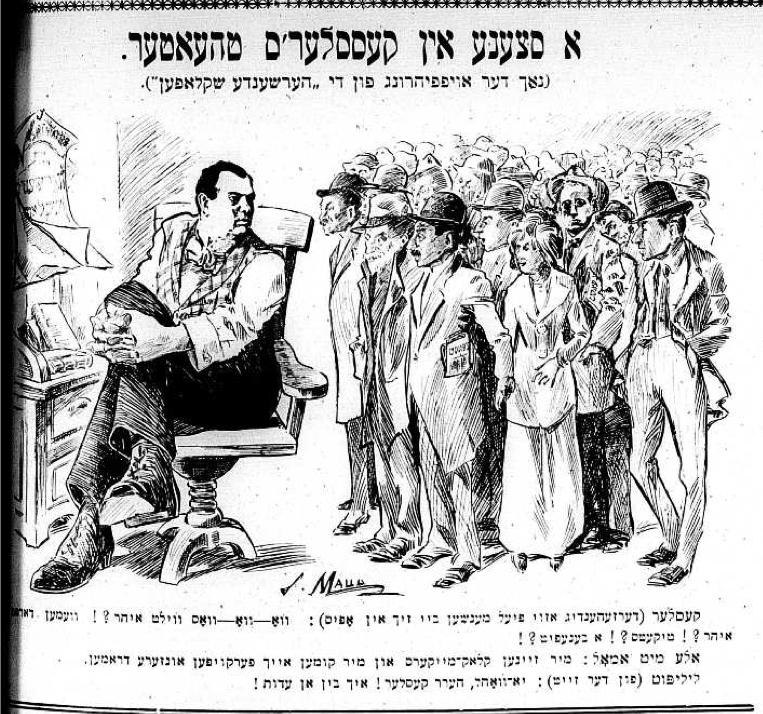
From the theater page, Der kibitser (October 27, 1911), page 8. Historical Jewish Press.
ABSTRACT
This introduction opens the In geveb special issue dedicated to shund theater. In it, the guest editors of the issue lay out the history of shund and of its study, while underscoring the contributions of the four articles and two translations included in this special issue.
Click here to read this article as a pdf.
The story goes something like this: I. L. Peretz goes to the theatre to see a play he considered shund. Yiddish theatregoers, he thought, should patronize only elevated, sophisticated art theatre, not what he dismissed as lowbrow entertainments. During the performance he was said to have stood up in protest, vividly demonstrating his disdain for this type of play. After his outburst, he reportedly stormed out of the hall. But then – and here’s the twist – he secretly came back in and enjoyed the rest of the performance. It wasn’t art theatre, but it was entertaining. Even Peretz thought so.
For decades, critics and scholars of Yiddish theatre have often analyzed Yiddish theatre and drama through a lens that pits two forms of Yiddish theatre against one another: kunst vs. shund, “art” vs. “trash,” “highbrow” vs. “lowbrow,” “serious” vs. “popular” theatre. The late scholar of Yiddish literature Khone Shmeruk, in an article translated into English for the first time for this issue, explains that shund “refers to the clear and supposedly unequivocal obverse of recognized, canonical, artistic literature, with all its possible definitions.” Regardless of the exact wording, the result is essentially the same: shund tends to be understood by its opposition to what it is not, whether we call that great art, high culture, or “better drama” (a phrase Yiddish theatre critics were fond of using). Such dualities may have served a useful purpose in getting a fledgling modern literature on its feet and delineating the contours of the developing Yiddish dramatic canon. However, there are multiple problems with this approach. For starters, it replicates a stark and false dichotomy that is better envisioned as a spectrum. Regarding an entire culture’s repertoire in binary terms makes us fail to appreciate the nuances that become apparent when we evaluate plays more dispassionately.
Even a self-appointed reformer like Jacob Gordin, who vowed in an 1892 article to “do everything I can to clear the mud off of the Yiddish stage,” 1 1 Jacob Gordin, “Der suzhet fun mayn tsukunftige [sic] drame,” Arbeter tsaytung, 20 May 1892. would make plenty of use of that “mud” (i.e., elements of popular theatre) as he set out to write a new, more coherent, more socially conscious type of Yiddish play than had existed before. While he did bring something dramatically new to the table, he had to work within many of that theatrical culture’s norms if he wanted actors to agree to perform in them and audiences to pay good money for a ticket. So while he brought greater cohesiveness to the plots of Yiddish dramas and much more attention to social issues in their content, he still included the comic foils and subplots, local color of characters’ speech, and even songs and dances that were such a staple of Yiddish performances by the time he started writing plays.
By dismissing the elements of shund as “mud,” Gordin also showed that he subscribed (at least rhetorically) to a school of thought that viewed popular entertainments as being inferior to “highbrow” theatre not only aesthetically, but also morally. This way of thinking runs through a great deal of commentary on Yiddish theatre and drama over the decades. For example, here is how prominent New York-based critic Nokhem Bukhvald opens his chapter on shund in his magisterial 1943 book Teater: “The sort of vulgar theatrical entertainment that is suited to the tastes of a naive, minimally cultivated audience, is known by the name ‘shund’” – a category that he said included “moments of coarseness, obscenity, and pornographic gestures.” 2 2 N. Bukhvald, Teater (New York: Farlag-komitet Teater, 1943), 305. A generation earlier, another noted critic (as well as playwright), Zishe Kornblith, not only drew a clear line between the poet (dikhter) and the shund writer (shund-shrayber), but asserted that “the soul of the poet comes from a completely different temple than the soul of the shund writer.” 3 3 Zishe Kornblith, Di dramatishe kunst: lektsyes un diskusyes (New York: n.p., 1928), 146.
At least during the heyday of the professional Yiddish stage, from the last couple of decades of the nineteenth century to the eve of World War II, the binary division of kunst vs. shund by Yiddish theatre critics often followed a predictable arc that went something like this:
1. Kunst and shund constitute two diametrically opposed categories of plays.
2. The creation of kunst is what playwrights and other theatre artists should aspire to.
3. All too often, however, Yiddish playwrights and performers cater to the lowest common denominator and give the basest elements of the audience what it wants, which is shund.
4. This is only lamentable, both aesthetically and morally, because art elevates the soul whereas cheap entertainments debase it.
5. The promotion of shund at the expense of kunst also keeps the Yiddish stage from joining the ranks of the great Western theatrical traditions: e.g., French, English, German, Scandinavian, et al.
6. It is our job as critics to sound the alarm about this, and the responsibility of artists and audiences to shun shund and help bring the Yiddish stage to a higher level.
Of course, the broad outlines of such arguments were by no means unique to the Yiddish stage. Critics have been telling playwrights how to write – not infrequently literally making up the rules as they went along – for millennia. Most of the time, working playwrights probably just ignored such demands. By and large they needed the audiences more than they needed the critics, and were writing for a paycheck, not for posterity. When they did bother to respond, they were quick to note that critics could insist on all the rules they wanted to, but slavishly adhering to them didn’t put food on the table. Or as the prolific Spanish playwright Lope de Vega playfully expressed in an address he delivered in Madrid in 1609:
Now when I have a comedy to write
Six keys I use the laws to lock away;
Plautus and Terence banish from my sight
For fear of what these injured souls might say….
Since after all, it is the crowd who pays,
Why not content them when you write your plays?
4
4
Lope de Vega, Arte nuevo de hacer comedias en en este tempo, quoted in Marvin Carson, Theories of the Theatre: A Historical Survey, from the Greeks to the Present (Ithaca: Cornell University Press, 1984), 62.
But just as Lope was responding, in his unique way, to the conditions under which he was operating, the critics-vs.-playwrights or “art”-vs.-“trash” divide had unique contours and stakes in the cultural milieu of the Yiddish stage. The heat that Yiddish critics brought to their arguments against shund – for often, though not always, when they invoked the term shund it was to rail against it and call for the “reform” of Yiddish drama – was fueled by their awareness that the Yiddish stage was coming to the table at a very late point in the development of Western drama. If, these critics suggested, shund should prevail over kunst in the Yiddish repertoire, then Yiddish speakers could forget about ever having their theatrical culture taken seriously.
What major, serious-minded Yiddish critics seemed neither to appreciate nor accept when they railed against shund were a few basic facts about this phenomenon that a more dispassionate observer might have found reassuring: that (a) every theatrical culture produces a range of entertainments catering to a variety of tastes; this was not a uniquely Yiddish phenomenon; (b) the very works they felt were catering to the audience’s basest tastes have been the ones that the vast majority of any culture’s audiences have gravitated to; it’s one reason why theatre scholars now prefer the term “popular theatre” or “popular entertainment” to more judgmental labels like “lowbrow,” much less “trash”; (c) browbeating playwrights into creating the sorts of plays critics want them to write may work sometimes, but it rarely if ever spurs them on to write works that are either popular or memorable; and (d) a certain type of playwright is going to set out to write aesthetically ambitious works for the stage regardless of what anyone else wants them to do.
At the end of the day, as any playwright or producer understands, it’s audiences whose money keeps the lights on in the theatre, so they’re the ones playwrights usually set out to satisfy. As a result, the vast majority of the Yiddish repertoire, like any theatrical repertoire, consists of the works that put tukheses in seats. And as theatre scholar Nahma Sandrow points out, "Shund is the sort of art that most cultures and most people like best." 5 5 Nahma Sandrow, Vagabond Stars: A World History of the Yiddish Theater (Syracuse: Syracuse University Press, 1996), 110. Those entertainments are frequently not the ones that get anthologized, studied by scholars, and analyzed in university classrooms. Conversely, for the century-plus that scholars have been studying the Yiddish stage, they have overwhelmingly examined the very plays the critics privileged. And the plays that most audiences went to most of the time have tended to be overlooked by critics.
No single book or set of articles is going to rectify that situation overnight. One thing that the field of Yiddish theatre studies desperately needs is far greater attention to the popular entertainments that were its bread and butter. But the essays in this special issue tackle noteworthy chapters in the rich history of Yiddish popular theatre, and model a variety of methodological approaches that can be brought to bear to the study of such material.
This special issue of In geveb comes at a time when scholars in Yiddish Studies and beyond are rethinking traditional hierarchies between "high" and "low" culture. Such categorizations took as a given that kunst was the most appropriate avenue for academic study, whereas shund was unseemly, unserious, and might cast Jewish cultural producers and consumers in a negative light. By reorienting our focus towards popular theatre, we seek to add to a body of cross-cultural scholarship that values the everyday, the (seemingly) mundane, and the popular. The point here is not to delineate what was “good” or “art” theatre, but rather to interrogate what people went to see (sometimes in droves) and frequently enjoyed, and to consider what drew people to these productions and what insights we can draw about Yiddish theatre as whole by focusing on its popular side.
The idea for this issue sprouted from a number of related efforts. They began in 2019-2020, with discussions Nick Underwood had during his year at the University of Michigan’s Frankel Institute for Advanced Judaic Studies, which centered its fellowship year on “Yiddish Matters.” In addition to Yiddish matters and Yiddish mattering, there was talk about how “shund matters.” The fellowship cohort included Saul Zaritt, who was then developing his “taytsh manifesto,” which is another demonstration of ways to analyze and interrogate shund as part of the broader framework of Jewish history and culture. The momentum that was gained in Ann Arbor complemented, too, the work of the Digital Yiddish Theatre Project (DYTP), which Joel Berkowitz co-founded and for which Nick Underwood serves as Project Manager, and its efforts to center Yiddish drama, including popular entertainment, as a key feature of modern Jewish culture. In addition to the DYTP’s digitization and blogging efforts, its project Plotting Yiddish Drama – an ever expanding collection of plot synopses of Yiddish plays for which Sonia Gollance serves as Managing Editor – treats the full spectrum of Yiddish drama, including both popular theatre and more literary dramas. The result of these scholarly experiences and efforts was the initiation of discussions among the guest editors about how to best develop a special issue of this journal that spoke to the vibrancy and relevance of shund theatre.
These articles, too, come during a period in Yiddish scholarship where there is seemingly less of a need to prove the worthiness of Yiddish culture and a greater interest in examining the lives of Yiddish speakers from below, while expanding what might be considered the Yiddish literary canon. Where Jewish ethnography and labor history have long emphasized the contributions of ordinary people, this new scholarship pays new attention to literary texts, urban life, and the contributions of women. A number of these interventions come from the study of the Yiddish press,
6
6 including new translations of serialized novels by writers such as Miriam Karpilove.
7
7
See, for instance, Eddy Portnoy, Bad Rabbi: And Other Strange but True Stories from the Yiddish Press (Stanford, CA: Stanford University Press, 2017); Gennady Estraikh, Transatlantic Russian Jewishness: Ideological Voyages of the Yiddish Daily Forverts in the First Half of the Twentieth Century (Boston: Academic Studies Press, 2020); and Ayelet Brinn, A Revolution in Type: Gender and the Making of the American Yiddish Press (New York University Press, forthcoming).
In the field of Yiddish theatre, initiatives like the Rediscovering The King of Lampedusa project, which emerged from Katie Power’s research, and numerous contributions to the DYTP showcase the power and importance of shund theatre.
Staged readings and full productions of shund plays in recent years, such as Isidor Zolotarevski’s Gelt, libe, un shande (Money, Love, and Shame) and Paula Prilutski’s Eyne fun yene (One of Those) at the YIVO Institute for Jewish Research in New York in 2017 and 2018 respectively (both translated by Allen Lewis Rickman), reveal the ongoing crowd-pleasing potential of these melodramas. Rickman’s translation of Prilutski’s play will be published in a groundbreaking, forthcoming anthology of three works of popular Yiddish theatre by women, Three Yiddish Plays by Women: Female Jewish Perspectives, 1880-1920, edited by Alyssa Quint and Amanda (Miryem-Khaye) Seigel (Bloomsbury, forthcoming 2023). To build upon these efforts, it is time for academic theatre scholarship to engage more fully than it has in the past with a body of material that has been gaining prominence in the form of public performances and in other areas of Yiddish Studies. By placing scholarly articles alongside translations in this issue, we hope to also demonstrate a way to utilize platforms such as In geveb to blend together these various efforts.
The contributions to this issue offer new insights into the study of shund theatre and intervene in timely discussions in the field of Yiddish Studies that go beyond the appreciation of popular literature. While this issue includes a work of scholarship by Khone Shmeruk in Tsiona Lida’s translation, “On the History of ‘Shund’ Literature in Yiddish,” which details an etymology of the word shund while exploring the vastness of this particular cultural production and the backlash it elicited, the articles and other translation brush up against topics that have tended not to be well-represented in Yiddish Studies – or, in other words, are in emerging areas that have room for a new, performance-focused angle. In addition to a geographic scope that covers plays that were written in Israel, the United States, and the United Kingdom (with settings that also expanded to Spain at the time of the Inquisition), the articles address issues that could use greater attention in Yiddish Studies in general and Yiddish theatre in particular: gender, visual culture, liturgical music, and race.
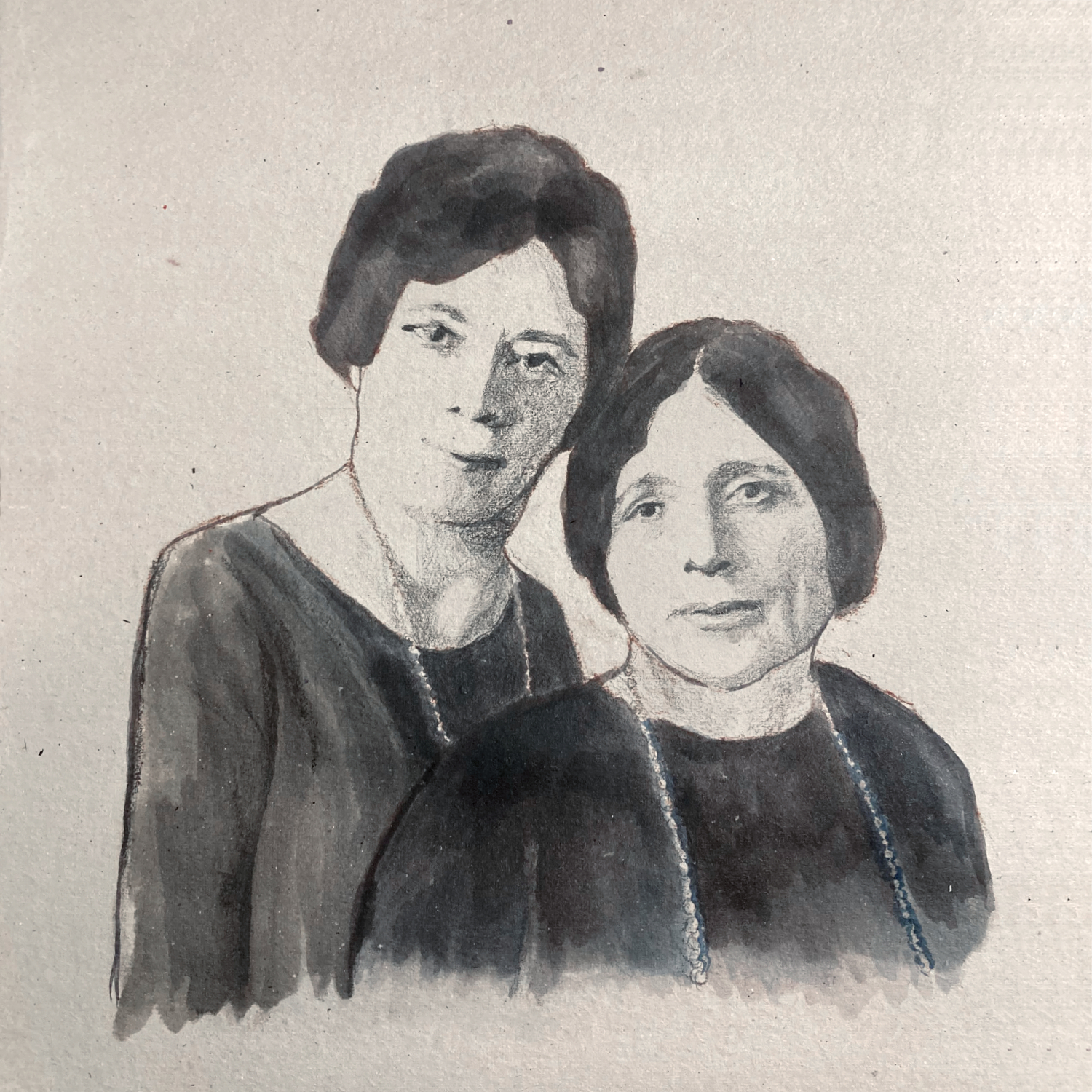
This special issue intervenes in our understanding of gender and Yiddish playwriting. Women who wrote plays in Yiddish have been neglected – even when they have been recognized for their contributions to other genres. Sonia Gollance’s article, “‘An altogether unusual love and understanding’: The Shomer Sisters and the Gender Politics of Shund Theatre” is only the second academic article (to our knowledge) that focuses on Yiddish women playwrights, and the first to examine the role of sisterhood as a theme in Yiddish literature. This article considers Rose Shomer Bachelis and Miriam Shomer Zunser in the context of their famous shund-writing family. It argues that the play Der liebes tants (The Dance of Love) can be read against the grain to decenter its own marriage plot and instead celebrate a peer relationship between women. Similarly, this special issue includes Vivi Lachs’s translation of the one-act play Bankrot (Bankrupt) by London writer Katie Brown, one of the very few plays by an Anglo-Yiddish writer and/or by a Yiddish woman writer to be published in English translation.
8
8
See Jessica Kirzane’s translations of Miriam Karpilove’s Diary of a Lonely Girl, or the Battle against Free Love (Syracuse: Syracuse University Press, 2019); Judith (Farlag Press, 2022); and A Provincial Newspaper and Other Stories (Syracuse: Syracuse University Press, forthcoming). Other texts which expand our understanding of women’s engagement with the popular press include: Anita Norich, A Jewish Refugee in New York: Rivke Zilberg’s Journal (Bloomington: Indiana University Press, 2019); Nick Underwood, “Women Writers and the Postwar Remaking of Yiddish Paris,” Journal of Jewish Identities 16, nos. 1&2 (2023): 471–487; Anna Margolin, During Sleepless Nights And Other Stories, trans. Daniel Kennedy (n.p.: Farlag Press, 2022); and Vivi Lachs, trans., London Yiddishtown: East End Jewish Life in Yiddish Sketch and Story, 1930–1930: Selected Works of Katie Brown, A. M. Kaizer, and I. A. Lisky (Detroit: Wayne State University Press, 2021).
Images played an important role in the marketing, and audience experience, of shund. In their article, "’Di Yidn Kumen!’: Israeli and Multicultural Identities in Israeli Yiddish Light Entertainment Shows,” Olga Levitan and Roni Cohen discuss Israeli promotional posters for Yiddish theatre performances from the 1960s to the 1990s. The posters analyzed in this piece offer up a new, intermedial perspective on the sometimes embattled place of Yiddish in Israeli society that charts, furthermore, the impact of immigration waves and current events in the packaging of shund. Levitan and Cohen thus demonstrate the way that ongoing discussions about multilingualism in Israel and the Yishuv can also be reflected in the realm of visual culture.
9
9
See S. J. Harendorf, The King of Lampedusa, trans. Heather Valencia (London: Jewish Music Institute, 2003); Beth Dwoskin, “Let’s not wait!: Introducing preschoolers to Yiddish through Leah Hoffman’s Alefbeys.” In geveb (November 2022): Accessed Mar 01, 2023. https://ingeveb.org/pedagogy/bringing-leah-hoffmans-alefbeys-to-childrens-classes.
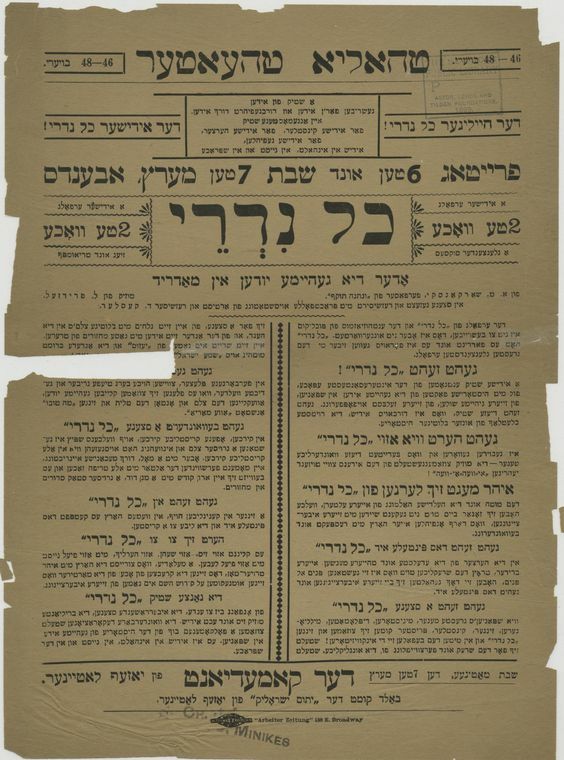
Ruthie Abeliovich’s article, “Kol Nidre and the Making of the Jewish Theatre Audience,” examines Abraham M. Sharkansky’s 1896 play Kol nidre, oder di geheyme yidn in Madrid (Kol Nidre, or the Secret Jews of Madrid), the earliest shund text up for study here. While recent scholarship has examined German-Jewish fascination with Spanish Jews during and after the Inquisition, 10 10 For examples of such scholarship, see Liora Halperin, Babel in Zion: Jews, Nationalism and Language Diversity in Palestine, 1920-1948 (New Haven: Yale University Press, 2015); Shayna Weiss, “Shtisel’s Ghosts: The Politics of Yiddish in Israeli Popular Culture,” In geveb (March 2016): Accessed Mar 24, 2023. https://ingeveb.org/blog/shtisel-s-ghosts-the-politics-of-yiddish-in-israeli-popular-culture. this topic – and the representation of Sephardic Jews in general – is only just beginning to generate scholarly interest within Yiddish Studies. 11 11 See John M. Efron, German Jewry and the Allure of the Sephardic (Princeton, NJ: Princeton University Press, 2015); Jonathan M. Hess, Middlebrow Literature and Making of German Jewish Identity (Stanford, CA: Stanford University Press, 2010), 26-71; Jonathan Skolnik, Jewish Pasts, German Fictions: History, Memory, and Minority Culture (Stanford, CA: Stanford University Press, 2014). By focusing on the role of the Kol Nidre prayer, Abeliovich also challenges preconceptions that Yiddish culture – both on stage and off – was a primarily secular enterprise. Unlike other articles in this volume that focus primarily on printed material associated with shund, this article emphasizes the importance of listening to performances of this liturgical music in staged versions of the play and how this experience fostered a sense of community among audiences.
Jewish Studies in general – and In geveb in particular – has begun to confront the role of American racism in Jewish and Yiddish culture. With exceptions, like discussions of Leyb Malach’s Mississippi,
12
12
One exception, with a similar focus on shund theatre, is Sonia Gollance, “Brush Up on Your Yiddish History Plays.” Digital Yiddish Theatre Project (April 2018): Accessed Jan 29, 2023. https://web.uwm.edu/yiddish-stage/brush-up-on-your-yiddish-history-plays.
this reckoning has tended not to focus upon theatre. Gil Ribak has been a leading figure in this area, and his article "My Mom Drank Ink: The ‘Little Negro’ and the Performance of Race in Yente Telebende’s Stage Productions," contributes to our understanding of race and racial stereotypes on the American Yiddish stage. While much of the scholarship on portrayals of Black characters in Yiddish literature has emphasized sympathetic narratives that decried lynchings and other mistreatment, Ribak analyzes the role of the “little Negro” character inYente Telebende to complicate this sort of interpretation in the context of American vaudeville (and minstrelsy) on the one hand and Jewish tropes for rendering non-Jewish Slavic peasants on the other.
Collectively, this set of essays and translations represent an initial and focused attempt to analyze and take seriously a genre that pleased crowds and that critics like Peretz loved to hate. As such, they serve as starting points for what we hope will be far greater attention paid to every aspect of shund, including texts, productions, performers, music, audience and critical reception, and marketing. By acknowledging popular entertainment as a fruitful area for understanding the dreams, desires, obsessions, and anxieties of theatregoers, we can better comprehend a broad range of Yiddish cultural production and gain a deeper understanding of how it operated within a larger social context – in every corner of the Yiddish-speaking world.