Apr 17, 2026
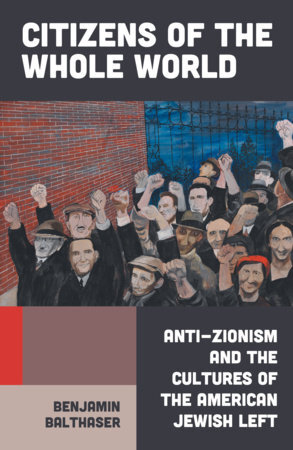
Benjamin Balthaser, Citizens of the Whole World: Anti-Zionism and the Cultures of the American Jewish Left. Penguin Random House, 2025. 320 pp. $29.95.
Today’s debates around Diaspora Judaism can seem to US Yiddishists like old wine in new bottles. Questions about the staying power and porous boundaries of Judaism and Jewish culture in a non-Jewish state are not new.
Benjamin Balthaser’s Citizens of the Whole World is a book that can fairly be called “Yiddish” in the broad, non-linguistic sense of the word. Although this work does not directly draw on many Yiddish sources, the groups it examines reference and draw upon histories of Yiddish activism in their organizing work. In geveb readers will find much to learn about the English-language reverberations of political ideas and communities once grounded in Yiddish.
In much contemporary writing about Jewish activism and community building in the anti-Zionist left, emphasis has been placed on relearning or unlearning Jewish culture and its previous Zionist assumptions, reinscribing Jewish history (to use Atalia Omer’s word) with a view to solidarity with Palestinians.
The materials used in this relearning have varied; some have focused on Bundist history (as an alternative and accessible ideology); others have focused on an attention to rabbinic texts and their midrashic or halachic interpretation. Still others have deepened our understanding of the diverse roots and potential alternative understandings of Zionism as a way to escape what might seem to some the dead-end of the nation state.
Few besides Balthaser have framed US Jewish culture, in its actual existence post war, as a site for dispute, alternative world-making, and potential examples of anti-Zionist Judaism.
While he emphasizes his disciplinary location in culture studies, Balthaser’s book is also a work of history scaffolded on “four moments of left-wing upsurge”: the Old Left, the New Left, the Left of the 1970s during a period of “ethnic revival” activism and second-wave feminism (which Balthaser and others characterize as the “identitarian left”), and the left associated with pro-Palestinian and anti-Trump efforts in our day.
By far the most interesting material in the book, to my mind, is the interviews, which the author himself characterizes as “the most vital part of the project.”
Balthaser sits down with members of various New Left organizations, including small left Jewish collectives in New York, Chicago, and Boston, “ranging from SDS and the SWP to the Chutzpah Collective, Communist Party, International Socialists, Revolutionary Union, and the Revolutionary Communist Party.” These interviews share the recollections of participants who have not been included previously in popular works on this topic, lending the book the heft of primary research.
While Balthaser also provides detailed close readings of various foundational texts from post-war American Jewish fiction and thought (Roth, Arendt, and Dollinger, among others), I found the affective connections of Balthaser to his material to be of great interest. While not autobiographical, this work is an analysis of the parts of Jewish culture in the postwar US that most move the author: the fading embers of Jewish Communism, Zionist-skeptic thinkers, and the alternative splinter groups I mention above are all marginal in histories centered on power but productively recentered in Balthaser’s view. This view might be idiosyncratic, might represent the coming consensus of a saving remnant, or might remain a marginal but productive and generative resource for whatever the American Jewish community could become.
Because this book encompasses a wealth of detailed historical information, and I am not an expert in the groups he describes here (I learned a lot and look forward to learning more), I will not attempt to evaluate every stop on Balthaser’s journey. I can’t say there is anything here I disagree with, merely that one must accept as a point of departure that the cultural and political genealogies of groups marginal to mainstream Jewish life are a foundation for future change. His book is one of hope, and it feels like a dream to rely on that.
I want to make some observations about the stories and histories brought by the author that made a particular impression on me, and that I thought could have deserved more emphasis.
As I mentioned earlier, it is in the history of smaller alternative Jewish groups that Balthaser’s book has its eye-opening novelty. Two of those groups discussed include the Chutzpah Collective (of Chicago) and the Brooklyn Bridge Collective (of New York), both active in the 1960s and 1970s. In an account of Chutzpah’s approach that appears quite topical today, Balthaser notes, “[I]t is not despite the fact but rather because Chutzpah and BBC saw themselves as primarily on the left, that many articles in their magazines begin with a critique of the ‘antisemitism on the left’ and end with a sense of their necessary connection to the left.” Such antisemitism in the point of view of these groups, points out Balthaser, had more to do with a refusal to Jews of their right to autonomy. That is, Jews on the left should be allowed, according to these groups, “to have their own position on Zionism, fascism, and antisemitism that would be aligned with the left but not necessarily always in agreement.”
It is a testament to Balthaser’s strengths as a cultural studies scholar that he does not judge these groups’ departure from the non-Zionist orthodoxy that currently characterizes much of the Jewish left. On the contrary, he characterizes their positions as both contradictory (they were on the left, yet Zionist) and also as characteristic of a diasporism which has developed a “flexible, relational form of political commitment.” He also notes that Chutzpah and BBC might insist on “Jewish subjectivity” in some organizing contexts but not in others.
These groups in their exceptionality emphasize something about Balthaser’s presentation. On the one hand, he analyzes American Jewish literary works as cultural phenomena addressing how Diaspora Jews see themselves (or fail to see themselves) as reflected in the Jewish state. On the other hand, he provides detailed interview-based chronologies of organizational life on the Jewish left. While Balthaser does consider “the revival of an anti-Zionist, radical Jewish culture” (and spends several pages discussing the work of Daniel Kahn and Eli Valley), pride of place is given to the reinterpretation and reframing of institutional Jewish culture which is part of the work of the largest American Left Jewish groups like Jewish Voice for Peace.
While it is understandable that Balthaser focuses on such institutional developments (cf. a recent article in Jewish Currents with the title We Need New Jewish Institutions), one might look for an appendix, or a sequel, to Balthaser’s book that considers not just the novels of bygone decades, but the current cultural products of the Jewish left as creations of a thick non-Zionist culture.
Balthaser’s book is rich with detail and personal stories, modest, even self-effacing in its presentation, but far-reaching in potential inspiration and implication. I hope the American Jewish left will see itself in the groups that he has ably documented.