Sep 10, 2025

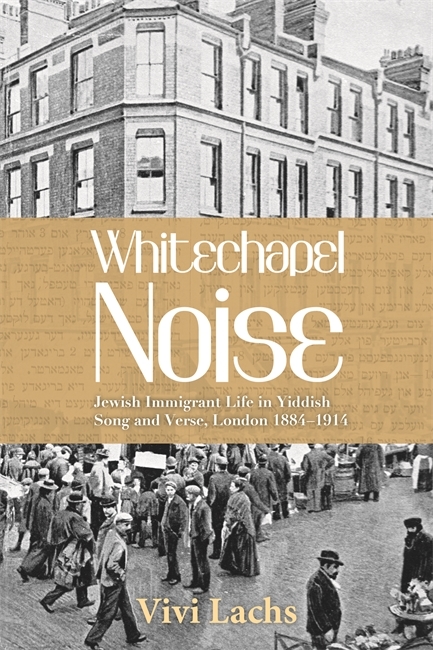
Vivi Lachs and Barry Smerin, eds. and trans. East End Jews: Sketches from the London Yiddish Press. Wayne State University Press, 2025. 238 pp. $34.99 [paperback].
East End Jews, as the subtitle indicates, is an anthology of brief articles from Yiddish newspapers and magazines published in Britain. The editors and translators — Vivi Lachs and Barry Smerin — have selected some 53 pieces, and organized them into five chronological sections, ranging from the 1880s and the rise of the East European Jewish immigrant community in East London, to its last years in the 1950s. The translated pieces are accompanied by a helpful introduction by Lachs, notes on the authors, and a list of titles and dates of the publications from which the sketches were drawn. The well-translated articles make for entertaining, and often moving, reading. But they also serve as an introduction to the social and cultural history of life in the Jewish East End. The book would be useful for those seeking that sort of introduction, including students in relevant courses.
East End Jews is also a work of journalism history, and especially of the genre known as the feuilleton. A definition is elusive even here, but Lachs gives a history of the feuilleton from its origins in turn-of-the-nineteenth-century France as a short “accessible and nonpolitical” (4) piece published as a supplement to the hard news in the main section of the paper. From France, the feuilleton moved to Germany, from there to Russia, and by the 1830s to Britain. Feuilletons were included in the Yiddish press from the beginning, with Kol mevaser in the 1860s, and in the British Yiddish press from its beginning with Der poylisher yidl in 1884. As Lachs notes, feuilletons “could be a topical laugh or an embellished fiction of a local event. They could be meandering thoughts or opinionated polemic.” (1) Not only could feuilletons take the form of “forthright opinion pieces on social issues,” but also of “stories, humorous sketches, satire, reportage and verse.” (5) A flexible urban genre, they provided a link between high and low culture.
Lachs points out that the feuilleton was always a controversial genre among intellectuals, even as many of them wrote them, because, after all, one also had to make a living. East End Jews presents a range of writers, including such well-known figures as Morris Winchevsky and Yosef Haim Brenner. Some might be known to students of British Jewish history, and others obscure even to them. Some are so obscure they can only be identified by pseudonyms. Among the contributors are six women, who seem, if the collection is any indication, to have occupied a more prominent place in the field in its later years.
Several themes emerge from the book. One is that of class conflict, or at least tension. Isaac Stone, for example, writes about “busy” and “slack” seasons in the garment industry, and concludes that both are plagues – characterized by either brutal overwork or idleness and starvation. In 1889, Morris Winchevsky asked, “How do you become a Poet?” He muses that if he could become a poet, he would sing of the chains and miseries of the workers, and call on them to rise up against an oppressive system. This, of course, is just what he was already doing, and continued to do. He uses a parable of boiling water on a gas jet for tea – warm is not good enough; neither are hot or “hissing.” Only boiling will do. Some pieces also comment on tense relations between the poor immigrant population and the well-established and well-off Anglo-Jewish community, which was criticized or, often, lampooned for its assimilationism, condescension, and begrudging charity.
Many feuilletons poke fun at the informal public life of the community. In doing so, they document the meeting places – restaurants, lemonade stands, grocery stores, synagogues, and streets – where people met and discussed everything from personal problems to international politics. There are many memorable and outspoken characters, some fictional and some real, who express their opinions on strikes, the war efforts during the first and second World Wars, plans to build a Channel tunnel (in which the main character warns that it will enable Germany to invade France and England), and the feasibility and desirability of a Jewish state in Palestine. Many pieces poke fun at the pretensions of the café and street-corner “politicians” that they might play a role in solving world problems. Despite obstacles, public spaces also helped foster religious life, according to the observers, at least during the East End’s heyday. One account of a procession honoring a new Torah scroll described some disagreement about whether it was dignified to parade through streets in front of gentiles. But it concluded that doing so provided a good demonstration of traditional Judaism in a place where it was often hard to maintain tradition. It also made special note of the role that women played in the procession.
Homelife was also an important topic, and here gender roles and tensions between men and women were a particular focus. Not surprisingly, poverty is said to have contributed to conflict between husbands and wives. Katie Brown invented a satirical exchange of letters, each letter with a different fictitious signer, in which women complain about husbands who complain about their wives, and wives who complain about their husbands – back and forth for several pages. The upshot is that both have hard lives in their roles as breadwinners and housekeepers – and, though this is never quite made explicit, that each side should try to understand the other. Were the many bad marriages depicted in the columns truly representative of the community? Or were they intended to make many readers feel better about their own marriages by reading about what could go wrong? Often, the situations described are played for laughs, so it’s hard to tell.
The years during and after World War II were difficult ones, not only because of awareness of the Holocaust, but also because of the aging of the immigrant population, both of which conspired to shrink the Yiddish world at home and abroad. Feuilletons in this era describe and lament the contraction or passing of the public spaces previously celebrated. Katie Brown, for example, expresses anxiety and even despair as she leafs through her old address book. So many of the people and places in it are now gone. L. Beynishzon humorously describes the struggle to gather a minyan for weekday prayers. Ella Zilberg and Rachel Mirsky write nostalgically about their vanished childhood shtetlekh. Other writers provide memoirs of the old days in London. In 1948, Dora Diamant bewailed the passing of Shloyme Mikhoels just at the time when she and others abroad were looking to Soviet Jewry to continue the legacy and culture of East European Jewry. Of course, she was unaware that Mikhoels’s murder signaled that Soviet Yiddish culture was also in the process of being shut down.
Vivi Lachs argues that the feuilletons in the book, and the many others that did not make the cut, were “written by the people for the people.” (201) Of course, by definition, the writers who produced them were not quite representative of the general population. Most people are not writers. But, just as obviously, the immigrant authors shared the experiences of the general immigrant population in which they were embedded. And as talented journalists they kept their fingers on the community’s pulse. Even if the lens they created sometimes distorted the picture for the sake of humor or tragedy, it still provides an intimate look at East End Jewish life.