May 15, 2026
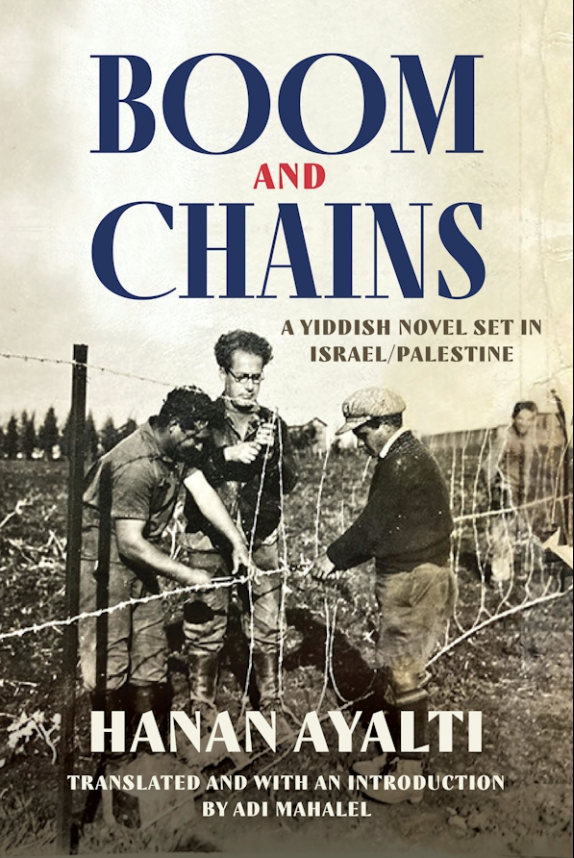
Hanan Ayalti, Boom and Chains: A Yiddish Novel Set in Israel/Palestine, translated by Adi Mahalel. Wayne State University Press, 2025. 194pp. $34.99 [paperback].
[Editorial Note: This review contains detailed information about the plot of the novel. Some readers may prefer to wait to read the review until after reading the novel.]
This is a welcome translation of an important Yiddish novel, Boom and Chains by Hanan Ayalti (the pen-name of Hanan Klenbart, 1910–1992), originally published in 1936. Not only does the translation, by scholar Adi Mahalel, make accessible an additional title in the small corpus of Yiddish fiction written in pre-state Israel, it also offers a view of contemporaneous ideological differences and conflicts that is rare in Jewish writing about the Palestinian Zionist community (the yishuv). At the same time, the novel addresses social and political developments of the time in the local Palestinian population, which are largely neglected in this genre as a whole.
The opening scene thrusts the reader into a world where lives in limbo and conflict are set against a promise of ideals being realized. We meet the main character, Zalmen, a romantic young European Zionist headed for a kibbutz, as he shivers at dawn on the deck of a ship on the Mediterranean. However, when the ship anchors in the port of Jaffa, the Jewish passengers are initially unable to disembark, though the local Palestinian boats that ferry passengers from ship to shore are bobbing in the shallow water nearby. Zalmen soon learns that the boatmen are on strike against Jewish immigration. He begins to realize that his very presence in the land is inextricably bound up with these Palestinians.
The two strands of Jewish and Palestinian experiences run in parallel throughout the novel. The utopia-minded Zalmen eventually becomes disillusioned with the Socialist brand of Zionism, as well as with communal life in the kibbutz. The young men and women are deprived of privacy, as they share large group tents on the outskirts of a swamp they are draining in order to expand Jewish settlement. The area around the swamp is populated by local Palestinians barely able to subsist on land they lease from local Arab owners, known as Effendis. These wealthy landowners, for their part, are happy to sell their properties to Zionist organizations eager to establish settlements in the land, and are hardly concerned with the dispossession of the Palestinians. Both aspects of life in this Promised Land are immediately foregrounded and developed until their inevitable collision.
Kibbutz goals are also soon placed in question, as the women are relegated to working in the traditional domains of kitchen and laundry, in spite of their hopes for equality. The project of creating a new society, free of “bourgeois” customs such as exclusive partnering, is unmasked when the heavy toll it takes on personal lives becomes evident. Ayalti devotes space to the tribulations of the young women. The only privacy is found out of doors, and sexual desire—rarely acknowledged in the dense tent camp—finds expression, if at all, in evening walks among trees and bushes; the inevitable sexual frustrations are vividly depicted. The “Arab question” that had been confined to words during the ideological discussions in the Zionist youth clubs of Poland is now a reality. A letter Zalmen receives from his friend Motke, who has left the kibbutz, presents the Jewish-Arab nationalistic conflict in stark terms that are prescient for our own times: “Either the Jews will give up Zionism, canceling the antagonism with the Arabs, or Zionism will eradicate the Arabs from the land.”
The fictional figure of Milner, a Communist agitator active among Jews as well as Palestinians, represents an additional important political aspect. In his detailed introduction, Mahalel argues that the character of Milner is likely based on the real-life figure of the Communist activist Shalom Lustig (probably a pseudonym). Zalmen and his friend Motke are strongly influenced by Milner, who espouses the ideal of full equality between peoples. The two young men leave the kibbutz, and drift between the large cities of Palestine—Tel-Aviv, Haifa, and Jerusalem. In Tel Aviv, Zalmen realizes that “the first Hebrew city,” as it is fondly termed by its residents, is rapidly turning into a mirror image of the European Jewish shtetl, in which non-European Jews and local Palestinians are the second-class citizens. Motke moves to Jerusalem, where he encounters ultra-religious Jews who are remote from twentieth-century culture and ideas. He later joins the Palestine Communist Party (better known as PKP), which was repressed by the British Mandate authorities. Zalmen eventually becomes involved in underground left-wing joint Jewish-Arab activism and the two friends serve jail sentences. The ethnic and political diversity of urban life in the territory is made clear.
Ayalti devotes much space to the experiences and problems of local Palestinians, still in “chains,” at a time that the region was experiencing an economic “boom.” Yet the lives and culture of the Palestinians are nonetheless changing rapidly. This segment of the population was mostly ignored by contemporaneous local Hebrew writers; at best, as in the work of Moshe Smilansky, it was presented as folklore. Ayalti’s early chapter “Abu Khalil Also Wants to Live” depicts the crucial, subservient relationship between tenant farmers and rich Effendis. It also introduces intergenerational conflict, as the elderly Abu Khalil worries about the future of his favorite grandson, Rasheed, who has gone to seek a modern, better life in the city. Abu Khalil’s fears prove justified: Rasheed’s dreams are dashed, and at the end of the novel he is hanged as a terrorist by the Mandate authorities in the territory’s top-security Acre prison. Another young Palestinian is Saeed, who sees through the sham ideal of Jewish-Palestinian equality touted by the Jewish Socialists. Palestinian landowners are represented by the figure of Shukri Effendi Latif, who enjoys the improving economy fed by British colonial rule. The Arab agitator, Mustafa, who hails from Syria, exemplifies Palestinian Arab communist activists. Unfortunately, Ayalti’s interest in politics seems to subsume his interest in art. The book seems more a sociopolitical report on Zionists and local Palestinians in the 1930s than a fully realized novel. The two-dimensional characters form a microcosm of contemporaneous trends. Women, mostly situated in the kibbutz, are largely viewed through the lens of their sexual dilemmas, and lose whatever individuality they have as the novel progresses. They eventually disappear from the narrative altogether, except as objects of the sexual desires of Jews and Palestinians. The British Mandate authorities are mostly presented as antagonists to both segments of the population, while the local Palestine-born Jews are largely depicted as religiously observant and unconcerned with secular politics. Ayalti models another fictional character on a major real-life figure: “Rabbi Buk” in Jerusalem, who is being courted by left-wing Jewish workers to convince Jewish farmers to pay their Arab laborers the same wage as their Jewish counterparts, or not hire Arabs at all. “Rabbi Buk” to be based on the towering figure of Rabbi Abraham Kook, the Chief Rabbi of Palestine in the interwar period. Rabbi Kook was known for his adherence to the traditional Jewish principle that hiring one’s own people is preferable, even at higher expense.
Jewish as well as Palestinian characters are delineated to represent different, often contrasting, political ideologies and practices. Ben Asher leaves the Socialist kibbutz, purchases an orange orchard, and joins the ranks of established Jewish farmers. He is therefore designated a capitalist, an anathema to the Socialist Zionists. He further negates the values of Socialist Zionism when he refuses to employ the eager young Jews who demand higher wages, and perpetuates the traditional landowner-serf economy by hiring local Palestinians at lower rates and then sending them to work in the worst parts of the swamp.
The tensions between Jews, Palestinians, and Mandate authorities come to a head toward the end of the novel in a description of one of the periodic armed clashes between Palestinian and British forces—possibly an allusion to events that occurred during the 1920s. The fighting takes place in Palestinian Jaffa, while Jewish Tel-Aviv continues to flourish as it celebrates the acquisition of more land by Jews. The Palestinians inevitably lose this skirmish, and suffer fatalities. Young Saeed loses his life as a result of these events.
The economic boom promised in the novel’s title begins to expand in the 1930s, when well-to-do Jews flee Europe, following economic sanctions against Jews in Poland and the accession of Hitler to power in Germany. The characters, though, are not overly concerned with world affairs. At the end of the novel, Ayalti neatly ties up several loose strands. Motke, the Communist, is deported. Hanke, one of the women who left the kibbutz, marries an American journalist and prepares to leave the land. Another former kibbutz member, Dora, apparently partners with the Syrian agitator Mustafa. Zalmen himself, whom we first met on the ship at the port of Jaffa, is arrested, and imprisoned in Acre, together with others who are deemed extremely dangerous. As he watches a Palestinian going to the gallows, he recognizes young Rasheed, whom he knew from his early days on the kibbutz. As the book concludes, Zalmen is in limbo once again, watching the night-time sea from the window of his prison cell. The novel ends on the sea, as it began, with Motke boarding the vessel that will return him to Europe. Ayalti concludes ominously: “Secret forces were swimming from hidden abysses … A storm was in the air.”
In an Appendix, Mahalel provides the Prologue from the serialized form of the novel, published in the Polish Yiddish press in 1936. The Appendix provides a helpful back story for the young characters who arrive at the port of Jaffa at the beginning of Boom and Chains, while also laying the groundwork for some of the problems they encounter in the Promised Land. Despite its literary shortcomings, Boom and Chains is a key, under-appreciated work that traces some of the social and political currents underlying the early years of Zionist ferment in Europe and settlement in Palestine at the beginning of the last century. Ayalti himself shifted his political stance several times, eventually settling on Communism, which was strongly curbed by the British Mandate authorities. He left Palestine for France, where he began to work as a Yiddish writer. In the 1930s, he volunteered with the International Brigades during the Spanish Civil War, and after World War II settled in New York.
We are fortunate to have a translation of this significant yet overlooked work, supplemented by Mahalel’s in-depth research. It greatly enriches our understanding of a crucial period in modern Jewish history and the history of pre-State Israel.