Mar 08, 2026
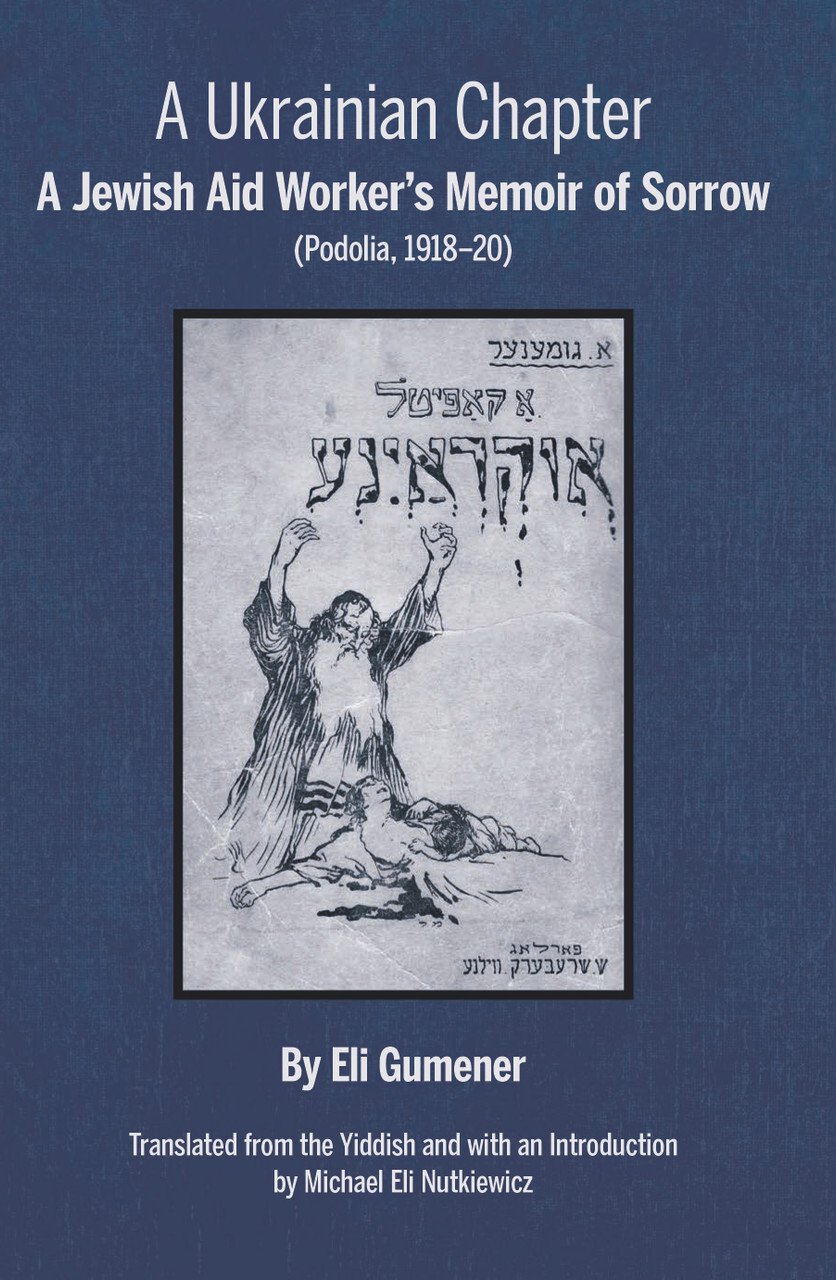
Eli Gumener. A Ukrainian Chapter: A Jewish Aid Worker’s Memoir of Sorrow (Podolia, 1918–20), transl. Michael Eli Nutkiewicz. Slavica, 2022. 114 pages. $24.95.
This memoir by Eli Gumener (1886–1941?), a socialist and aid worker, introduces readers to the history of the 1918–1920 pogroms through his experiences with relief work and political participation. Translated from Yiddish by Gumener's nephew, scholar Michael Eli Nutkiewicz, the book also tells an intimate family story. Like many testimonies from the period of the pogroms, the memoir has a commemorative function; however, it also focuses on strategies of self-defense, political alliances, and the organization of relief efforts. Originally from Mariampole in the Suwałki Region (now Marijampolė, Lithuania) Gumener later studied law in St. Petersburg. Unable to practice law, he came to Ukraine to work as a relief worker for various organizations, including EKOPO (the Jewish Committee for the Assistance to War Victims), Kultur Lige, and the Jewish Ministry within the Ukrainian government. Although Gumener was not originally from Podolia, he treated the local Jewish communities as his own, feeling the commitment to stay despite the danger and help people.
The book is centered on the region of Podolia, specifically the cities of Kamenets-Podolsk (now Kamianets-Podilskyi)) and Proskurov (now Khmelnytskyi), where Eli Gumener was working at the time. Since the period of the Polish–Lithuanian Commonwealth, Podolia had been an important region of Jewish settlement, with many Jews living in shtetls. During World War I and the subsequent revolution, Podolia became a site of military campaigns and a frequently shifting front line, bringing devastating destruction to the civilian population, particularly to Jews.
Unlike other, similar testimonies, Gumener does not focus solely on the events of the pogroms and descriptions of horrors but tries to convey the unstable atmosphere in the midst of war, with all its insecurity, fragile alliances and the need for momentous decisions. Michael Nutkiewicz's detailed introduction with a rich bibliography provides historical context, a detailed biography of Gumener, and an overview of other ego-documents on pogroms (xxv–xxviii). This explanation is very useful for what is one of the most complex periods in Ukrainian history, when governments, borders, and the sides of conflict changed in the blink of an eye. In one chapter, Gumener lists the sixteen governments that passed through Proskurov (Khmelnytskyi) in the years following the revolution (45).
The Gumener memoir offers the nuances and detailed description of the Ukrainian-Jewish relations during this period, showing the social divisions, which sometimes mattered more than national. Gumener, probably because of his own socialist leanings, looked for predominantly social reasons for pogroms, though he probably overestimated the leadership of theUkrainian “intelligentsia [which] established itself at the head of the peasant movement” (41). He also observed that the differences in attitudes within the Jewish community toward the Ukrainian Revolution were largely shaped by social factors. The large bourgeoisie tended to support the Russian Revolution, while the petty and middle bourgeoisie—the social base of the Zionist movement—were more sympathetic to the Ukrainian national cause (43). Yet it was this group that suffered most from the upheavals of the revolution. Artisans, by contrast, maintained the closest and most stable relations with the peasantry. The memoir is supplemented with documents, and Appendix 2 (99) includes “A Declaration from the Working Group (Artisans) of the Kamenets. Jewish Kehillah (July 6, 1919).” These documents reflect the artisans’ belief in the possibility of building a new Ukrainian state on socialist foundations, with the participation of Jews as “full-fledged, equal citizens of Ukraine, side by side with the Ukrainian working people.” Jewish workers, represented by socialist parties such as the Bund, opposed Bolshevism and expressed sympathy for the Ukrainian national movement. However, according to Gumener, this sympathy was not reciprocated, as Ukrainian parties rejected the Jewish socialists.
As a member of the Jewish Ministry in the Ukrainian National Republic, Gumener was deeply familiar with Ukrainian political life. In his memoir, he explains the internal divisions within the Directory and the political tactics of its various leaders. He did not portray all Ukrainian soldiers as pogromists, instead providing detailed accounts of when pogroms occurred and who was responsible. Gumener also acknowledged the discipline of the Ukrainian divisions from Galicia, noting their ability to maintain order whenever they entered the towns. However, he held the Directory’s leadership accountable for the pogroms, criticizing their inability to control the army, their failure to properly investigate the events, and the silence of the Ukrainian intelligentsia regarding the massacres (46). But Gumener also understood that Bolsheviks were not the messiah for Jewish communities, which became clear from the first day of their rules, when they infiltrated all important organizations and started arresting Jewish intelligentsia.
The memoir offers not only descriptions of the pogroms and the tense atmosphere surrounding them, but also, thanks to Gumener’s involvement in administrative work, valuable insight into the political climate and decision-making processes at the municipal level. Thanks to this detailed, microhistorical account of daily life and relations in the cities, one can sense the complex political situation of Jewish representatives who had to be careful with their words and decisions. In one episode, Gumener describes the establishment of the Committee for the Protection of the Republic in Kamenets in March 1919, which effectively constituted a coup against the Petliura leadership in the UNR. The local Jews found themselves in a difficult position, torn between angering the leadership by joining the Committee and angering the local authorities by refusing to join. The situation could differ from town to town: if in Proskurov the Jewish organizations refused to collaborate with the Ukrainian government, in Kamenets, Ukrainian and Jewish socialist parties achieved rapprochement and Jews participated in the Jewish Ministry (57).
Though difficult and complex, the everyday interactions show that the leaders of Jewish organizations had more roles than that of merely victims of the situations. The most important of their roles was in the provision of aid to the population after the pogroms and the war. Similarly, Gumener finds the importance in the Jewish self-defense, which, for him, was a very important sign of the agency of Jewish communities—he even made a note for future historians. Thus, he describes four cases: Orinin (Orynyn), Vinitse (Vinnytsia), Proskurov, and Khmelnik (Khmilnyk) where Jewish self-defense groups, consisting of workers and young men, were successful in their endeavors.
Gumener, being familiar with the inner workings of relief organizations, was honest about all of their shortcomings. He described all the problems with their activities and the way political organizations instrumentalize relief work. The author explains, in detail, political divisions within the Jewish community, which complicated the aid work, and shows how the Jewish relief organizations tried to collaborate with the state institutions (though the latter were constantly changing). Several Jewish organizations took part in the relief effort, with the support of American Jews. The war and the lack of government caused the atomization of society and, in an absence of stable government or statehood, the inability to function . Gumener demonstrates the disparity between American benefactors and local committees:
We were from two different worlds. They were the representatives of a new fully developed Jewish community, and we were the remnants of a Jewish society. On their shoulders stood Jewish kehillot with large populations; on our shoulders—destroyed towns and villages. . . . “What is life like here?” they asked us. We remained silent. How could we answer the question what life was like . . . (75).
The introduction, well-prepared footnotes, and rich bibliography at the end of the book make it a valuable resource for scholars and educators, helping them navigate the extensive historiography of pogroms. The Yiddish names of locations, though sometimes unfamiliar to readers, reflect the translator’s intention to convey the atmosphere and language of the original memoir. The English translation of A Ukrainian Chapter, previously known only to a small circle of scholars, is an important contribution to the study of pogroms, political life during the revolution, and the work of Jewish relief organizations. It also opens up new questions about how these organizations managed to operate amid the constantly changing political and military situation in Ukraine.