Nov 17, 2025
INTRODUCTION
In geveb publishes pedagogical materials along with reflections from teachers. This worksheet was generously shared with In geveb by Shlomo Groman. We want you to use it in whatever way best aids your teaching. If you wish to alter or add to it, please make note of this in your new worksheet, and please keep the original attribution. You may send questions or comments to the creator through us: [email protected].
Download a PDF here.
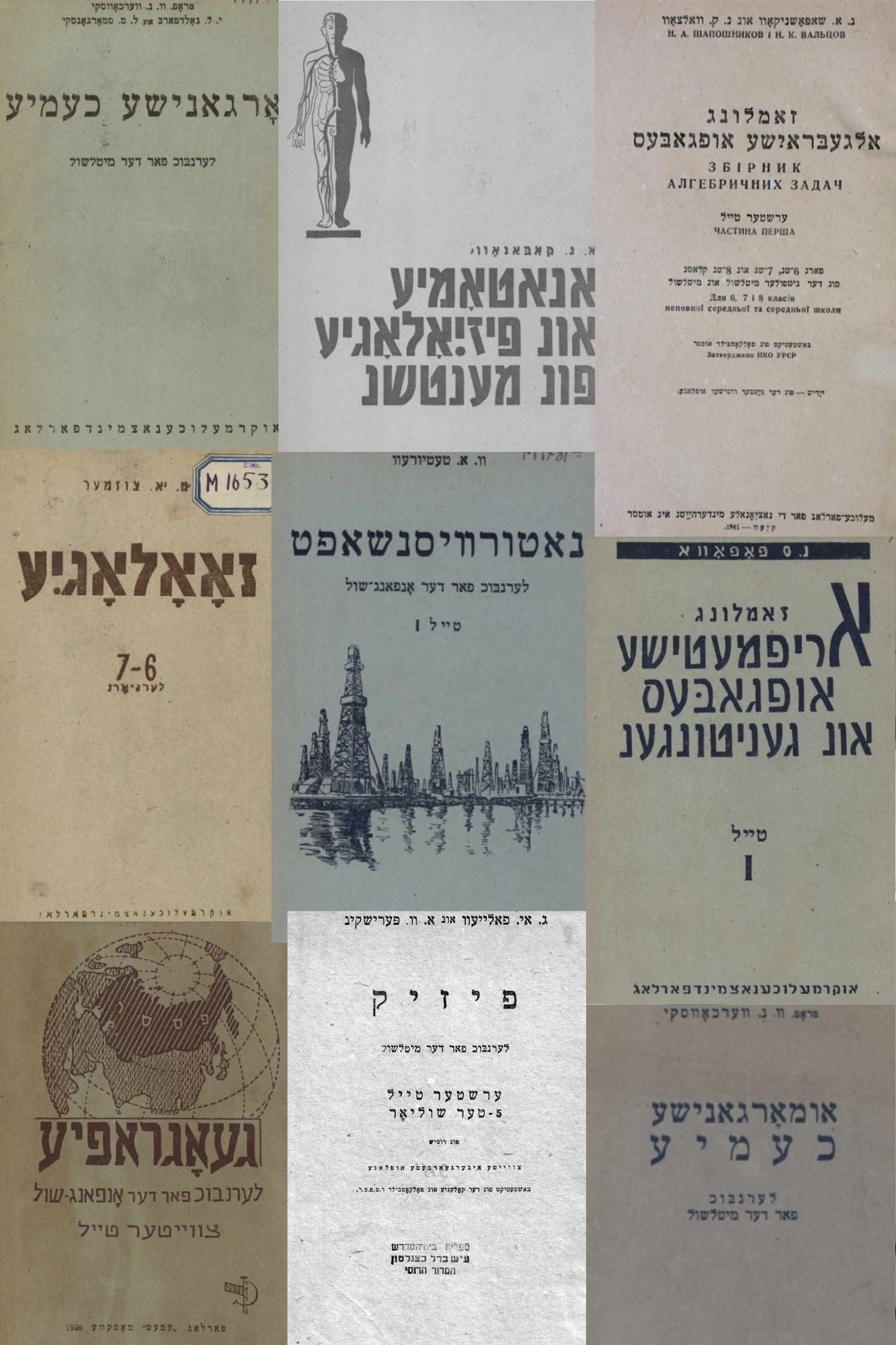
During the 1920s and 1930s, full sets of Yiddish scientific and technical textbooks were produced in the Soviet Union for nearly all academic subjects and secondary school levels. Today, these works are almost entirely forgotten. Yet scientific literature provides an outstanding and largely untapped resource for teaching the Yiddish language.
First, technical and scientific and Yiddish texts, like their counterparts in other languages, display exemplary grammatical precision and clarity. They expose students to linguistic features that appear frequently in formal registers, including: the productive suffix -ung creating verbal nouns; the passive voice; and complex compounds.
Second, such texts have a distinctive lexical profile rich in loan translations and international terminology, significantly expanding learners’ vocabularies. Words that students already know often reappear here as specialized terms with new meanings, fostering semantic flexibility.
Third, most students of Yiddish are primarily exposed to literary or cultural materials that represent only one aspect of the language’s expressive range. Reading a scientific text allows them to encounter Yiddish as a fully functional modern medium capable of precision, abstraction, and technical sophistication. It situates Yiddish in everyday, professional, and educational contexts, thereby broadening students’ cultural literacy.
Fourth, many learners of Yiddish have studied or are pursuing scientific or technical disciplines. Lessons based on scientific materials can therefore speak to their existing interests, combining linguistic study with intellectually familiar content.
Moreover, the Soviet corpus provides an opportunity to address questions of orthography and ideology without venturing into overtly political territory. The spelling reforms, which replaced Hebrew orthography with a phonetic system, reveal the deep interconnection between language policy and cultural identity.
Working with authentic material that consistently exemplifies such structures enables teachers to sharpen students’ grammatical and lexical awareness and to highlight how Yiddish functioned beyond its traditional literary boundaries.
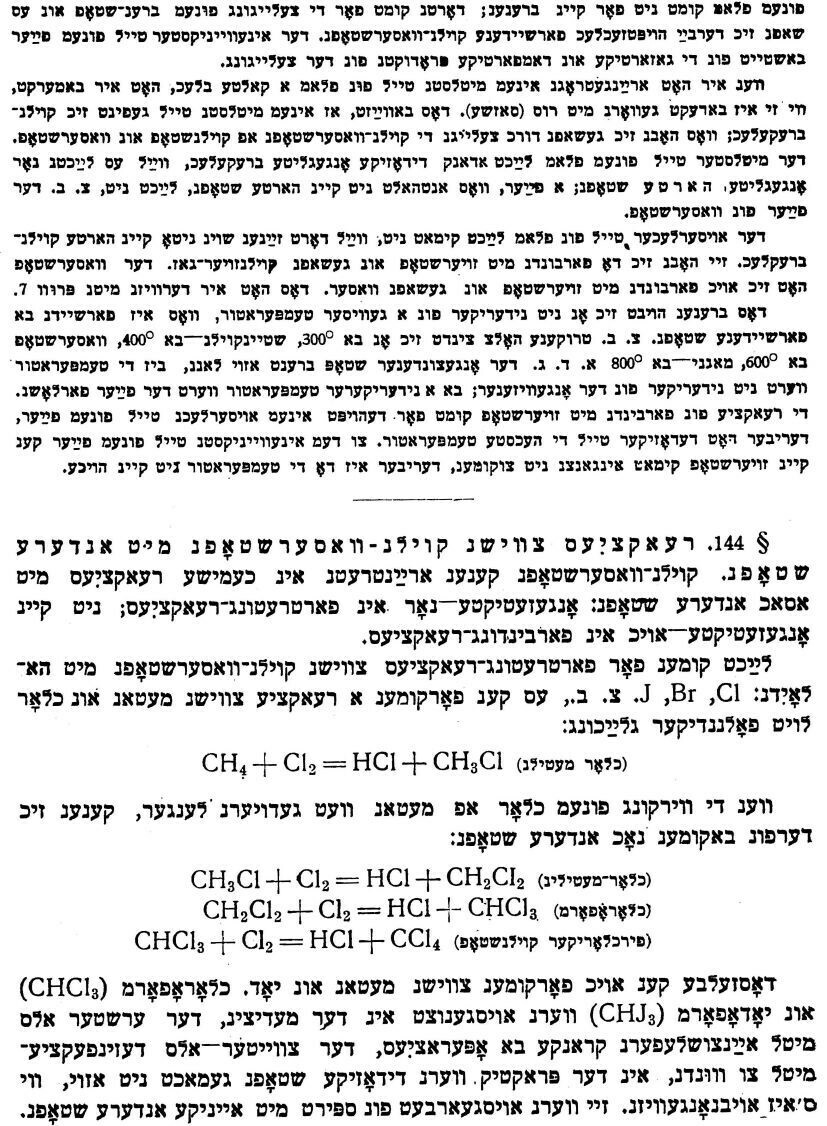
The following lesson, adapted from Appendix B (pp. 319–325) of my doctoral dissertation Scientific Literature in Yiddish: Ideology and Terminology (Bar-Ilan University, 2023),1 is built around an almost randomly selected page from the Soviet high-school chemistry textbook authored by Sh. Brokhes (1931).2
I have translated the material, originally written in Hebrew, into English for use with upper-intermediate and advanced English-speaking students of Yiddish.
The lesson assumes knowledge of roughly 2,000 common Yiddish words and basic grammatical structures, some of which are briefly reviewed in connection with the new scientific vocabulary.
Depending on instructional context, the material can be divided into three or four sessions. Assignments are italicized, and particularly challenging tasks—those that may be skipped initially—are marked with a single asterisk.
This material has been tested in the advanced Yiddish course I taught at the New York Arbeter Ring (Workers’ Circle) in 2023, as well as in other teaching settings.
I warmly invite feedback from fellow Yiddish scholars, instructors, and language-pedagogy specialists.
You can find a printable PDF of the lesson here.