May 05, 2026
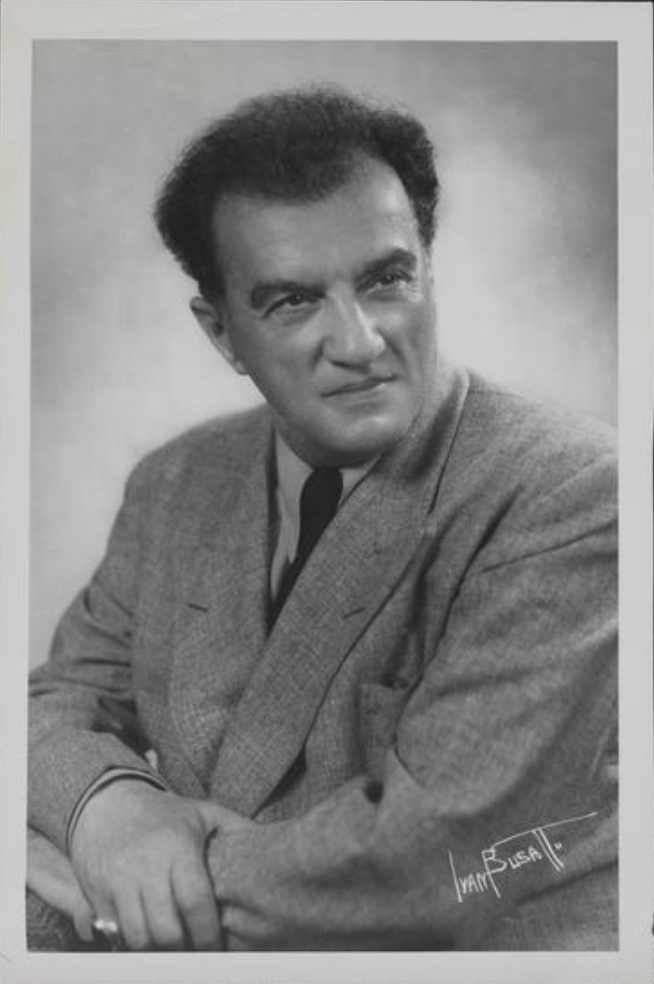
The Yiddish actor Samuel Goldenberg (1886-1945), circa mid-1930s (Museum of the City of New York).
Samuel Goldenberg was a Yiddish dramatic actor who in his heyday enjoyed considerable popularity and critical acclaim. But in October 1945 he collapsed on stage and died at the age of just fifty-nine, following which he lapsed into semi-obscurity. Though he was trained in a conservatory and had a pleasant baritone singing voice, the handful of recordings that he made is not easy to track down.
Goldenberg wasn’t immortalized on the silver screen, either. His only Yiddish talkie, a 1935 adaptation of the musical Shir ha-shirim, by Anshel Shor and Joseph Rumshinsky, has been “mercifully lost,” writes the film historian J. Hoberman. 1 1 J. Hoberman, Bridge of Light: Yiddish Film between Two Worlds (The Museum of Modern Art; Schocken Books, 1991), 207. When Goldenberg ventured out to Hollywood during World War II to play Leon Trotsky in the propaganda feature Mission to Moscow, his role was left on the cutting-room floor. His only surviving cinematic role is an uncredited appearance as Prince François de Namur in The Fallen Sparrow, a now-obscure 1943 potboiler starring John Garfield and Maureen O’Hara. I watched it on the Internet Archive’s site a few years ago, but it’s been taken down since then.
And alas, Goldenberg didn’t pen an autobiography or bequeath his archive to any repository. That said, he’s mentioned in the memoirs of many of his Yiddish actor contemporaries, and there’s a good deal of information on him available through the Historical Jewish Press (JPress) website and the Yiddish Book Center’s Digital Yiddish Library. But until quite recently I hadn’t bothered to search his name in commercial sites for digitized English-language newspapers. Now I have.
In the ProQuest suite of subscription databases, I’ve found dozens of articles about Goldenberg in The New York Times and the New York Herald Tribune. And recently I stumbled across a rather unusual find in another ProQuest database: a review in Variety, in both English and Yiddish [!], of the vanished Shir ha-shirim movie. (Variety is included in the Entertainment Industry Magazine Archive—which also covers such trade newspapers as Billboard and The Hollywood Reporter.) Written by Wolfe Kaufman, the review of Shir ha-shirim occupied two complete columns in the October 23, 1935, issue.
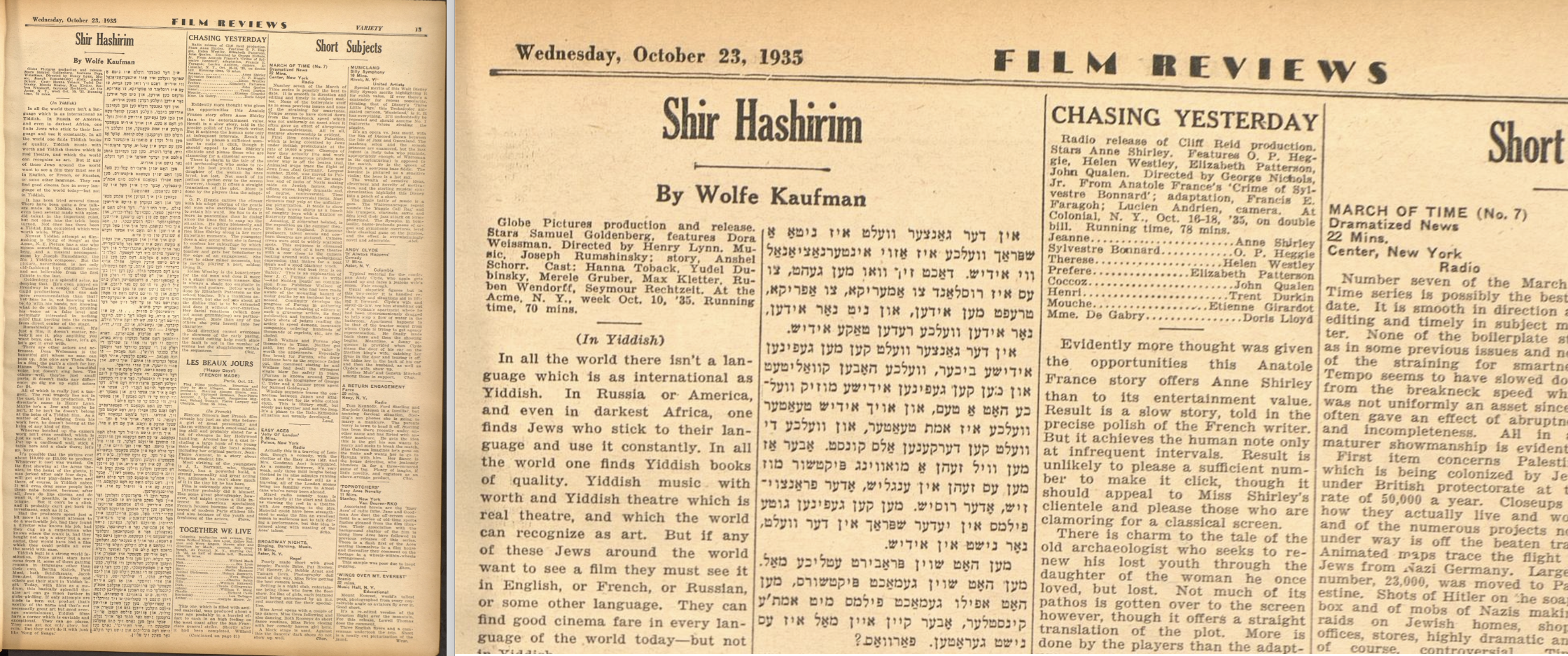
The English and Yiddish versions of Wolfe Kaufman’s review of Shir ha-shirim, in the October 23, 1935, issue of Variety (on the right in cropped form). The operetta’s dialogue and song lyrics were by Anshl Shor, with music by Joseph Rumshinsky. (ProQuest’s Entertainment Industry Magazine Archive)
Variety specializes in the “business” side of “the show business,” and from the 1920s to the 1940s it devoted a decent amount of space to the Yiddish theater. New York’s Second Avenue and its outer-borough and out-of-town offshoots were a parallel universe to the Great White Way and “the Road.” Given that Yiddish theater was serious box office, this counted for a lot to the entertainment press. Variety regularly published reviews of Yiddish plays, and it sometimes surveyed the Yiddish theater scene overall. Names like Adler, Thomashefsky, Schwartz, Picon, and even Goldenberg were reasonably familiar to its journalists and readers.
All of Variety’s reviews of Yiddish plays that I’ve seen so far are in English; Kaufman’s bilingual review of Shir ha-shirim is a total outlier from a linguistic standpoint. What might have motivated the editors of Variety to print both English and Yiddish versions of that review? Which version came first? How do the two versions compare, stylistically and content-wise? Who was Wolfe Kaufman? And why should we even care about Shir ha-shirim today?
The Shor-Rumshinsky operetta was first put on in October 1911, with Maurice Moscovich in the role of Leon Oppenheim, a middle-aged composer with failing eyesight. The teenaged orphan Lily, who had been adopted by Leon’s uncle, is infatuated with the composer and he reciprocates her affections. A singer herself, she’s mesmerized by her “Uncle” Leon’s piano playing. Both at its premiere and in the film version nearly a quarter century later, Lily was played by the “vivacious soubrette” Dora Weissman. 2 2 Ronald Robboy, “Program Notes,” The Song of Love – Shir ha-shirim: Dos lied der liebe (New York: YIVO Institute for Jewish Research, 2023), 1.
Shor’s script was based on “Die Siebzehnjährigen,” by “a B-team German playwright” named Max Dreyer. 3 3 As Ronald Robboy characterized Dreyer to me in an email. In the words of Yiddish theater historian Ronald Robboy, Shir ha-shirim “was about a cast of characters helplessly and thrillingly falling in love with one another even when—maybe especially when—they knew it was not going to work out.” 4 4 Robboy, “Program Notes,” 1. Rumshinsky called Shir ha-shirim “the first modern Yiddish operetta,” with its themes of romantic love and a title referencing the biblical “Song of Songs.” 5 5 Quoted in Robboy, “Program Notes,” 1. The frothy song lyrics in its (pirated) 1913 edition read like knockoffs from Central European operettas, despite the characters’ periodic interjections of English expressions in the spoken dialogue. Shir ha-shirim was a hit that was soon performed in Yiddish theaters across the globe. It became a staple of Goldenberg’s repertoire, too, allowing him to flaunt his pianistic skills on stage.
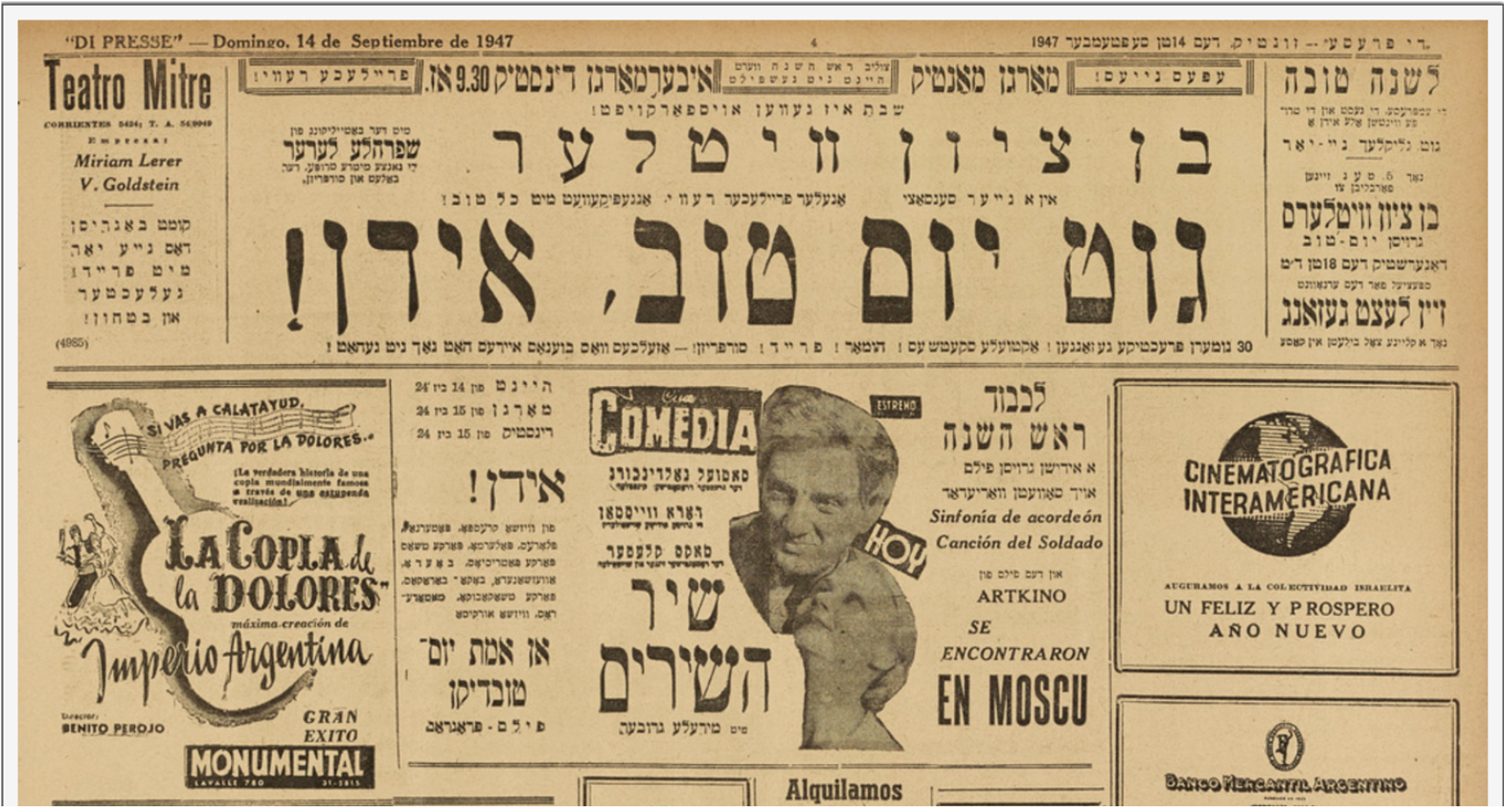
Selected theater and movie ads in Di Prese (Buenos Aires), September 14, 1947. At center: An ad for a screening of Shir ha-shirim, at the Cine Comedia. The movie was shown there twelve years after its initial release. (University of Florida, George A. Smathers Library, Digital Collections)
WALL STREET LAYS AN EGG is one of the most unforgettable headlines in American newspaper history. That was Variety’s reaction to the stock market crash of October 1929, which heralded the coming of the Great Depression. The rapid-talking prose of its news articles is amply reflected in the English version of Kaufman’s scathing review of Shir ha-shirim, too. It’s peppered with Variety-isms like “Yiddish legit” (referring to the professional theater) and “nabe houses” (neighborhood movie houses). A characteristically breezy passage reads: “Sets? Who needs it? Put up a cardboard wall, stick a table here and a chair there; let’s go, boys.” The Yiddish version offers a conversational tone of its own: “Nu, dekor, oykh mir a zakh—shtel avek a vant, un ot do a tir, un ot dort a tish.” No hint, though, of “Let’s go, boys.”
Kaufman’s assessment of Shir ha-shirim might be summarized as follows (the following quotes are all from the English-language article): There’s definitely room in the cinematic universe for Yiddish talkies. But though several attempts have been made, “not once has the trick been turned.” The Yiddish theater “is real theatre,” which “the world can recognize as art.” Rumshinsky is “the No. 1 Yiddish composer” and “Goldenberg is a splendid actor, no denying that.” However, the plot of Shir ha-shirim is so ridiculous that it’s “not believable from the first minute to the last.” The camera work is execrable and the movie’s director, Henry Lynn, “doesn’t belong at the helm of any kind of film.” As for “Rumshinsky’s music—well, it’s just a film, it doesn’t matter, nobody’ll see it, play anything you want boys, one, two, three, let’s go, let’s get it over with.” For Kaufman, the nail in the movie’s coffin was its meager box-office receipts: “On its first showing at the Acme theatre, in the heart of the ghetto, it was jerked after only four days.”
I don’t have a ready explanation for why the editors of Variety saw fit to run its review in the two languages. If the editors’ intention was to prod prospective Yiddish producers and filmmakers to take the cinematic medium more seriously—artistically, technically, and financially—well, the English version alone would have sufficed. Moreover, it seems highly unlikely that running a movie review in Yiddish was designed to expand the newspaper’s readership base. Perhaps this was just a gag “un det’s ol,” as Hymie, one of the operetta’s minor characters, liked to say.
Stylistically, there are subtle contrasts between the English and Yiddish versions of the review: Variety-speak in English, versus standard Yiddish journalese that would not have been out of place in the pages of the Forverts or Morgen Zhurnal. There are subtle differences in content between the two versions as well. The English-language review enumerates several crossover Yiddish stars who “gain[ed] renown in languages other than their own”: “Bertha Kalich, Paul Muni, the Schildkrauts [Rudolf and Joseph], Jacob Ben-Ami, Maurice Schwartz and others [who] gained their start in Yiddish legit.” To these names, the Yiddish version adds Jacob P. Adler, Boris Thomashefsky, and David Kessler. There are also other passages where the texts diverge.
There’s probably no way of determining which of these versions was written first. I’m willing to hazard a guess that Kaufman wrote his review in English and then either rewrote or dictated a more or less faithful Yiddish translation. I suspect that the typesetting was outsourced to one of New York City’s Yiddish dailies or a local Yiddish printing establishment.
Kaufman undoubtedly understood Yiddish, but as far as I can tell he didn’t have any experience writing in the language. He was born in Lemberg, Austria (Lviv, Ukraine), in 1905 and came to the United States in 1913, at the age of eight. As a young man, he spent time in France “in the glamour era of Scott Fitzgerald and Ernest Hemingway” and returned there for good in the mid-1950s. Kaufman was a frequent contributor to Variety during the 1930s and again from the mid-1950s until his death in 1970. In addition to his work as a journalist, he was a publicist, novelist, and talent scout—most notably, for the famous impresario Sol Hurok. According to his obituary in Variety, he was married five times. 6 6 “Wolfe Kaufman, 65, Dies; Hurok’s Paris Rep; Wide U.S. & France Contacts,” Variety, December 2, 1970.
One of Kaufman’s (disputed) claims to fame was coinage of the term “whodunit.” “Wolfie” (as his colleagues affectionately called him) was the first president of the Association of Theatrical Press Agents and Managers (ATPAM) in the U.S. (Ads placed by the ATPAM in the Yiddish press during the 1950s list the officers of both the Association as a whole and its Yiddish subsidiary.) That organization sponsored a luncheon in Kaufman’s memory at Sardi’s Belasco Room following his death.
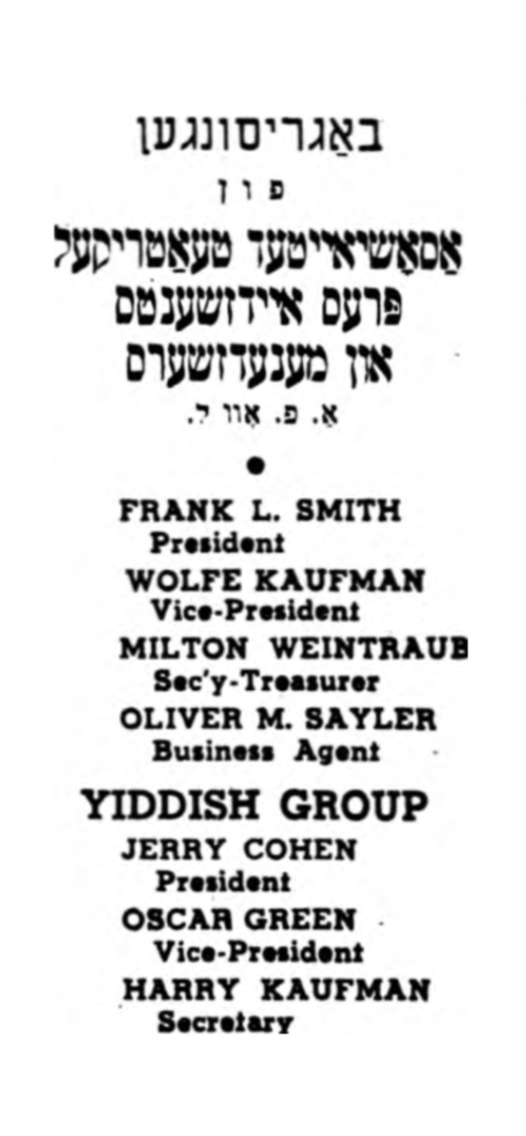
An ad placed by the ATPAM (Associated Theatrical Press Agents and Managers), A.F. of L., in Der Tog (New York), September 4, 1950. Wolfe Kaufman, listed here as Vice-President, was the Association’s first president. (Historical Jewish Press – National Library of Israel)
Because the film of Shir ha-shirim hasn’t survived, we don’t really know how faithful its musical score was to Rumshinsky’s compositions for the stage production. Nevertheless, it might just be the case that Wolfe Kaufman, in his disdain for the movie’s nonexistent production values, unjustly slighted what could have been its most important contribution to Yiddish cinematic history: Rumshinsky’s score for “this first modern Yiddish operetta.”
Indeed, in recent years, Rumshinsky’s work—including Shir ha-shirim—has received renewed attention, which is one reason why this quirky bilingual review may be of interest for the Yiddish world today.
Joseph Rumshinsky has enjoyed something of a vogue during the past quarter century. Between 2005 and 2010, the late music director of the San Francisco Symphony, Michael Tilson Thomas, led concerts with several major orchestras, honoring the legacy of his grandparents, Boris and Bessie Thomashefsky. In these concerts, Rumshinsky’s music occupied a central position. (“The Thomashefskys” was televised by PBS in 2012, as part of its “Great Performances” series. Michael Tilson Thomas posted a video of the broadcast on his YouTube channel.) An operetta with music by Rumshinsky, Di goldene kale (The Golden Bride), was reconstructed by the retired music librarian Michael Ochs, and staged in 2015 and 2016 by the National Yiddish Theatre Folksbiene in New York.
On December 11, 2023, the YIVO Institute’s Sidney Krum Young Artists Concert Series staged a revival of selected musical numbers from the operetta Shir ha-Shirim. Extensive research in the YIVO and UCLA archives (where Rumshinsky’s papers reside) led to the reconstruction of the performance materials by Ronald Robboy, Max Friedman, and Alex Weiser. The 2023 performance by members of the Bard Conservatory Vocal Arts Program was streamed and can be viewed on YIVO’s YouTube channel. And—hot off the press!—yet another Rumshinsky operetta, Khantshe in Amerike, is enjoying a revival as part of the Sidney Krum Young Artists Concert Series. Khantshe’s May 18, 2026, performance is co-sponsored by the American Society for Jewish Music’s Jewish Music Forum, in conjunction with Carnegie Hall’s festival United in Sound: America at 250. All of these efforts pay homage to Rumshinsky’s emergence as a top-notch composer of American Yiddish musicals.
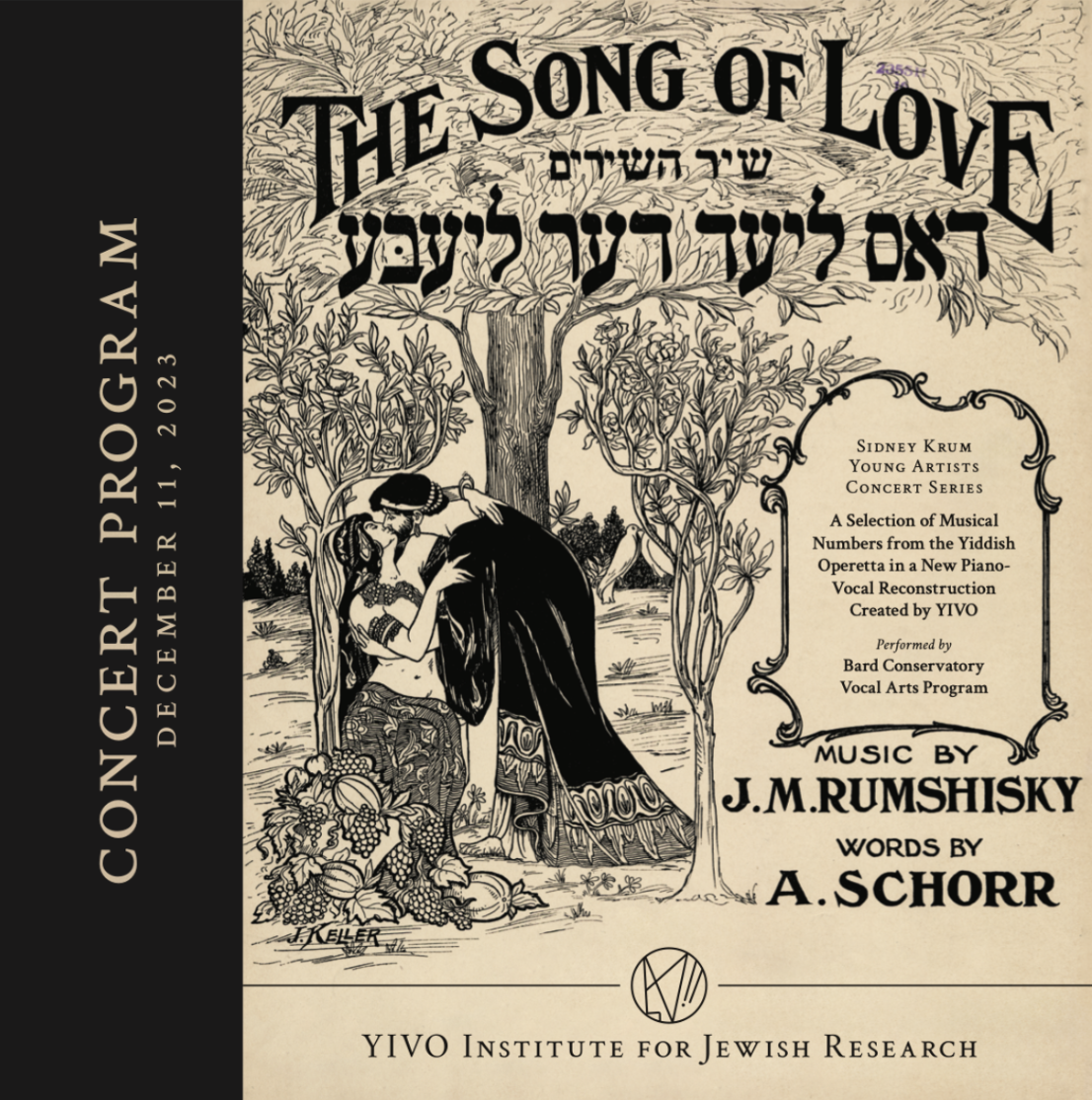
Cover of YIVO’s 2023 concert program for the Shir ha-shirim revival. A PDF of the program book, The Song of Love – Shir ha-shirim: Dos lied der liebe, can be found here.
Now a contemporary critic could view the YouTube production of the 2023 performance and pen their own bilingual critique in snappy razzle-dazzled vernacular if they wanted to. What goes around comes around, I guess, and love and longing are always fashionable in show biz.