Dec 09, 2025
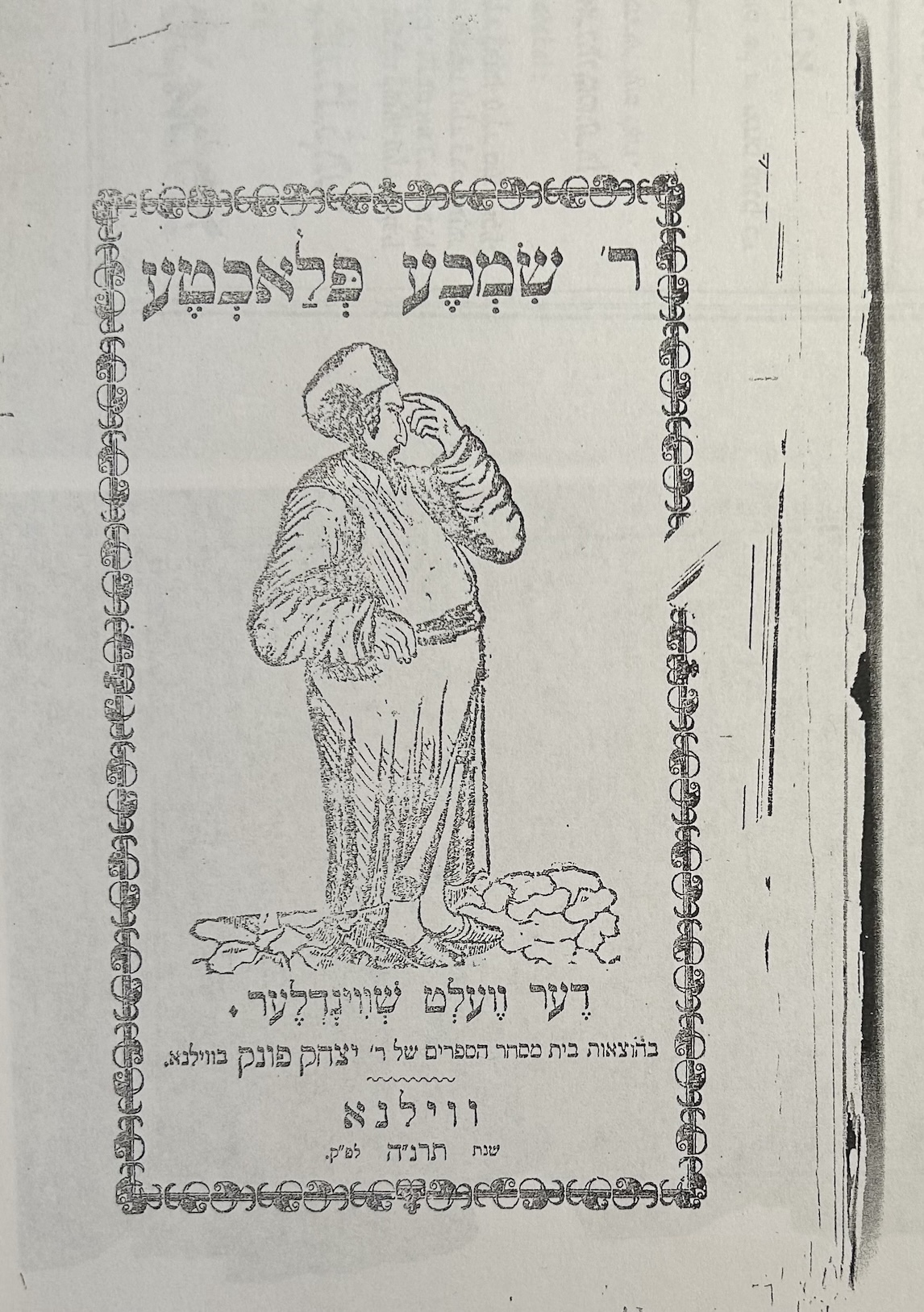
Cover of an original Simkhe Plakhte, or The World Swindler chapbook, printed on onion skin, from the Hebraic Section of the Library of Congress’s African and Middle Eastern Division (AMED)
In my parents’ attic in Cleveland, crammed into cardboard boxes that bow in the middle, is our ever-expanding hand-drawn family tree, along with old photos captioned in languages none of us can read and maps of empires that no longer exist. All the names in the boxes are consonant-heavy, the vowels seemingly inconsequential, every word spelled different ways on different documents. In keeping with Ashkenazi tradition, first letters reappear between generations, passed down like a pair of candlesticks or a sarcastic bent—Shema Wulf becoming Szymon Wolf becoming Stanley Walter (a.k.a. my grandfather, who we all call Bop).
My mom began piecing together our ancestry in her twenties, driven by the desire to help her dad find out more about his own father, Harry Franklyn Morgenstern, who died of a heart attack when Bop was only fourteen. Growing up, tellingly, my grandfather never heard any of his relatives say a nostalgic word about Poland, where Harry immigrated from as a young man. Bop lost touch with his extended family in New York after his father’s premature death. His many questions about who Harry was, and the world he came from, lingered, only intensifying after he married and had two children of his own.
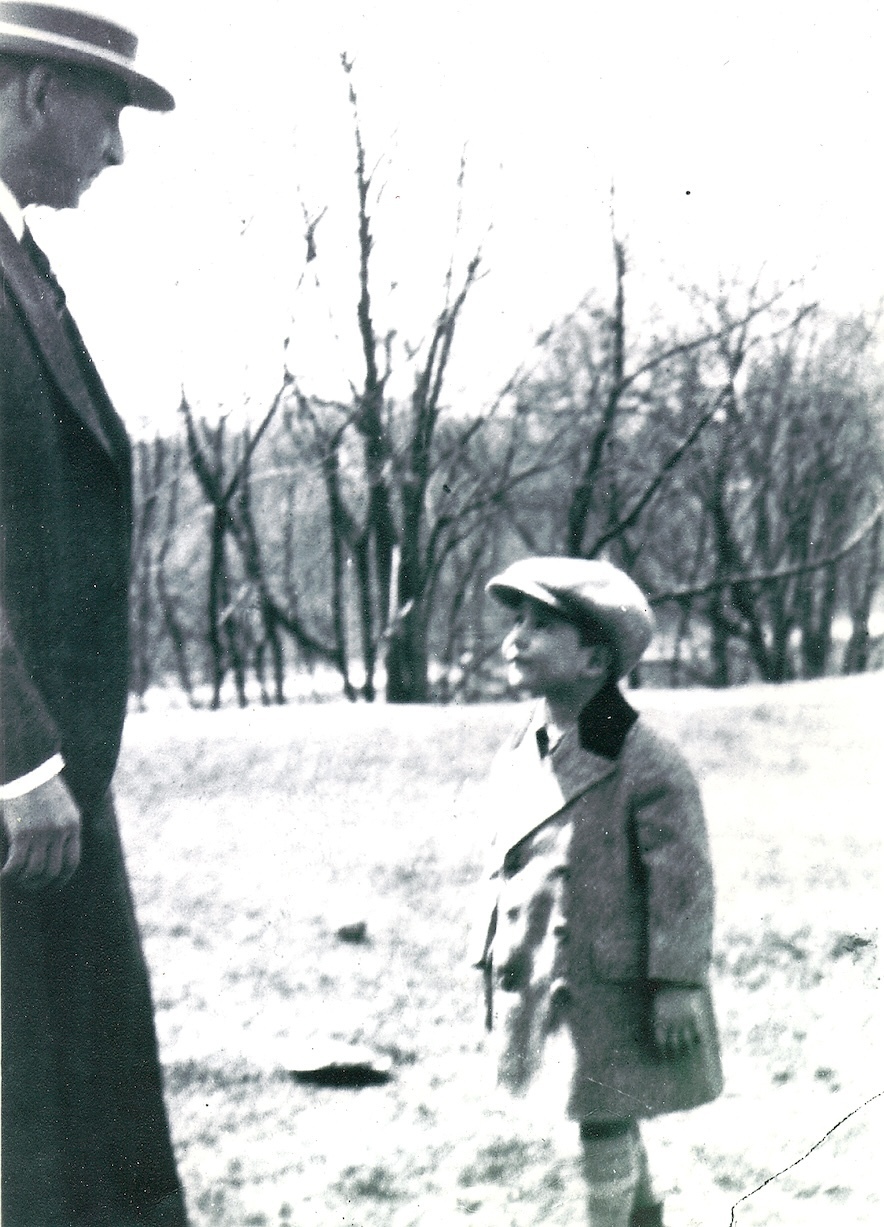
Stanley Morgenstern as a little boy, looking up at his father, Harry Franklyn Morgenstern
*
As part of my mom’s research, she jotted down anecdotes, bits of family lore, and speculation, along with who had told her each story and a note indicating whether or not that person’s gossip could be trusted. One recurring rumor was that we had a relative who was a published Yiddish author of some renown. Bop’s mother, Lulu—who, towards the end of her life, claimed to have both worked for the FBI and been a colonel in Guam—insisted there were copies of his books in the Rivington Street branch of the New York Public Library. A more reliable cousin said she had found some pages of his at the YIVO library. Bop remembered hearing the words “kaczka” and “lehrer” as a child and wondered if they might be pen names. My mom contacted booksellers, professors, and genealogical researchers, trying to unearth more information. All she got back were brief words of encouragement on her quixotic quest.
In 2000, as a high school graduation present, Bop took my brother Peter to Poland to try and find out more about the Morgenstern line. At one point, they came to the gate of the Jewish cemetery in Warsaw, only to find that it was locked. Their guide, Ludwick, bribed the guard with three bottles of vodka, and they were allowed in to wander the premises for a few hours. Many prominent people were buried there, including the writer Y. L. Peretz and a whole section of Morgensterns. But no sign of our family members.
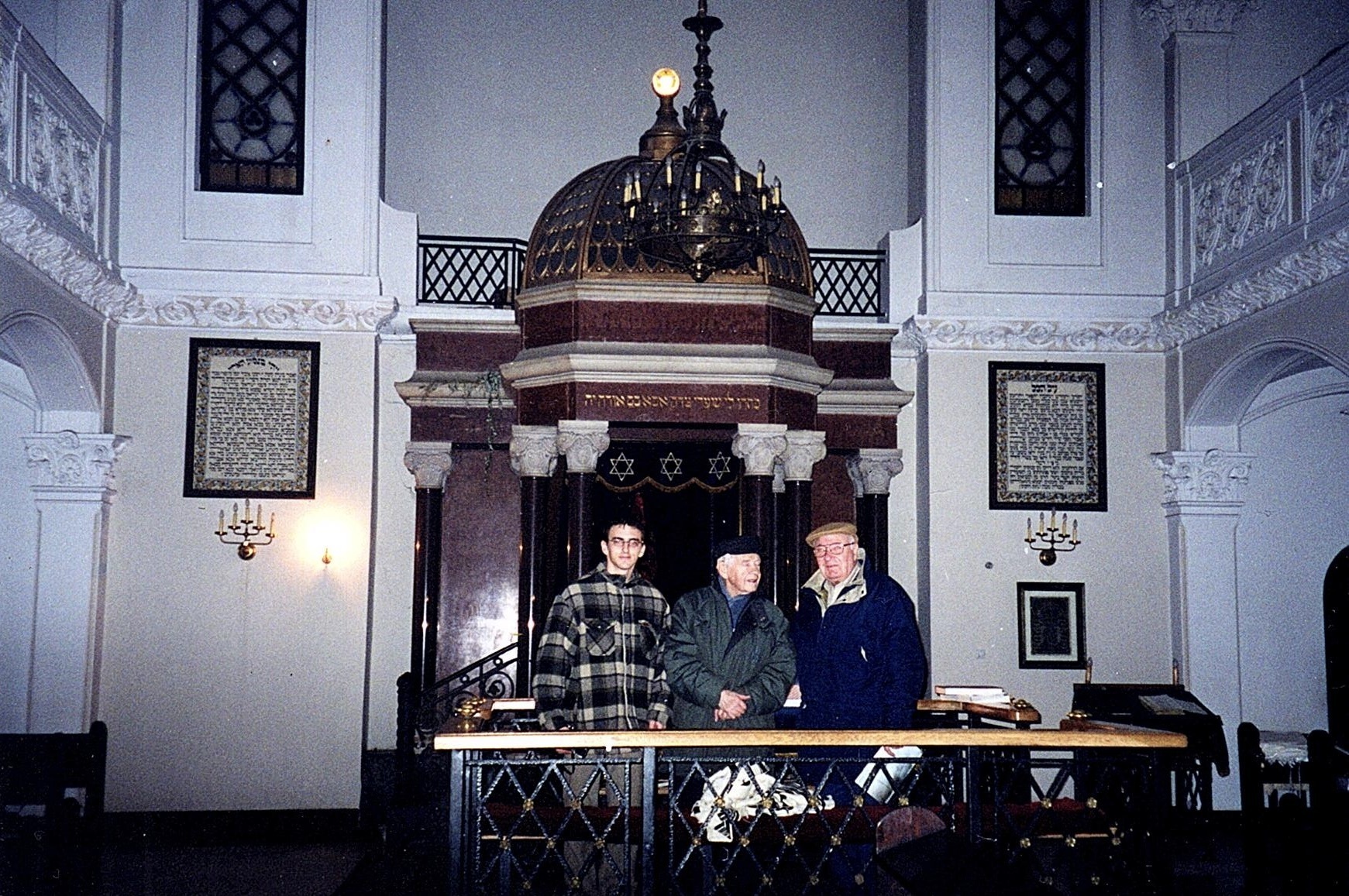
Peter Morgenstern-Clarren (left) and Stanley Morgenstern (right) on a tour of the Nożyk Synagogue, the only still-functioning pre-war synagogue in Warsaw
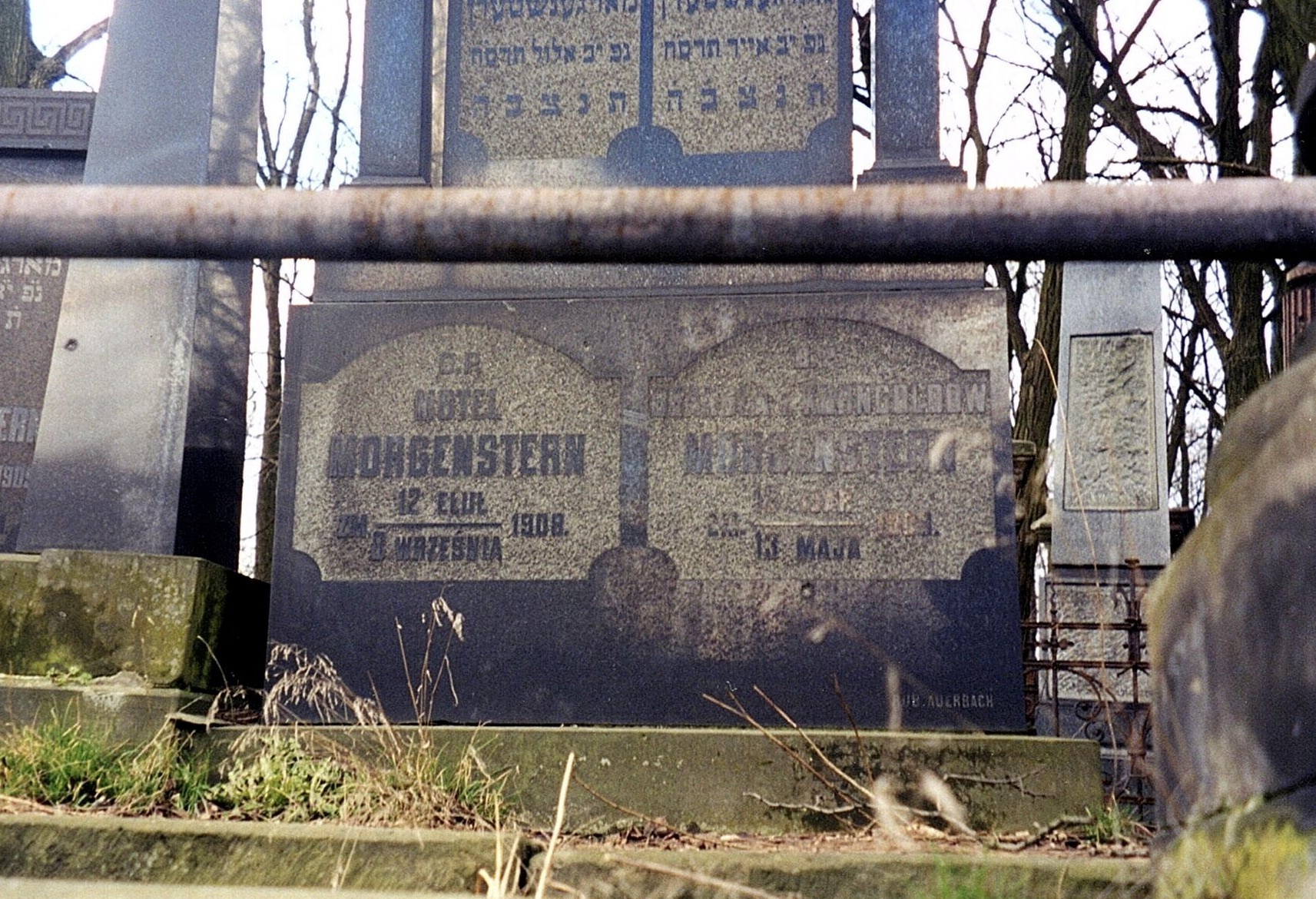
Morgenstern tombstones (no relation) in the Warsaw Jewish Cemetery
*
Sometimes my mom’s investigation would hit a wall and then, reinvigorated by one of my grandfather’s health scares or an unexpected message from a cousin three times removed, she would once again flood my inbox with genealogical details.
It wasn’t until 2010, right after I moved to the city to begin my MFA in poetry and literary translation, that my mom (then a federal bankruptcy judge, and typically reserved in writing), sent me an email that began “Unbelievable!!!!!” A Polish researcher named Gosia, whom she’d hired to try and find Harry’s birth certificate (after Cleveland- and New York-based researchers came up empty-handed), inadvertently located the first evidence of our literary ancestor’s existence. A short but dramatic entry in Andrzej Kempa and Marek Szukalak’s The Biographical Dictionary of the Jews from Lodz described this writer’s personal and professional life. 1 1 Andrzej Kempa and Marek Szukalak, The Biographical Dictionary of the Jews from Lodz (Oficyna Bibliofilow, 2006). But, surprisingly, it said that this man was born a Kaczka. Meaning that we’d had things reversed, and Morgenstern—what my family had been calling themselves for over one hundred years in America—was actually a pen name.
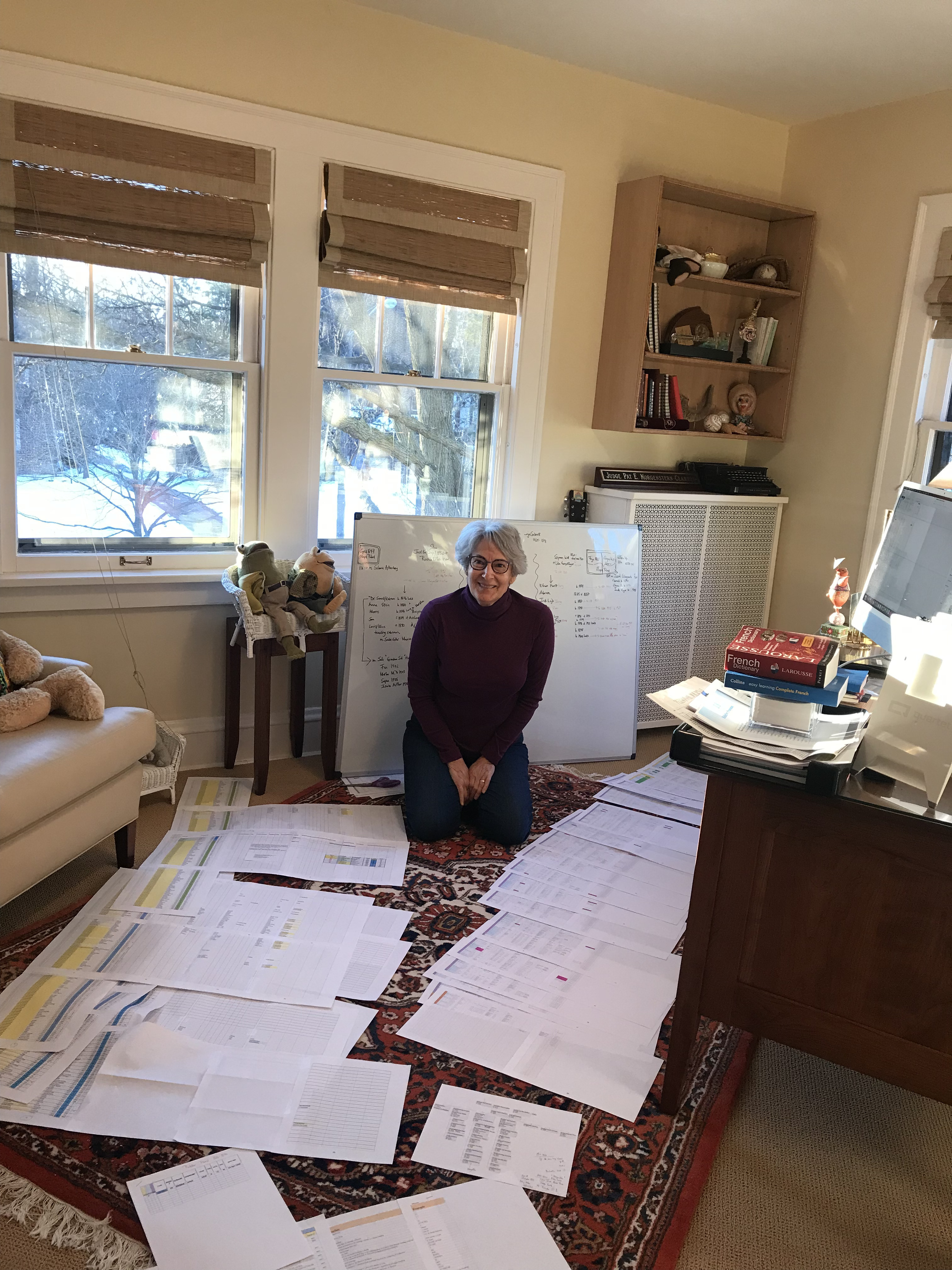
Patti Morgenstern-Clarren in her home office, surrounded by genealogical research
*
Through the bilingual Gosia (who was able to access archival documents from the State Archive of Łódź that had never been translated or digitized before), a portrait of Jacob, and our family’s life in eastern Europe, began to emerge.
I learned that our long-lost writer relative was born into a poor family in Pietrikov (Piotrków), a city near Lodz, in 1820. He attended yeshiva in Leczyca (Łęczyca) and then became a teacher himself, joining the local circle of maskilim. He returned to Pietrikov to marry Laja Goldenrat, a woman described only as a “mute” with “modest parents” in The Biographical Dictionary of the Jews from Lodz and a “deaf-mute from a prosperous home” in Khayim Leyb Fuks’s Lodz shel mayle (Heavenly Lodz). 2 2 Khayim Leyb Fuks, Lodzh shel mayle (Y. L. Peretz Publishing House, 1972). All translations from this book come from Professor Robert Shapiro’s unpublished translation of chapter one, “Yankl Lehrer—The Author of Stories for Plain Folk.” Whatever their true economic status, Laja’s parents had apparently promised to support Jacob’s literary career if he married their daughter—a promise that was broken almost immediately after the wedding.
Straining matters further, Jacob and Laja’s family soon began to grow: seven children survived into adulthood, including Bop’s paternal grandfather, Szymon Wolf. In search of greater opportunity, they moved to Lodz, where Jacob opened the first modern cheder in the area, educating the children of laborers and craftsmen. The job earned him the nickname Yankel Lerer (“teacher” in Yiddish, which explained the other name Bop had remembered hearing as a boy), but not much in the way of income. To make ends meet, Jacob worked as a shadkhn (matchmaker) and a badkhn (wedding jester); he taught maids and cooks to read and write; he wrote letters for Jewish women whose husbands had moved to America, as well as for ones whose husbands and sons had been conscripted into the Russian army. These correspondences were often love letters, I was delighted to learn, written in rhymed verse, and he earned additional money composing wedding poems.
At the same time, despite rejection and hardship, Jacob never stopped dreaming about his own literary career. He didn’t publish his first chapbook, Mayse be-giml akhim (The Story of the Three Brothers), until 1870, when he was fifty years old. He went on to publish many well-received and popular stories, as well as some plays, a few translations of German fiction, and a collection of his Badkhonishe lider (Wedding Jester Songs).
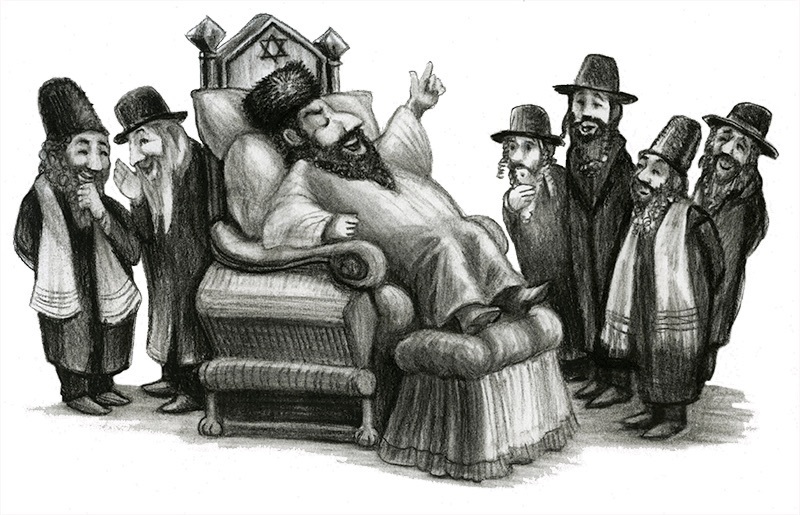
Jacob’s most enduring creation was Simkhe Plakhte, the protagonist of his Hasidic folk satire Reb Simkhe Plakhte, oder Der velt shvindler (Simkhe Plakhte, or The World Swindler) (1880), and its sequel, Der glikhlekher nar, oder Der khaver fun Simkhe Plakhte (The Happy Fool, or Simkhe Plakhte’s Friend) (1882). In the former, through a series of follies, the simple water carrier Simkhe Plakhte, a man on the lowest rung of the shtetl social ladder, is mistaken by a Polish aristocrat for a holy man, a "vunder-rebbe" (wonder rebbe), a zaddik, and much to his and his wife’s delight (and the other Jewish villagers’ dismay) accidentally becomes one of the richest and most respected figures throughout the Polish kingdom. Like many of Jacob’s books, we learned, it is a story of wish fulfillment and fortune reversal. It also, like many of Jacob’s books, pokes fun at everyone from the shtetl elites to the Hasidic rabbis to the Polish aristocracy. His name itself is a joke, of course, as simkhe means a joyful celebration and plakhte is a coarse cloth.
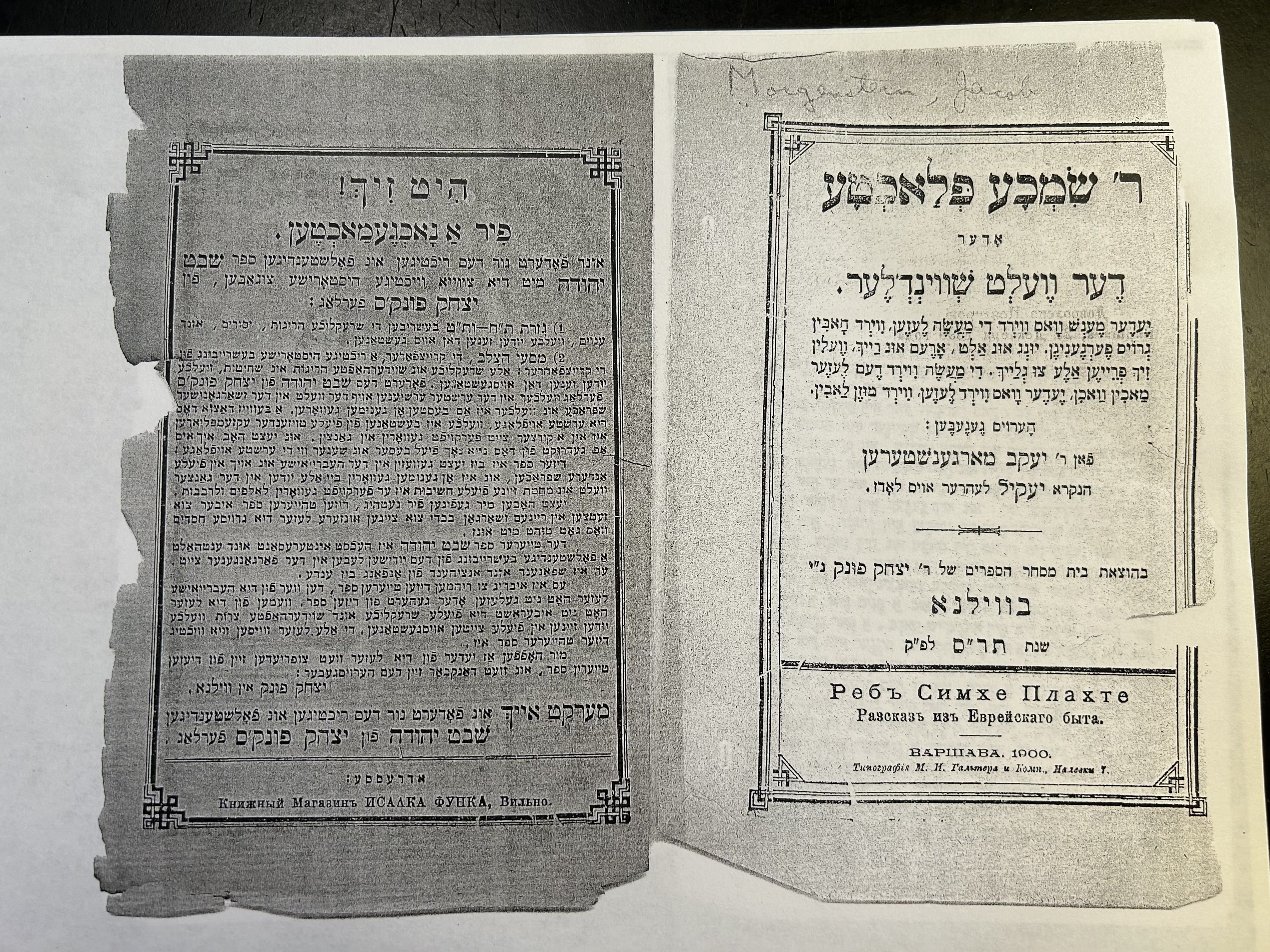
Interior pages of an original Simkhe Plakhte, or The World Swindler chapbook, printed on onion skin, from the Hebraic Section of the Library of Congress’s African and Middle Eastern Division (AMED)
Jacob’s chapbooks—which were known for being entertaining as well as inexpensive—attracted a large readership. His stories were reprinted numerous times, even after his death in 1890. However, Jacob’s publishers often left his name off the covers, intentionally obscuring his authorship in order to cheat him out of his earnings. Worse yet, this erasure meant that already during Jacob’s lifetime many people erroneously believed Simkhe Plakhte to be a Polish Jewish folk tale and not the invention of a specific writer.
In lieu of photos, we have Itzik Manger’s description of Jacob as “the skinny matchmaker with the little rounded beard [and] threadbare overcoat” (in Lazer Lederhendler’s translation, found here), while Fuks says he was a “tall, pale Jew with an eternally sad face.” 3 3 Fuks, Lodzh shel mayle.
Though the details vary slightly depending on the source, by all accounts Jacob lived and died in poverty, his literary contributions overlooked by scholars and critics, and his name today all but forgotten.
*
It is important to note here that even as Jacob the author faded into obscurity, Simkhe Plakhte the character was evolving and reaching new audiences. Yankev Preger adapted the book into a play that was performed throughout the 1930s in Poland as Simkhe Plakhte; then by Maurice Schwartz’s legendary theater troupe in New York, Paris, and London as Der vaser-treyger (The Water Carrier); and as late as 1978 in Montreal, when Dora Wasserman (founder and director of Canada’s only Yiddish theater) directed Simha Plachte at the Saidye Bronfman Centre. Y. Y. Trunk expanded Jacob’s chapbooks into the comedic novel Simkhe Plakhte fun narkove, oder, Der yidisher Don Kikhot (Simkhe Plakhte from Narkove, or the Jewish Don Quixote) (Buenos Aires, 1951), featuring Jacob himself as a character. Similarly, Itzik Manger wrote one of his stories inspired by real Yiddish authors’ lives about how the downtrodden “Yankev Morgenshtern” comes up with the idea for Simkhe Plakhte in the first place, while matchmaking and letter writing (“So many trades, so few blessings,” he mutters, in Lazer Lederhendler's translation) one cold wintry day in Lodz.
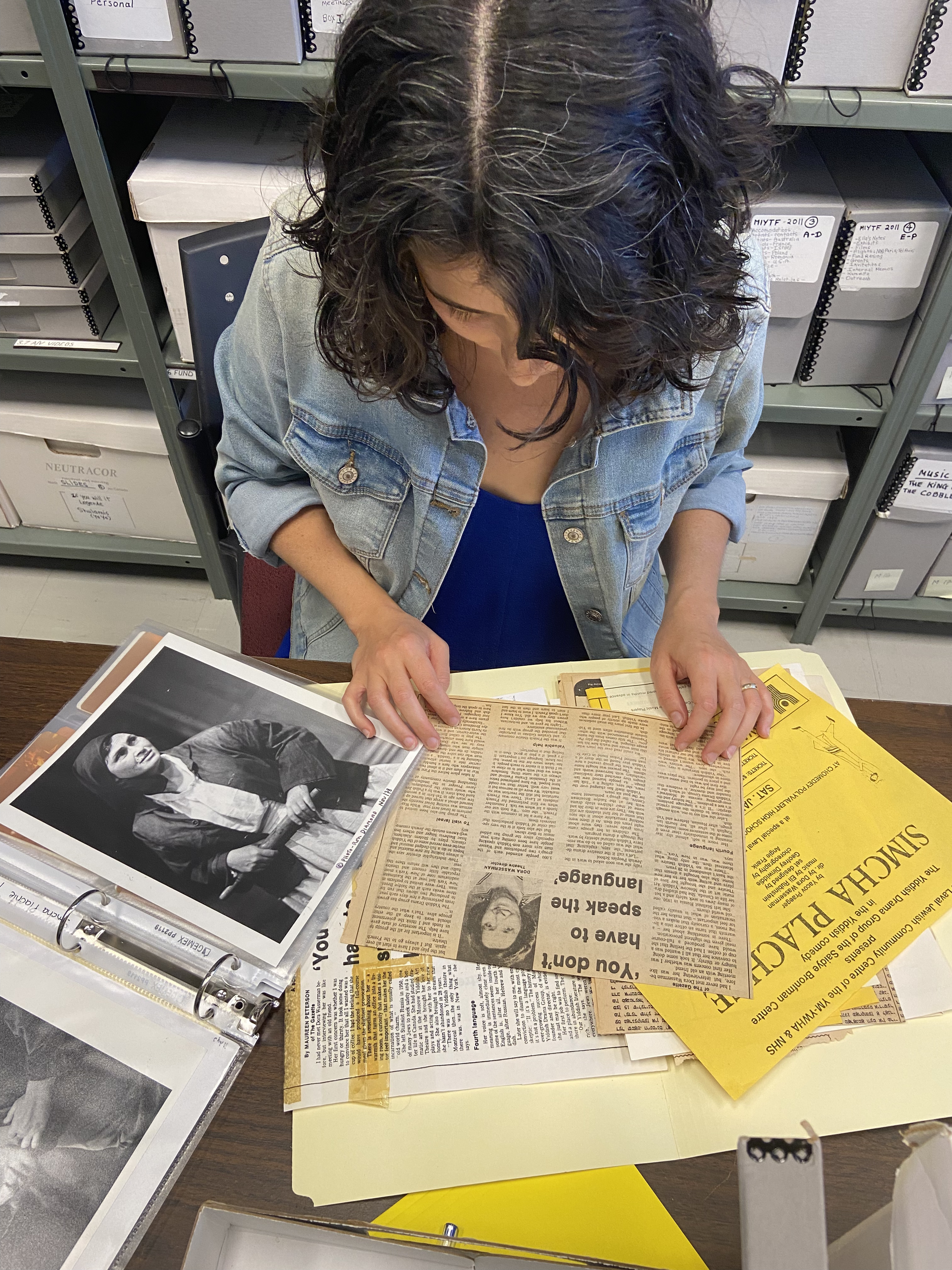
Rachel Morgenstern-Clarren in the Dora Wasserman Yiddish Theatre Archives, looking through materials from the Yiddish Drama Group’s production of Simha Plachte presented at the Saidye Bronfman Centre. Photo credit Sivan Slapak
As my mom was making inroads with Jacob’s backstory, she discovered on WorldCat that Jacob’s surviving chapbooks were held by the New York Public Library (just like Bop’s mother, Lulu, had claimed), as well as YIVO, the National Library of Israel, the British Library, and a host of universities. In many cases, the paper is so threadbare, the stories can barely be scanned. Nonetheless, she was able to locate an intact copy of Simkhe Plakhte, or The World Swindler in the Library of Congress and commissioned its translation for Bop as a Hanukkah gift.
Up until that point, Jacob had been an interesting anecdote to me, Simkhe Plakhte a character in other people’s stories. It wasn’t until I was able to read Jacob’s own words, transported into English by Miro Mniewski, that I could finally hear his voice, which I was taken aback to realize sounded familiar—like family. The writing is cynical and idealistic, fantastical yet keenly aware of reality. Jacob clearly enjoyed pushing boundaries, but at the same time held a deep respect for tradition. He defies easy categorization, drawing inspiration as much from the Talmud as he does from A Thousand and One Nights.
Fuks, who devotes the first chapter of his book Heavenly Lodz to restoring Jacob’s legacy as a pioneer of early nineteenth-century Yiddish literature, writes that Jacob “was admired by both the Jewish poor, the weavers of Baluty who would gather around him and listen to his stories and jokes, and also by the maskilim of ‘Wilke’ [a street or neighborhood in Lodz]." 4 4 Fuks, Lodzh shel mayle. The description evokes my own grandfather’s ability to connect with people from all walks of life. A man who never finished college and who was largely self-educated, he worked his way up from a traveling fabric salesman to the head of his own import business (specializing in silk flowers and ceramics), traveling the world and learning from everyone he could, so that his friends took to calling him “The Professor.”
Jacob was his great-grandfather—a relationship that sounds distant until I look at Bop (now 101 years old) holding my baby daughter on his lap, singing a silly song to her as my four-year-old daughter races around them. According to Fuks, “Even when [Jacob] was already old, he liked to make little jokes and also take a drink." 5 5 Fuks, Lodzh shel mayle. I think of how my grandfather’s stately belly has shrunken over the past few years, so that maybe he is as skinny now as Jacob once was. How his wit, curiosity, mischievous smile, and appreciation for a nice glass of white wine (with a dash of water, “like the Romans”) remain intact.
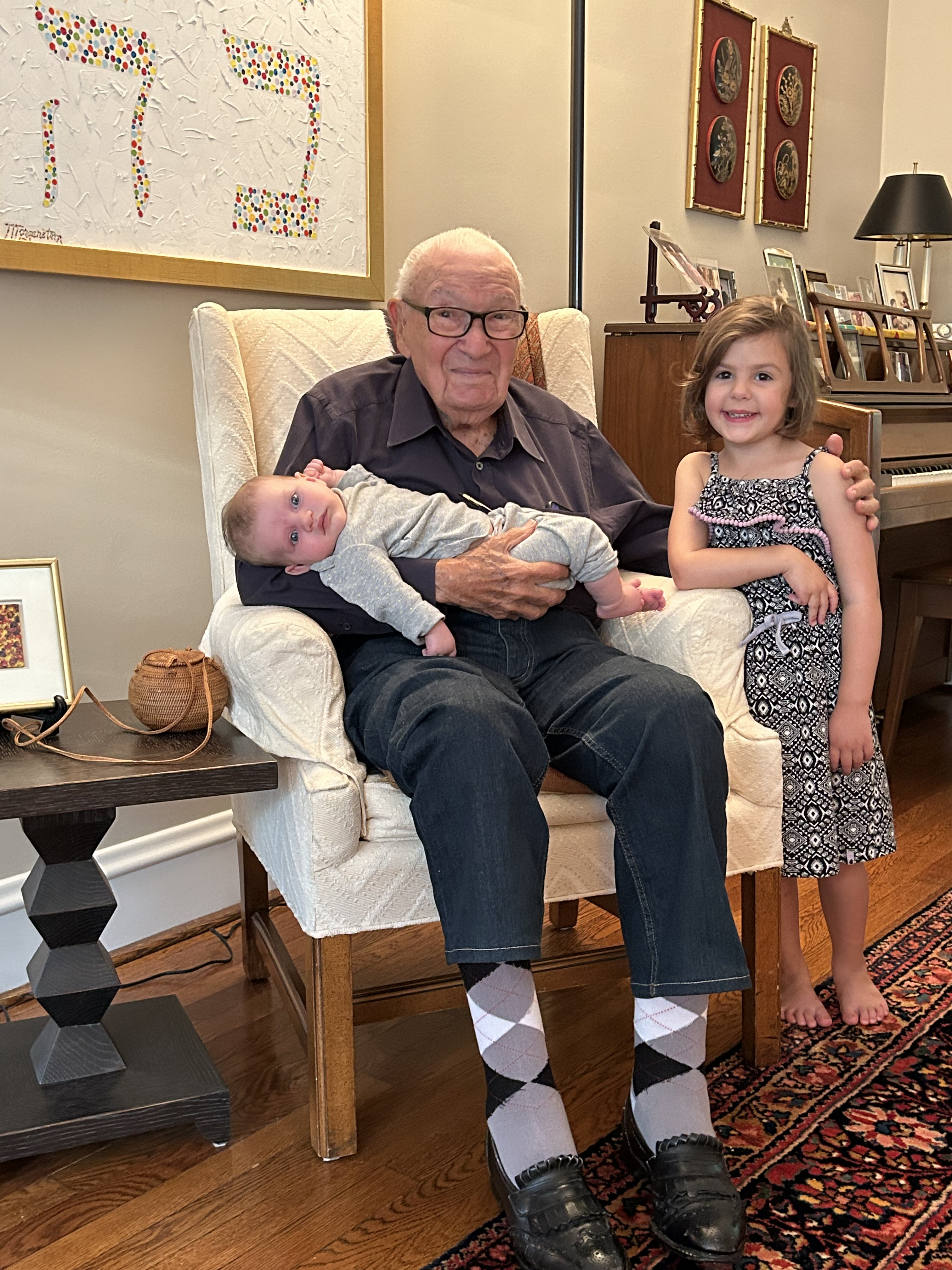
Stanley Morgenstern with his great-granddaughters, Zélia (left) and Margot (right) Morgenstern-Fontaine
*
I write this essay from Montreal, where I joined my Quebecois husband—a writer and translator like myself—a decade ago. In 2017, a few years after my arrival, I had the opportunity to meet translator Miro Mniewski and their archivist wife, Chana Pollack, at a cafe on the Plateau while the couple was visiting Chana’s hometown from New York. They had collaborated on the English translation of Simkhe Plakhte, which made perfect sense, as the Lodz-born Miro came from a secular, culturally Jewish background, while Chana was raised Modern Orthodox. Miro, whose work often revolved around Holocaust memoirs, confessed what a relief it had been to translate something lighthearted and funny.
I thought of this conversation recently as I reread Professor Seth L. Wolitz’s chapter in Polin about Jacob, which explores the continuing relevance of Simkhe Plakhte across different countries, time periods, and genres. Wolitz argues that its longevity is due to the power of nostalgia: the strategically chosen distance between narrator, story, and reader. Every iteration of the comedic narrative takes place in a “fartsaytishn Poyln (long-ago Poland) . . . when ‘lost time’ seemed more stable and ordered, and problems were small.” 6 6 Seth L Wolitz, “Simkhe Plakhte: From ‘Folklore’ to Literary Artefact,” in Polin: Studies in Polish Jewry (Volume Sixteen), ed. Michael C. Steinlauf and Antony Polonsky (Liverpool University Press, 2003), 125. Wolitz explains:
Morgenshtern’s 1880 chapbook is written against the reality of a lost Poland and tsarist repression of both Poles and Jews. Preger’s 1932 comedy indulges in a nostalgia for a lost Polish past at the very time when the Jews of inter-war independent Poland were experiencing economic and social upheaval as well as unprecedented antisemitism. Trunk’s 1951 novel . . .deliberately [confuses] Simkhe Plakhte’s existence in the eighteenth century together with a last evocation of pre-Holocaust Jewish folk life. 7 7 Wolitz, “Simkhe Plakhte,” 125.
This interplay between past and present “forces upon the audience a consciousness that the story was always a wish incapable of fulfillment” and “articulates Proust’s awareness that ‘les seuls paradis sont les paradis perdus.’” 8 8 Wolitz, “Simkhe Plakhte,” 125.
Bop’s paternal grandfather, Szymon Wolf, was killed in a pogrom shortly before he planned to join his sons, Harry and Irving, in New York. Bop’s father, Harry, died of a heart attack in Cleveland just weeks after Germany invaded Poland—where several relatives he was trying to sponsor were trapped. Bop came of age in an American society that was unselfconsciously antisemitic yet characterized by upward mobility and relative safety for Jews. And maybe that's what resonates the most with me today, when that particular era of acceptance and promise is waning and the trajectory of my grandfather’s complex life looks, in retrospect, quite charmed.
What would Jacob, with our family’s characteristic mix of optimism and fatalism, think of today’s world and our shifting place in it? I can easily picture him pulling up a chair at our dinner table after a long day of odd jobs, eager to commiserate and hash it out over a stiff drink.
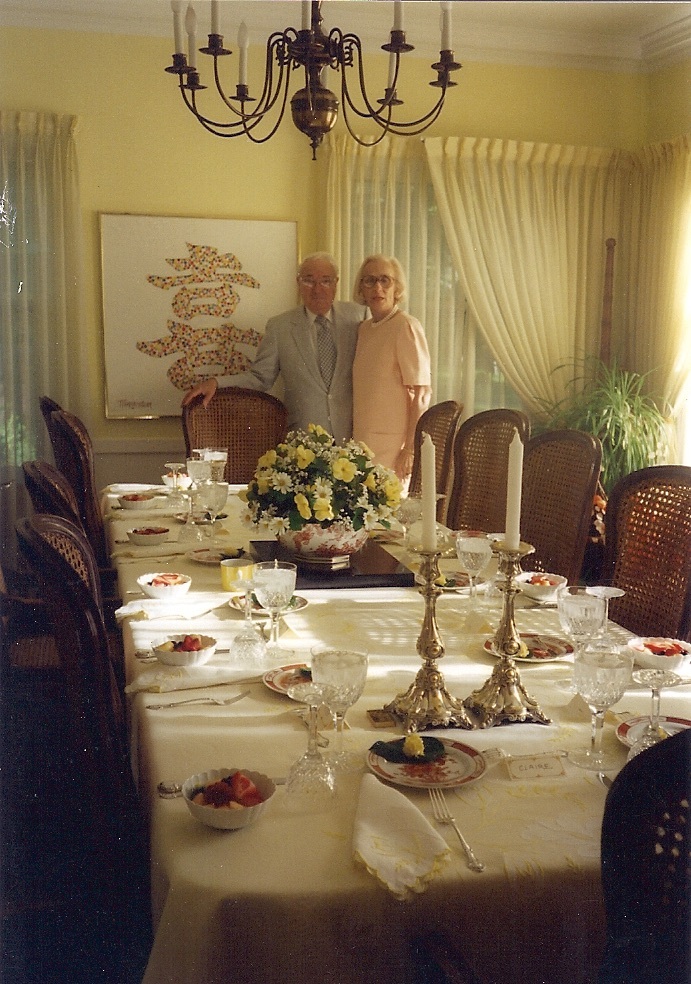
Stanley Morgenstern and his late wife, Claire, at their Shabbat dinner table