Apr 22, 2025
INTRODUCTION
In March 2023, In geveb and Yale’s Fortunoff Video Archive for Holocaust Testimonies announced a call for proposals with the goal of unlocking and activating the Yiddish-language materials in the archive’s nearly 12,000 hours of audiovisual survivor testimony. Together we sought to fund meaningful scholarship and creative productions based on these unique Yiddish oral histories. This blog is one in a series from our 2023 In geveb/Fortunoff fellowship cohort. Each fellow writes about the unique and innovative ways they engaged with the Yiddish-language material housed at Yale’s Fortunoff Video Archive for Holocaust Testimonies.
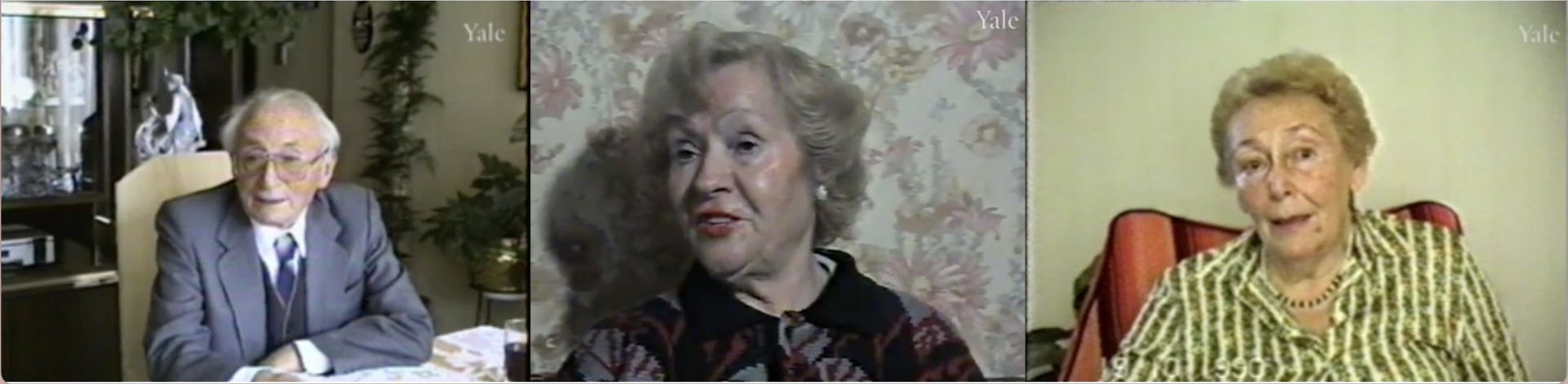
For the Fortunoff/In geveb fellowship, I am developing a teaching guide based on Yiddish oral history testimonies of Holocaust survivors. This blog post offers a glimpse into my ongoing work, focusing on the oral histories of Fiszel Swerdszarf,
1
1
Fiszel Swerdszarf was born in Kraśnik, Poland in 1923.
Sara Proszowska,
2
2
Sara Proszowska was born in Przysucha, Poland in 1918.
and Paja Levín
3
3
Paja Levín (née Wapner) was born in Vilnius, Poland (now Lithuania) in 1921.
(née Wapner). These Polish-born, native Yiddish-speakers were in their late teens or early twenties when WWII began. Despite their varied survival journeys, each eventually established new lives in distant and initially unfamiliar places like Bolivia and Argentina.
The teaching guide will include:
- Survivors’ biographies drawn directly from their testimonies.
- Four analytical frameworks (time, movement, language, and oral history), each accompanied by theoretical background, secondary literature, and examples from the testimonies with time codes and English translations.
- Questions and assignments.
While this blog post is not the teaching guide itself yet, it serves as an introduction to the core ideas shaping its development. Ultimately, the guide will serve as a resource for educators and instructors to explore these testimonies as both historical records and teaching tools. With a structured approach and clear references, the guide will support classroom discussions by offering tailored questions and assignments for college students and future historians. These resources aim to encourage critical thinking, active engagement with the material, and a deeper understanding of the process behind creating oral histories.
Time
According to a recent demographic study by the Claims Conference, published in January 2024, there are only 700 Holocaust survivors still living in South America and the Caribbean, out of an estimated 245,000 survivors worldwide. 4 4 Conference on Jewish Material Claims Against Germany. “Holocaust Survivor Demographic Reports.” Accessed August 20th, 2024. https://www.claimscon.org/demographics/. As the global population of survivors continues to decline, their oral testimonies become increasingly valuable, offering intimate perspectives on history and memory. This prompts questions: Are the experiences of Holocaust survivors who resettled in the Global South different from those who found refuge elsewhere? Are there alternative perspectives through which to interpret their testimonies?
Many interviews focus primarily on Holocaust experiences, often overlooking the details of survivors’ lives in Latin America, as the main purpose of such testimony was primarily to document their pre-war and Holocaust narratives. However, it is crucial to remember that by the time these interviews were conducted in the early 1990s, the survivors had already spent more than half of their lives in Argentina or Bolivia. 5 5 Interviews were recorded in 1990 (Paja), 1994 (Sara), and 1995 (Fiszel). This extended period of residence undoubtedly influenced their identities and frames of reference. Their stories, while anchored in the trauma of the Holocaust, were also interwoven with the cultural, social, and political developments of their new homes.
In this context, I find myself reflecting on the concepts of “time” and “chronology,” especially through the lens of decoloniality, challenging dominant perspectives of “conventional” historiography by embracing alternative temporalities. 6 6 For more on decoloniality and decentering chronologies, see: Katharina Hunfeld, “The Coloniality of Time in the Global Justice Debate: Decentering Western Linear Temporality,” Relational Theory: Feminist Approaches, Implications, and Applications 18, no. 1 (2022): 1–28; Walter D. Mignolo, and Katherine E. Walsh. On Decoloniality: Concepts, Analytics, Praxis, Durham: Duke University Press, 2018; Barbara Mittler, Thomas Maissen, and Pierre Monnet, eds. Chronologics: Periodisation in a Global Context, Heidelberg: Heidelberg University Publishing, 2024; and Sergio Wanderley, and Amon Barros. “Decoloniality, Geopolitics of Knowledge and Historic Turn: Towards a Latin American Agenda,” Management & Organizational History 14, no. 1 (2019): 79–97. Having received my education in Europe and the U.S., I often use terms like “interwar period” or “post-war period” as if they were universally accepted markers of time. However, my research into Latin American history has led me to reconsider this viewpoint. Initially, I assumed that the Jewish experience during and after the war followed a similar trajectory worldwide, marked by a uniform sense of urgency and historical rupture. As I delved deeper, I realized that individuals like Fiszel, Sara, and Paja arrived in regions that were removed from the immediate dangers of the war. These newcomers joined Jewish communities influenced by distinct historical contexts and timelines. 7 7 Determining the actual size of the Jewish population in Argentina during the 20th century presents challenges. The dynamic shifts in Europe’s landscape and borders from 1880 to 1939 complicate matters. Before 1918, immigrants were classified based on their nationality; for instance, Jewish immigrants from Polish territories were often categorized as Russians (from the Russian Empire) or Austrians (from the Austro-Hungarian Empire). The situation clarified after Poland regained independence in 1918. Statistics show that a significant portion of Jewish immigrants to Latin America, particularly Argentina, had Polish origins. For more on Polish-Jewish migrations to Argentina, see: Mariusz Kalczewiak, Polacos in Argentina: Polish Jews, Interwar Migration, and the Emergence of Transatlantic Jewish Culture, Tuscaloosa: University of Alabama Press, 2019; From 1938 to 1941, Bolivia welcomed over 20,000 Jewish refugees, primarily due to the initiatives of Mauricio (Moritz) Hochschild, a German-Jewish mining magnate who utilized his connections with Bolivian President Germán Busch to promote immigration after the Chaco War. For more on Jewish migrations to Bolivia, see: Leo Spitzer, Hotel Bolivia: The Culture of Memory in a Refuge from Nazism, New York: Hill and Wang, 1998. In Argentina, they navigated a political climate shaped by President Juan Domingo Perón's mid-1940s administration, characterized by social and economic reforms and a complex relationship with the Jewish community, while in Bolivia, the Chaco War's aftermath significantly reshaped national identity and influenced the perception and integration of immigrants. 8 8 For more, see: Raanan Rein, Populism and Ethnicity: Peronism and the Jews of Argentina, Translated by Isis Sadek, Montreal: McGill-Queen’s University Press, 2020. In parallel, being removed from the war's devastation fostered the continuation of Yiddish culture in Latin America, enabling it to retain its vibrancy, unlike its fading presence in Europe. By the time the interviews with Fiszel, Sara, and Paja took place, both Bolivia and Argentina had already experienced periods of intense military dictatorship. These regimes were characterized by widespread human rights violations, including disappearances, torture, and repression, leading some to draw parallels with the horrors of the Holocaust in terms of their brutality and impact on society. 9 9 For more, see: Estelle Tarica, Holocaust Consciousness and Cold War Violence in Latin America, State University of New York Press, 2022. The interviews with Paja and Sara 10 10 Sara’s interview took place a month (June 15th, 1994) before the AMIA bombing (July 18th, 1994). took place before the AMIA building terrorist attack in Buenos Aires, a watershed moment in Jewish Latin American history (but two years after a suicide bombing targeted the Israeli embassy in Buenos Aires). 11 11 The bombing took place on July 18, 1994, in Buenos Aires, Argentina, aiming at the Asociación Mutual Israelita Argentina (AMIA), a Jewish community center. This suicide attack involved a van filled with explosives being driven into the AMIA building, leading to an explosion that resulted in the deaths of 85 individuals. Two years before on March 17, 1992, a suicide bombing targeted the Israeli embassy in Buenos Aires, killing 29 people. As I listened closely to these narrators, I came to understand the importance of reframing my perspective on these pivotal moments in Latin American history—not as peripheral or mere background noise to the central event of the Holocaust, but as integral to the narrators’ lives and identities.
Beyond examining historical events on a macro level, these interviews reveal the intimate ways individuals construct and share their life stories. Narration styles vary significantly. For example, Fiszel strictly adheres to a chronological sequence, while Sara frequently shifts between different time periods, and reflects on the past with the knowledge of future events.
12
12
For more, see: Tim Cole, (Re)Placing the Past: Spatial strategies of retelling difficult stories. The Oral History Review, 42(1), 30-49, 2015.
Ultimately, viewing these testimonies prompts us to consider broader questions: do survivors consciously blend their personal memories with overarching historical narratives? Does moving between different time periods help them navigate their trauma, or does it complicate their ability to create a coherent narrative? How do their narration styles influence the audience's understanding? These are the kinds of details and guiding questions I will introduce through the teaching guide.
Movement
I often think about how different scholars understand and use the terms “immigrate,” “emigrate,” and “migrate,” along with the motivations behind their choices. These terms do more than define movement—they reflect distinct perspectives on human migration and its causes. I also find myself questioning how Holocaust survivors should be classified: are they migrants, refugees, or a combination of both? 13 13 Many Holocaust survivors may be classified as both refugees and migrants because their initial flight from Europe was due to persecution (making them refugees), while their later resettlement efforts can be seen as migration in search of stability and a better future.
A large amount of the academic literature on migrations tends to center on immigration, focusing primarily on the dynamics and conditions within receiving countries. However, the nature of the interviews allows for a deeper understanding of the narrators’ country of origin. For example, Sara’s recollections of the street she grew up on in Łódź, Fiszel’s formative experiences in a yeshiva in Janów Lubelski, and Paja’s vivid memories of life in Vilna. As a Pole, I find it particularly fascinating to delve into the emotions that the narrators express toward Poland. For example, at the end of the interview, Fiszel was asked if he had ever returned to Poland after settling in Bolivia. He replied:
“No, never. Maybe one day, but probably not. Why would I? What's left for me there to see? I've even forgotten my Polish. I'd rather go to Punta del Este [holiday destination in Uruguay].” 14 14 Videocassette 2, Segment 14
By the time the narrators left or were forced to leave, they were in their late twenties or early thirties—an age when one's sense of identity and belonging is usually already significantly shaped. At this stage of life, people typically have a clear connection to their community and cultural roots, yet for these individuals, their ties to Poland were deeply disrupted by the circumstances of the war and its aftermath. What strikes me most is the ambivalence in their reflections—how they navigate the tension between a sense of belonging formed during their youth and the alienation brought by the displacement.
In my scholarly work, I prefer to use the term “migrate” because it captures the dynamic process of movement. Sara was born in Przysucha and, at the age of 10, relocated with her family to Łódź. She endured the horrors of the Łódź ghetto and later survived both Auschwitz and Bergen-Belsen. After the war, she was transferred to the Zeilsheim Displaced Persons (DP) camp and later spent 4.5 years in Belgium. In 1951, following a brief stop in La Paz, Bolivia, she finally settled in Argentina. Before Fiszel built his new home in South America, his journey also took him through several locations. He first moved from his hometown of Kraśnik to Janów, and during the war, he endured forced labor and concentration camps in Budzyń, Mielec, Wieliczka, Flossenbürg, Leitmeritz, Mauthausen-Gusen, and Linz. After the war, he spent a year in a DP camp in Modena, Italy. From there, he obtained a visa and traveled to Paris and Cherbourg, where he boarded a ship to Brazil before finally flying to Bolivia. Meanwhile, Paja grew up in Vilna and survived the early years of the war in the ghetto there. From Vilna, she was transferred to the Kaiserwald/Strasdenhof camp near Riga, where she spent a year. Afterward, she was moved to the Stutthof and Burggraben camps. Severely injured, she was eventually taken to a hospital in Moscow, where she spent six months recovering and learning to walk again. With assistance from the Bund, she made her way back to Vilna and then to Łódź. From there, she traveled to Paris via Warsaw, where she stayed for a year. Though she had hoped to immigrate to the U.S., in 1949, after passing through Italy and Montevideo, Uruguay, she finally arrived in Buenos Aires.
Here, the concept of “migrations” extends far beyond the simple act of physical relocation from one place to another. It encompasses the complex, ongoing transformations individuals face during their journeys. These transitions are multifaceted, involving not only movement but also emotional, psychological, and social adjustments, reflecting the realities of migratory processes. For narrators, they often serve as important reference points, helping them frame their stories and mark significant moments in time. Moreover, in Holocaust narratives, researchers gain insights into the conditions of specific locations because narrators tend to draw comparisons between them. Such comparisons can illustrate aspects like living conditions, treatment by guards, access to resources, etc. thereby deepening the understanding of the different levels of suffering and survival experienced in various camps, ghettos, or hiding places.
The map below illustrates each survivor’s journey. This visual representation raises many questions: Why are there no country borders? What is the significance of this boundaryless representation in the context of migration and history? Should the map reflect the names of places as they were known during the survivors' experiences—using German names, original names, or contemporary ones? Additionally, what are possible ways to enhance such visualizations to better convey the emotional and experiential aspects of these journeys? Including such a map as part of the teaching guide will prompt student discussions about space, boundaries, and what it means to traverse them.
Language
Throughout my undergraduate and graduate studies, one statement was echoed time and again: “If you want to study the Holocaust, you must know Yiddish.” Yiddish was the primary language spoken by most Jewish victims, and many testimonies and firsthand accounts from that time were recorded in it. Ironically, despite their importance, these testimonies are often underutilized because few researchers, and even fewer members of the general public, can understand Yiddish today. As a result, many of these narratives remain inaccessible, tucked away in archives, and overlooked in scholarly discussions. This language barrier risks silencing the voices of survivors and victims, whose stories are essential to understanding the full scope of Holocaust history.
Jews, however, have always lived in multilingual environments. While the analyzed interviews were primarily recorded in Yiddish, fully appreciating their depth also requires knowledge of Spanish and Polish. For instance, Sara attempts to explain the meaning of the Polish word “[sklep] spożywczy” (grocery store) to the oral historian who does not speak Polish. When Sara references specific dates or months, she switches to Spanish. Fiszel is asked questions in Spanish at several points during his testimony. Despite the use of Spanish in these interactions, he quickly and almost instinctively reverts to Yiddish. When he references antisemitism in Poland, he uses the Polish term “Endek,” which denotes a member of the pre-WWII National Democratic Party, historically known for its antisemitic stance. Paja begins her interview in Spanish but soon makes a deliberate choice to continue speaking in Yiddish.
The testimonies leave us uncertain about the motivations behind the narrators' choice to speak Yiddish. Was it a conscious decision reflecting their desire to express themselves in a language that resonates most deeply with their experiences? Did the oral historian encourage this choice? How does speaking Yiddish shape the emotional tone of their narratives? What impact does the language used have on the interpretation and reception of their narratives?
Furthermore, these oral testimonies provide a wealth of material not only for Holocaust historians but also for those interested in studying linguistic aspects of Yiddish, such as its dialects. Yiddish, whether as a language or a component of language politics, does not emerge as a theme in these interviews. However, Paja references her interactions with Abraham Sutzkever and Szmerke Kaczerginski, and Sara mentions her bilingual upbringing, which may be seen as a reflection of Yiddish culture and its wider importance.
In the teaching guide, I will emphasize the crucial role of language in shaping the testimonies, exploring how linguistic choices convey meaning, emotion, and cultural context. Additionally, I will propose strategies for integrating Yiddish learning into the analysis.
Download Assignment 2
Oral History
In analyzing the testimonies, my approach has been profoundly influenced by my work as an oral historian for the Yiddish Book Center's Wexler Oral History Project. This hands-on experience has provided me with a deeper understanding of the complexities and subtleties inherent in oral history work. It has encouraged me to adopt a more critical lens toward the field, particularly regarding the extensive resources and time required for the entire process—from arranging interviews to making them publicly accessible. This endeavor necessitates not only building strong networks with potential narrators but also engaging meticulous professionals who are often multilingual and adept at navigating diverse cultural contexts. Their critical thinking skills and foresight regarding the needs of future researchers and audiences are vital for ensuring the interviews are both accessible and useful.
During my analysis of the three interviews in this study, I paid close attention to various elements, such as camera angles, the narrators' clothing, their surroundings, and the presence or absence of personal artifacts. I also examined their body language, pauses in speech, and other cues. I scrutinized how the interviews were indexed, questioning whether any aspects might have been overlooked that could hinder the accessibility of these oral testimonies. These observations were complemented by my curiosity about the role of oral historians, in this case, well-known scholars, Marianne Hirsch
15
15
Marianne Hirsch is an American literary scholar known for her work on trauma studies, memory, feminist theory, and photography. She coined the term “postmemory,” which describes the way in which the experiences of previous generations shape the memories and identities of those who come after them, particularly in the context of trauma. For more, see: Marianne Hirsch, The Generation of Postmemory: Writing and Visual Culture After the Holocaust, Columbia University Press, 2012.
and Leo Spitzer
16
16
Leo Spitzer is a cultural and comparative historian specializing in memory studies. He explores both individual and collective reactions to colonialism and exclusion, as well as themes of Jewish refugee memory, trauma, and its transmission. He was born in Bolivia to parents fleeing Nazi persecution in Austria and grew up in La Paz within a community of German-speaking Jewish refugees. For more, see: Leo Spitzer, Hotel Bolivia: The Culture of Memory in a Refuge from Nazism, New York: Hill and Wang, 1998.
(Fiszel) and Abraham Huberman
17
17
Abraham Huberman was a graduate of the Hebrew University of Jerusalem and a professor specializing in Jewish history. He organized the first collection of Holocaust survivor testimonies in Argentina as part of a global documentation effort. For more, see: Wanda Wechsler, “Un Museo del Holocausto en Buenos Aires: Contexto de creación,” Hamsa 5 (2019).
(Paja and Sara), and how they engaged with narrators through their questioning techniques and interactions.
Moreover, the process of revisiting and rewatching these testimonies, interpreting their nuances, and piecing together the broader context significantly enhances empathy toward the narrators. This emotional engagement is precisely what makes oral histories such powerful tools for education and scholarly research. Therefore, I advocate that academics embrace their emotional responses when engaging with these sources. Reflecting on these feelings helps with the analytical process and does not undermine objectivity. Rather, it introduces vital human sensitivity, which is particularly significant in Holocaust testimonies, where the scale and complexity of events can render them difficult to comprehend. Focusing on individual experiences enhances the audience's understanding of the deep trauma and resilience involved, making the narratives more impactful.
In this section of the teaching guide, I will highlight the labor behind oral histories, including the efforts of interviewers, survivors, and production teams. Students will be encouraged to reflect on their emotional responses to the testimonies and consider how specific choices—such as subtitles, indexing, or metadata tagging—can enhance accessibility, make the content more searchable, and ensure its usability for diverse audiences and future research.
Next steps
I am continuing to develop the teaching guide, aiming to use these four analytical categories to support instructors in presenting the material to their students. My hope is to inspire students to critically engage with the content while enhancing their understanding of the Holocaust, oral history practices, and Yiddish source material.
-------------------------------------------
The full testimonies can be accessed here:
In geveb is turning t(s)en! We need your help to launch our second decade and help In geveb to continue to grow and thrive and remain a central address for the study of all things Yiddish online. Our goal is to raise $20,000 by our official tenth birthday: August 15, 2025. We invite you to donate to support In geveb and to honor everyone who has got us this far.