Jan 22, 2026
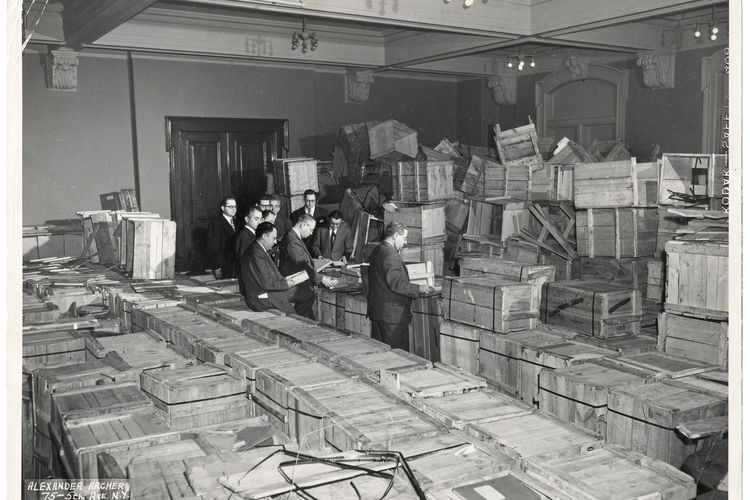
Leaders of the New York-based YIVO open crates of salvaged materials from Europe in 1947 at the Manischewitz matzah warehouse in New Jersey. (YIVO Institute of Jewish Research)
Guest Editors: Stefanie Halpern and Melanie Meyers
Over the past several decades, archival studies has emerged as an important scholarly field concerned not only with the preservation of historical materials but also with probing the theoretical, ethical, and ideological role of archives in shaping how we understand the past. Though much has been written on topics relating to various minority archives, Yiddish archives have often been under-described and under-theorized. We are seeking submissions for In geveb’s peer review, pedagogy, translation, and blog sections from scholars, archivists, special collections librarians, artists, musicians, and other practitioners whose work intersects either directly or conceptually with Yiddish archives.
In addition to academic articles for the peer review section, we will also accept case studies of specific archival projects that speak to the practical considerations of working with and making collections of Yiddish language, literature, and culture accessible. Case studies should include background information, analysis, and implications for a broader audience.
Topics of interest include (but are not limited to) some of the following:
Creating the Yiddish archive
- Object gathering, conscious collecting, and auto-archiving
- Absences in the archival record
- Provenance and questions of authenticity
- Anthology as archive
- Partnerships between organizations, both domestic and international, spanning historic and contemporary time periods
Caring for the Yiddish archive
- Acquisition and appraisal of collections (contemporary and historic)
- Translating culturally specific terminology and concepts in descriptive metadata and museum displays (both contemporary and historic)
- Ethical dilemmas in the archives
- Collections at-risk due to environmental, economic, technological, or institutional factors, and preservation strategies for responsible stewardship
Recovering the Yiddish archive
- Destroyed archives and the possibility of reinvention
- Orphaned collections
- Restitution
Performing the Yiddish archive
- Traces of performance in the archival record
- New works that have come from the archive
- Historic recreations of works found in the archive
The Yiddish archive and the creation of community
- Yiddish archives as community archives
- Yiddish archives in place of Yiddish community
- Yiddish collections at non-Jewish institutions
The Yiddish archive in the digital age
- The use of AI as a tool for access, including creation of metadata and the possible implications of that shift
- Digital humanities projects
- Digital gathering of dispersed collections
For our translation section, we are specifically seeking translations of letters, diaries, memoirs, etc. written by archivists, librarians, collectors, and researchers working with/for/in institutions that have historically collected and housed Yiddish archives. We will also accept translations of historic mission statements, manifestos, informational pamphlets, and other types of literature that address ideas regarding collecting.
For our pedagogy section we are interested in reflections on new initiatives that use archival sources as a way to teach Yiddish language, literature, and culture. Lessons plans and teaching guides that are meant to teach archival literacy alongside topics in Yiddish language, literature, and culture are also encouraged.
Those interested should send a biography (100 words) and abstract (500 words for peer-reviewed articles and case studies; 300 words for blog posts and translations) to [email protected] copying [email protected] and [email protected] by March 6. Any questions can also be directed to these email addresses. Contributors chosen to be part of the issue will be notified by March 23. There will be a full draft submission deadline of early January 2027 and publication in fall 2027.