Apr 15, 2026

INTRODUCTION
This piece is part of a series of reflections celebrating the 10th anniversary of In geveb’s publication. Biz hundert un tsvantsik, In geveb!
I’ve got abundant memories and impressions of In geveb, as a reader and writer and translator, but the two that stand out both have to do with politics, and both teach the same lesson: that In geveb is a place where what I would call rigorously progressive political ideas are not just welcome but obligatory, as they should be. In at least some other Yiddishist spaces, those ideas seem alien, though many of the Yiddishists involved are as progressive as can be in other parts of their lives.
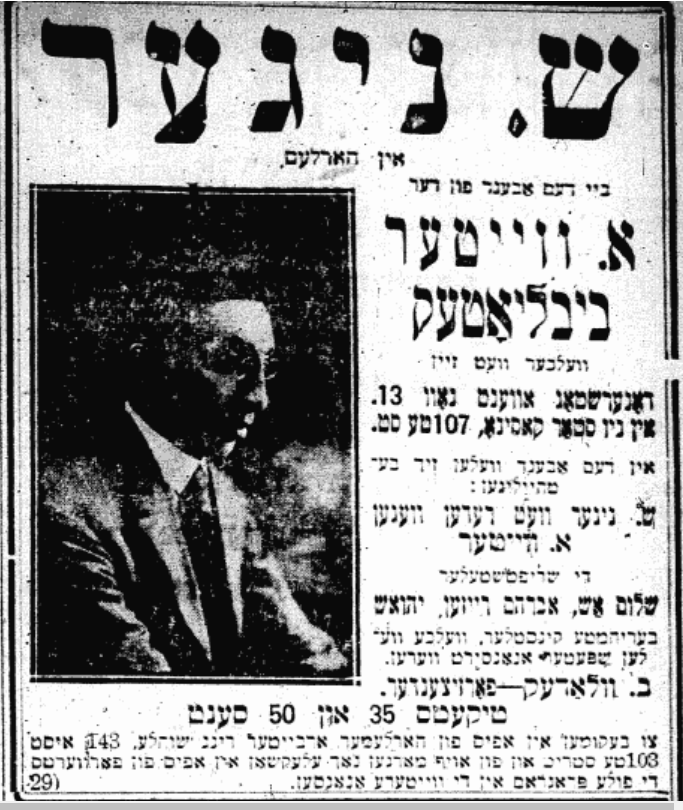
I became aware of this first by way of Eli Bromberg’s 2019 article, “We Need to Talk About Shmuel Charney.” Until I read that article, I’d been an unthinking user of Charney’s pen name Der niger, somehow barring from my Yiddishist consciousness everything my political consciousness knew about racial epithets—a task I found all too easy, a cognitive dissonance I hardly noticed—until I read Bromberg’s article, and all the boundary walls came falling down.
I became aware of this again, and still more forcefully, in 2020, by way of some readers’ comments on an essay I’d submitted, about the New York passages of Sholem Aleichem’s Motl the Cantor’s Son. I like to think of myself as having rigorously progressive ideas; but the comments, bearing on my too-vague account of Sholem Aleichem’s racist language for describing African Americans, and on my irresponsible silence about the sexist and voyeuristic aspects of lines I’d quoted from a poem by Moyshe-Leyb Halpern, showed me clearly that in writing the essay, in the Yiddishist spaces I frequented and imagined, I hadn’t let those ideas influence my writing anywhere near enough.
I didn’t, as it happened, revise and resubmit the piece; other tasks intervened. But I’m grateful for what I learned from the comments, and grateful to In geveb for teaching these principles, then and now, to me and I’m sure to others. Floreat in aeternum, as one might say in Latin, may it flourish forever!—or at least till a hundred and twenty.