Nov 28, 2023
INTRODUCTION
The days are getting shorter, there’s a chill in the air, and many Jewish Studies scholars are counting down the days until the annual conference of the Association for Jewish Studies. This year, the conference will take place in San Francisco from December 17 to 19.
If you are planning on attending the conference, we at In geveb are looking forward to learning with and from you, and we are pleased to offer this guide to Yiddish at AJS, aimed at helping you navigate the conference with Yiddish in mind. If you can’t make it, our hope is that this guide will make it easier for you to know what others are working on and to forge connections with scholars whose work contributes to Yiddish studies, even when those connections happen outside the conference itself.
This guide contains papers on topics related to Yiddish Studies, organized around session day/time. If you notice something we’re missing, please email us! We hope that you will discover, as we have, that our field is varied and fresh, full of new ideas and enriched by scholars working in a variety of positions and disciplinary backgrounds. If you are one of the presenters included here, we hope you will consider submitting your work to In geveb for publication!
We also want to highlight the events In geveb has organized and is participating in, and to encourage you to use them as an opportunity to meet us. In geveb aims to be a resource for Yiddish Studies in the broadest sense, which means that if you work with Yiddish and we don’t know you yet, we want to. We look forward to seeing you at the conference! If you will not be at the AJS but would like to connect with our editors, please email us to schedule virtual office hours.
WHERE TO FIND IN GEVEB AT AJS
As in past years, In geveb will host an informal kave-sho at the conference.
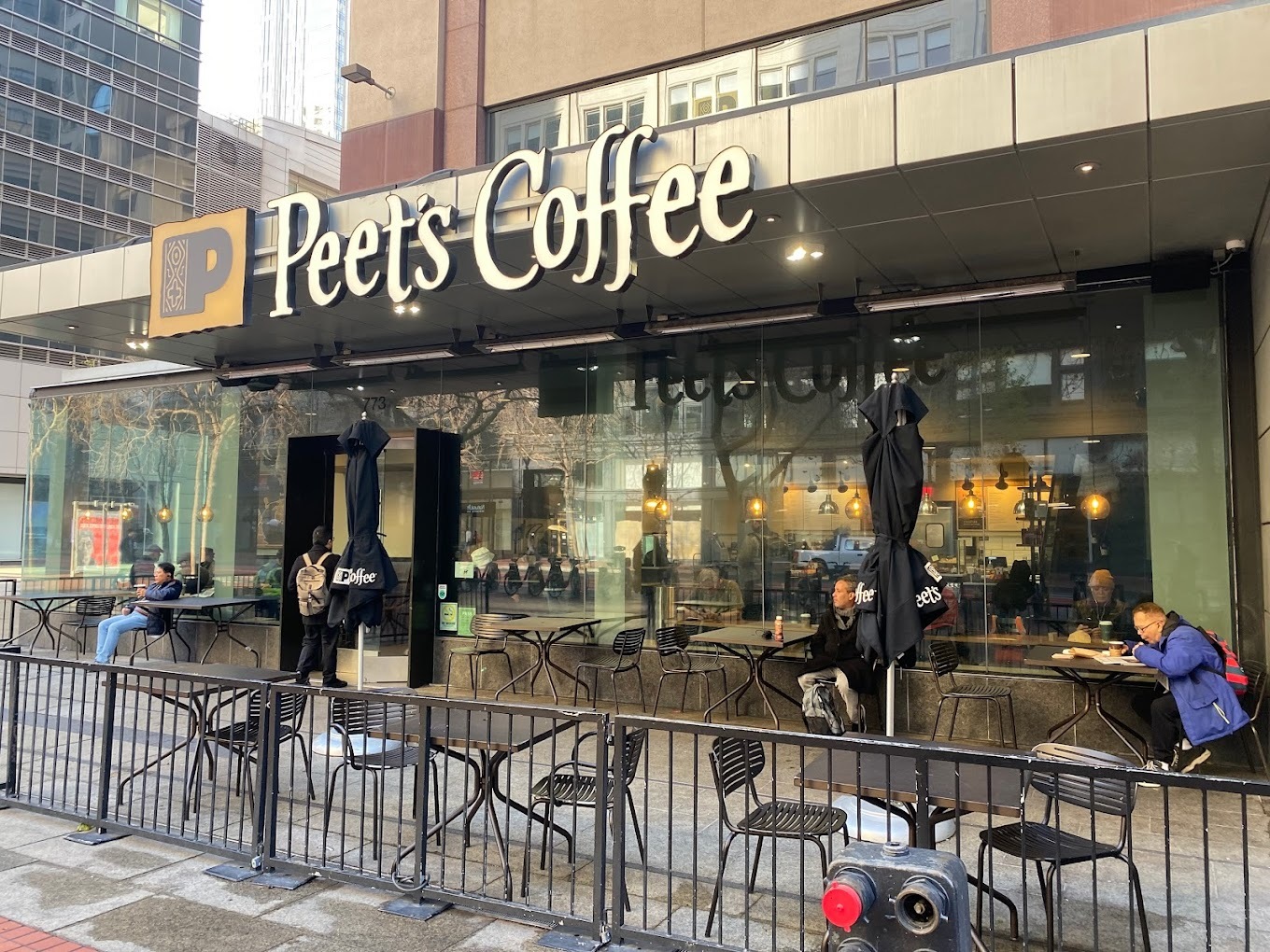
This year we will meet up bright and early at Peet’s Coffee at 773 Market St from 8:30-9:30 AM on December 17. We will be there to gather and talk informally - feel free to share with us your ideas about what you might want to contribute to In geveb, tell us your favorite pieces or what you’d like to see more of, or just introduce yourselves to us and to one another. RSVP is not necessary, but feel free to let us know you’re coming via our Facebook event.
This year, In geveb is sponsoring two round table discussions:
Curriculum Creation for Yiddish at the Intermediate and Advanced Levels
Mon, December 18, 3:15 to 4:45pm, San Francisco Marriott Marquis, Lower B2 (07) Salon 3-4 (AV)
Yiddish pedagogy has transformed in the past few years with the publication of In eynem and formal training at the Yiddish Book Center. Communicative pedagogy has become a norm in elementary Yiddish instruction with materials based on the latest research in second language acquisition, yet beyond that level, challenges remain- and even grow, along with the demand for Yiddish at a higher level. Existing textbooks focus on grammar and reading, rather than communication. Contemporary Yiddish is not standardized and a gulf exists between the Yiddish taught in academia and that used by most speakers. How can instructors create curricula in a stateless, endangered language they learned as adults? What authentic materials are desirable for upper-level Yiddish classes? Will students learn how to express themselves in Yiddish in the full range of human communication? Do we need standards for proficiency, and if so, how do we organize small, multi-level classes within such a structure? Agnieszka (Agi) Legutko will moderate these questions.
Beatrice Lang will give a brief overview of existing textbooks for intermediate and advanced Yiddish language study along with ideas about how such materials can be used as a springboard for communicative activities, with examples of activities for upper level Yiddish classes based on the principles of communicative language teaching.
Asya Vaisman Schulman will discuss the Yiddish Book Center’s support for the creation of proficiency-based curricular materials for instruction at the intermediate level, including supporting Yiddish teachers in participating in professional development opportunities, working with teachers on the creation and development of educational resources, and sharing curricular materials focused specifically on the building of listening skills.
Towards the creation of thematic units based on authentic texts, Sara Feldman will offer strategies for integrating classical, Hasidic, and contemporary secular Yiddish sources into these units. These can also facilitate project-based learning.
Elena Luchina will discuss the use of songs as a basis for writing skits. This speaking activity also motivates the student to engage with history in a creative and personal way. Rebecca Margolis will explore the concept of the usable past as a teaching approach with the example of queer Yiddishkeit.
Yiddish Literature and the Material
Mon, December 19, 10:45 to 12:15pm, San Francisco Marriott Marquis, Lower B2 (17) Nob Hill B
"Mayn shtot hot ongeshribn/ ot dos lid/ mit shteyner, grozn, un vint” [My city wrote/ this poem/ with stone, grass, and wind] - Shloyme Shvarts "Dos Lid" [This poem], 1988
What are the material conditions of Yiddish writing, and how have they shaped the literature that was produced? What, specifically, were the materials, tools, physical objects with which literature was produced, and how did literary figures interact with these objects both within and outside their literary production itself? How did Yiddish writers turn to and describe materials themselves - steel, iron, paper, ink? And what does attention to the materiality of Yiddish literature reveal for us as readers? Taking these questions as a starting point, this round table, moderated by Jessica Kirzane, will further conversations about Yiddish literature as a product of the material, Yiddish literature as material, and Yiddish literary representations of the material.
Rachelle Grossman will look at the Pinkes fun yidishe druker in poyln (Record Book of Jewish Printers in Poland) published in postwar Poland in 1949. She will discuss how the production of Yiddish texts operated at the intersection of literature, labor, and politics within a larger context of immediate postwar memorial culture.
Sophie Edelhart will explore memory maps in 20th century yizkor bikher, particularly looking at the 1971 Voronovo yizkor book map. She will discuss how these maps and their depiction of physical space as well as their presence in books embody the relationship between materiality, historical rupture, and collective memory in the post-war period.
Sophia Shoulson will discuss moments in which Yiddish texts engage with their own media specificity and cultural specificity, focusing in particular on the role of typewriters in early 20th century Yiddish texts by Daniel Tsharni and Avrom Reyzen.
WHERE TO FIND YIDDISH AT AJS
All of the following panels, roundtables, seminars, and lightning sessions promise to have at least one speaker whose presentation engages with Yiddish in a substantive way. We include the name of these presenters and their papers, and in the case of sessions fully devoted to Yiddish topics we include the chairs and respondents. In the case of roundtables and seminars, we have included the names of all participants. Follow the links to the conference schedule for more detail. If you notice something missing or incorrect, please email us!
December 17
9:45-11:15am
Testimony Over Time: Examining Diaries and Memoirs Across Time and Space
- Hana Green, Chair
- Adele Reinhartz, “Chanele’s Diary”: Adolescent female friendship in the Lodz Ghetto
- Nikki Halpern, “Darkness in Exile: Joseph Tunkel's GOLES”
12:45-2:15pm
21st Century Yiddish Popular Culture: Quotations, Translations, Reverberations
- Saul Zarritt, Chair
- Zehavit Stern, “In the Aftermath? The Imaginary Echo-Chamber of Yiddish in Contemporary Culture”
- Sarah Bunin Benor, “YidLife Crisis” and “Jewbellish”: Yiddish Ethnolinguistic Infusion on YouTube”
- Rebecca Margolis, “Between Two Goldbergs: The Semiotics of Yiddish on American Sitcoms”
- Dalit Assouline, “The language of contemporary comedy routines in Hasidic Yiddish”
Hidden Gems: Lesser Known Works by Major Modern Hebrew Writers
- Jeanne-Marie Musto, Chair
- Shirelle Doughty, “Women, the Home, and the Development of Modern Hebrew and Yiddish Literatures: Rethinking the Loci of Authorship and Textual Production”
Emotions in Modern Jewish History
- Yael E. Levi, ““Like Salt in Water”: Despair and Melancholy among Jewish Immigrants in Urban America, 1900s–1910s
New Approaches to the Polish Jewish Experience in the Interwar Period
- Daniel Kupfert Heller, Chair
- Ula Madej-Krupitski, “Zakopane: A Jewish Space?”
- Mariusz Kałczewiak, "The Seductive Jewish Power. Strongmen, Boxers, and Polish-Jewish Masculinities"
- Magdalena Kozłowska, “'Echoes of massive drug smuggling': Exploring Intra-Jewish Relations through the Lens of a Drug Dealing Network"
- Nancy Sinkoff, Respondent
2:45-4:15pm
Drowning, Leaking, Flowing: Images of the Aquatic in Jewish Literature
- Jacob Hermant, “Un-Living Water: Drowning in Sholem Aleichem and Franz Kafka”
- Caleb Sher, “Of Fish, Frogs, and Boyhood: Leaky Pedagogy in Abraham Golomb’s VI FUN A FISH IZ A FROSH GEVORN (How a Fish Becomes a Frog)”
In Forests, Camps and Ghettos: Jewish Material and Musical Culture during the Holocaust
- Joshua Zimmerman, Chair
- Jules Riegel, ““The Music of Gluttony and Lust”: Sex, Jazz, and Moral Outrage in the Warsaw Ghetto”
- James Grymes, “Singing for Their Homeland and Their Jewish People: The Musical Activities of Jewish-Ukrainian Partisans Moshe and Simcha Gildenman”
4:30-6:00pm
Dybbuks, Demons, and Hauntings: Images of Possession in Jewish Eastern Europe
- Gabriella Safran, Chair
- Agi Legutko, “Bashevis as ‘The Last Demon:’ Dybbuks, Demons, and the Crisis of Modernity”
- Samuel Glauber, “‘Demons in Warsaw!’ Possession in the Age of Mass Media”
- Lizy Mostowski, “Fictitious Remembering & the Spectral: Contemporary Polish-Jewish Literature”
- Ula Madej-Krupitski, Chair
- Miriam Chorley Schulz, “The Holocaust and Racial Capitalism: Soviet Yiddish Antifascism”
December 18
8:45-10:15am
- Sophia Elizabeht Shoulson, “‘I have become a book myself, and I give myself to you’: Books within books in 19th century Yiddish novels”
- Anruo Bao, “The Saturnine Messiah and Modern Sabbatists: Sabbatai Zevi in Modern Yiddish Literature— A Case Study of Der sotn in goray”
- Michal Fram Cohen, “The two versions of "A Wives' Revolt" by Sarah Feiga Foner as a case study of the JÜDISCHE FRAUENWELT editorial boundaries”
- Debra Caplan, “Memoir, Marriage, and Musical Theater: The Lost-and-Found Writings of a Professional Theater Husband”
Sculpting Jewish Selves in the Soviet Union
- Elina Vasiljeva, “Life cycle in the Holidays of the Jews of Latgale in the Soviet Period”
- Joshua Tapper, “The Fate of Soviet Jewry and the Origins of the Congress of Jewish Organizations and Communities”
Beyond integration: Yiddish and Hebrew literature in interbellum Europe and USA
- Maya Barzilai, Chair
- Shachar Levanon, “J.L. Teller in the 1930s and 1940s: Between Cultural Worlds”
- Irad Ben Isaak, “The Yiddish BILDUNGSROMAN in interwar Europe: Singer, Bergelson and Perle”
- Judith Müller, “Hebrew Literature as a Marker of Identification: German Jews Reading Agnon in the 1930s”
- Alana Marie Vincent, Chair
- Lily Kahn, “Yiddish-language metal music: the emergence of a new 21st-century genre?”
Protest, Negotiation, Enabling: Jewish Relationships with the State in the Twentieth Century
- Jessica Cooperman, Chair
- Ayelet Brinn, “Revisiting an Episode in Wartime Censorship: The Post Office and the American Yiddish Press”
Histories, Memories, and Conflicts in Music and Documentary Film
- Anna Koch, Chair
- Maya Gonzalez, “The Invisible Conflict: American Jewish Activism in Ken Burns’ THE US AND THE HOLOCAUST (2022)”
- Marsha Dubrow, “DP Camps and the Spiritual Rehabilitation of Post-Holocaust Survivors Through Music: The Gift of Emma Lazaroff Schaver”
Pedagogical Approaches in Teaching Jewish Language Varieties
- Sarah Bunin Benor, Moderator
- Jessica Kirzane
- Dmitry Romashov
- Joshua Price
- Canan Bolel
- Assaf Bar Moshe
10:45am-12:15pm
Postwar Yiddish Literature and Translation
- Jordan Finkin, Chair
- Madeleine Cohen, “Reading American Yiddish Literature’s Heteroglossia through Translation”
- Sean Sidky, “Unread, unspoken, undefiled: Glatshteyn & Yiddish Translation after the Holocaust”
- Rachelle Grossman, “Anti-Worldly? Postwar Yiddish and the Problem of Translation”
Jews and Transnational Organizations in Latin America
- Adriana Brodsky, Chair
- Christa Whitney, “The Crucial Role of Organizations in the Maintenance of Yiddish in Brazil within a Transnational Context”
1:30-3:00pm
- Anna Elena Torres, “Translation as Prosthesis: Yiddish Literature and Disability
- Noa Tsaushu, “Yiddish Art Making and the Defiance of Monolithic Medium in the Post-Revolutionary Soviet Sphere”
3:15-4:45pm
Language ideology with Respect to Yiddish
- Anastasia Badder, Chair
- Zoe Belk, “Negative concord in Contemporary Hasidic Yiddish”
- Tamari Lomtadze, “The Multilingualism of Georgian Jews”
- Nicola Menser Hearn, “Exploring Queer Yiddishkeit Through Autoethnographic Film: language, temporality and place”
Curriculum Creation for Yiddish at the Intermediate and Advanced Levels
- Agi Legutko, Moderator
- Beatrice Lang
- Asya Vaisman Schulman
- Sara Feldman
- Elena Luchina
- Rebecca Margolis
December 19
8:45-10:15am
Landscapes of Modern Yiddish Literature
- Naomi Brenner, Chair
- Karolina Koprowska, “Displaced Landscapes. Re-shaping Identity of the Birthplace in the Poetry of Avrom Sutzkever”
- Jason Wagner, “Moyshe Kulbak’s Raysn: A Yiddish Poem in the Context of a Multilingual Lithuanian Literary Tradition”
- Eli Benedict, “Language Ideology: Between Litvish and Hasidish”
Negotiating language ideologies, shift, and contact in global Jewish contexts
- Dalit Assouline, Chair
- Chaya R. Nove, “Reclaiming a language: Postwar efforts to preserve Yiddish among New York's Hasidim”
10:45am-12:15pm
Yiddish Literature and the Material
- Jessica Kirzane, Moderator
- Sophie Edelhart
- Sophia Shoulson
- Rachelle Grossmann
1:30-3:00pm
Revisiting Jewish Women and the Archive
- Chaya Halberstam, Chair
- Allison Schachter, “Feminist Yiddish Archives”
Timescapes in American Jewish Fiction & Poetry
- Jonatan Tadmor, “The End of the Poet? J.L. Teller and the Poetics of the Macher”
What Makes A Text Jewish? Literature and History in the Postmodern
- Chloe Blackshear, Chair
- Jacqueline Krass, “Hagar/Hajar Speaks: Reading Alterity in Itzik Manger’s KHUMESH-LIDER and Mohja Kahf’s HAGAR POEMS”
3:15-4:45pm
Postwar Yiddish Culture and the Holocaust
- Jules Riegel, Chair
- Tim Langille, “Purim Plays in Post-Holocaust Displaced Persons Camps”
- Jowita Panczyk, ““We are the monument that won’t vanish…” Khurbn literature in the quarterly DI GOLDENE KEYT, 1949-1959”
- Anna Rozenfeld, “The Resilience of Yiddish Culture: The Legacy of the Turkow Brothers after World War II”
- Ayelet Brinn, Chair
- Saul Zarritt, “Sarah Smith: Yiddish, Translation, and Popular American Fiction”
The Uses of Philosophy in the Early Modern Period
- Emily Bogin, “Glikl of Hameln: Philosopher? Using Philosophical Methods to Explore MEMOIRS”