Apr 11, 2023
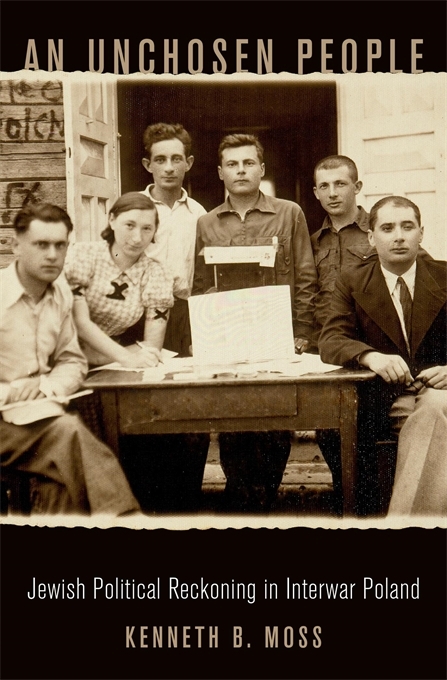
Kenneth B. Moss, An Unchosen People: Jewish Political Reckoning in Interwar Poland. Cambridge, MA: Harvard University Press, 2021. 400 pp. $45.00.
In An Unchosen People: Jewish Political Reckoning in Interwar Poland, historian Kenneth Moss crafts, with immense precision and nuance, a story that focuses on Poland’s Jews in the second decade of the interwar period. More particularly, the story’s subjects are Jews of Zionist and Diasporist bent, who are thinking about the Jewish condition and searching for solutions to it. These are lesser known urban intellectuals and provincial thinkers, writers and teachers, communal activists and politicized adolescents—the grassroots, that is.
Through what these Jewish grassroots thinkers wrote, Moss finds that the events of the years 1928–1935 unfolded to offer Jews a very bleak future. In late 1928, the Great Depression reached Poland. State policies were becoming ruinous to Jews who dominated Poland’s urban centers and commercial sectors. The political discourse that grew stringently antisemitic entered the mainstream. The idea of “Poland for the Poles” was taking hold. The country’s population grew rapidly and migrated into towns and cities in search of work, further diminishing Jewish economic prospects at recovery. Jewish future was foreclosed in Poland, the nationally minded Jewish thinkers prophesied.
The Jewish People were “unchosen,” Moss seems to suggest in his book title. Once the rabbinic idea of Jewish chosenness helped to “make the insults of exile bearable,” but that ceased to be true in the interwar era, the Diasporist Max Weinreich wrote in 1935.
1
1
Kenneth B. Moss, An Unchosen People, 134.
An impressive array of historical studies on the years prior to the Holocaust buttress the arguments that historian Kenneth Moss puts forth in his book about the darkening horizon for the Jews of interwar Poland. Historian Polly Zavadivker shows Jewish civilians in Russian-held Polish and Lithuanian lands facing state-sanctioned violence (deportations, expulsions, looting, rape) as they are removed from the areas of military activity with the outbreak of the Great War.
2
2
Polly Zavadivker, A Nation of Refugees: World War I and Russia’s Jews (Oxford: Oxford University Press, forthcoming).
The tsarist excuse for unprecedented anti-Jewish violence: allegations of spying for the enemy and supply hoarding. The terrorization of Jews by the imperial Russian army would become so abject that “among the dark [Jewish] masses, there is talk of the ‘end of days,’” historian Simon Dubnov noted in 1915.
3
3
Zavadivker, 43.
Moving along the timeline of turbulent times, historian Elissa Bemporad describes a series of events that accompanied the Great War— the pogroms of the Russian Civil War (1917–1921). She shows how the conditions of war made anti-Jewish violence that swept across Ukraine, Belorussia, and southern Russia “socially acceptable.” 4 4 Elissa Bemporad, Legacy of Blood: Jews, Pogroms, and Ritual Murder in the Lands of the Soviets (Oxford: Oxford University Press, 2019). With a focus on the pogroms in Ukraine, historian Jeffrey Veidlinger links a staggering number of anti-Jewish incidents throughout 1918–1921 to the violence of the Holocaust. 5 5 Jeffrey Veidlinger, In the Midst of Civilized Europe: The Pogroms of 1918–1921 and the Onset of the Holocaust (New York: Picador, 2021). He demonstrates how, amidst the wars, the previously peaceful neighbors took to organized forms of anti-Jewish violence. Their excuse: Jews were responsible for the depravities of the Bolshevik Revolution.
A wave after wave of mass violence and murder—directed against Jews but also against other groups—takes us all the way into the interwar era in Eastern Europe. In fact, wars inform the politics of the two interwar decades, the temporal frame of Moss’s study on Jewish political and social choices in Poland.
It is because the Great War did not end in 1918. It spilled over into many other, local wars. Between 1918 and 1921, Poland had fought in six military campaigns, all of them against its neighbors, all of them new states. In Galicia, the fighting between Polish and Ukrainian forces continued until 1919. The Polish-Soviet war raged until 1921. The slow “dirty war” between Polish and Lithuanian civilians in Lithuanian-Polish borderlands lasted until 1923. 6 6 Tomas Balkelis, War, Revolution, and Nation-Making in Lithuania, 1914–1923 (Oxford: Oxford University Press, 2018).
Violence invaded internal Polish politics, too. In December 1922, a right-wing Polish man assassinated the first President of Poland, Gabriel Narutowicz. The center, the left, and minority groups had supported his candidacy. Yet from the point of view of Polish nationalists, he represented compromise—something the radicals, including early Zionists and radicals of other nationalist groups, could not abide. “Marinated in the uncompromising narrative of a tragic past,” they believed in conflict instead, in “the winner takes it all.” 7 7 Tony Judt and Timothy Snyder, Thinking the Twentieth Century (New York: Penguin Books, 2013), 120.
As modern states rose on the ashes of the former tsarist empire, state and intercommunal violence was woven into the fabric of state building. In the process, Jews—most of them decidedly against tsarism, many uncertain about the choices modernity had offered them—found themselves in the crossfire between warring states and their competing visions of statehood. More than that, the fledgling states were targeting Jews as Jews: antisemitism became part of their state-making process.
Given these legacies and circumstances, it was no wonder that a sense of powerlessness, both political and psychological, pervaded the thinking of Jewish grassroots intellectuals in interwar Poland. As pauperization and unemployment among Jews rose, so did modern forms of antisemitism—even among the peasants who began to see Jews as outsiders. Antisemitism infected such state structures as the police and the government.
As the 1920s moved into the 1930s, the Right in Poland became more brazen, and, more often than not, violent. Though it did not govern the Polish state (the head of state Józef Piłsudski held tight the reins of power, with his federalist vision of statehood), the extreme Right held the government captive.
Moreover, after the military coup of 1926, the Polish government itself was abandoning its progressivist aspirations and veering in the direction of exclusivist nationalist policies. It did, however, try to keep a tight lid on the country’s anti-Jewish outbursts. But, in the eyes of Jewish grassroots thinkers, it was tacitly anti-Jewish. It could not extend a helping hand to Jews, even if it wanted to. It was afraid of its Right that controlled much of the Polish Street.
By 1934, no Polish politician could openly support a Jewish cause without losing his constituency and likely facing an assault on his person. According to Isaac Giterman, the Joint’s chief agent in Poland, “Any minister who treated the Jews fairly would cease to be minister.”
8
8
Moss, 28.
In 1934, too, Poland abandoned its Minorities Treaty. It saw its minorities—five million Ukrainians, three million Jews, and other, smaller groups—as a threat to its wellbeing. Its fears were not without foundation: in 1934, a Ukrainian nationalist assassinated the Polish Minister of the Interior Bronisław Pieracki.
And the Left? It was weak. The awaited world socialist revolution was not on the horizon, no matter how hard they stared at it, while the Soviet Union was beginning to disillusion many. In the view of Mikhl Astour, a Jewish socialist from Wilno, such a stance was too hopeful, like a naïve request to “wait with our hands in our pockets until the social revolution comes, and then everything will be fine.”
9
9
Moss, 2. Following Moss’s explicit choice in this book, we have used the Polish name Wilno to refer to this city in the Second Polish Republic.
Besides, some leftist movements harbored anti-Jewish sentiments. To Jewish nationalist grassroots thinkers in Poland, the ideas of the Left were idealistic, to say the least.
In its move toward illiberal policies, Poland was not unique. Poland’s neighbor Lithuania lapsed into authoritarianism in 1925, with Latvia and Estonia following in its footsteps several years later. In fact, all of Europe swung in the direction of Nazi Germany and a majoritarian politics of exclusion and discrimination. The Soviet Union, too, took to ever more brutal methods in carrying out its communist state-making policies: in 1931–1933, during its collectivization campaign, it starved four million of Ukrainian inhabitants to death (the Polish government kept a network of spies in Soviet Ukraine and knew about the famine).
In this climate, Polish Jews faced gloomy prospects indeed. A Jewish socialist turned Diasporist, Max Weinreich, head of the YIVO Institute for Jewish Research in Wilno, explored the issue at hand—only to discover “a youth without a tomorrow,” to quote the youth itself.
10
10
Moss, 53.
His sociological study, Der veg tsu undzer yugnt (The Path to Our Youth, 1935), analyzed over 300 Yiddish, Polish, and Hebrew autobiographies that Jewish youth from across Poland submitted to YIVO contests in 1932 and 1934.
To Weinreich, the claims of the young respondents who saw themselves without a future in Poland were a sign of their youthful immaturity, an emotional overreaction to the situation at hand. Similarly, their involvement with Zionism and Communism was a compensatory psychological response. What the autobiographies revealed challenged his Diasporist vision. Weinreich condemned the political preferences of Jewish youth.
Using the pen name of Binyomen Rotberg, one of the YIVO autobiography contestants read Weinreich’s study very closely. The politically attuned young man from Bielsk Podlaski, an ethnically mixed town in eastern Poland, disagreed with Weinreich’s conclusions. The concerns of Jewish youth were not just economic, as Weinreich seemed, in Rotberg’s opinion, to suggest, but as much political. In comparison to his town’s Polish and Belarusian youth, “at every step, we [Jews] are given to feel that we are second-class citizens,” Rotberg wrote angrily. 11 11 Moss, 76. Political antisemitism was also reaching the countryside. While working as a tutor in a nearby village in 1934, Rotberg watched, with a growing concern, the farmers bring back antisemitic views from their visits to towns.
As a Diasporist, Weinreich placed his trust in the creative force of Jewish culture. Those with a strong Jewish upbringing could use it as a shield against the pervasive sense of hopelessness. Assimilated Jews were therefore in a worse position, he thought. 12 12 Moss, 72. Moss delves deeply into Weinreich’s uniquely resourced sociological analysis that deserves a translation into English.
Yet Jewish culture, however vibrant, could offer only limited psychological compensation. The most tenable solution was emigration, many other grassroots intellectuals agreed. And a substantial group of Jews made the decision to leave Poland for Palestine. In the arena of modern Jewish politics, emigration—or, a Zionism of necessity in this case—was among many other available choices: Orthodox traditionalism, Diaspora socialism, communism, nationalism, and assimilationist liberalism.
Many of the emigrants, the readers will learn to their surprise, did not believe in the Zionist dream. As Moss convincingly shows in his book, a good number was neither Zionist nor apolitical. Many were searchers who simply saw no viable future in Poland for themselves and their children. So, theirs was dark, gloomy thinking indeed. But that could not have been otherwise, after decades of violence and policies of exclusion.
Embedded in the interwar years, Moss’s book is not about the Holocaust but it leads up to it, making the wartime brutalities seem more of what Polish Jews could have expected. After all, the interwar era did introduce, into the public discourse and state structures, the politics of hate against Jews and other groups, as reflected by nation-wide social surveys, Jewish youth autobiographies, and sociopolitical analyses of nationalist grassroots thinkers that Moss examines in his book.
The patterns of mass violence that emerged with the onset of World War II—the 1941 massacre, in Jedwabne, of Jews at the hands of Poles; the 1943 massacre, in Volhynia, of Poles at the hands of Ukrainians, among multiple other instances—were not novel to the region. Such violence erupted during World War I; much of it was kept in check during the interwar period; it resurfaced during World War II.
I am, however, a little concerned. The interpretation that some readers might come away with after reading Moss’s book might be this: Polish Jews knew things were getting worse for them; those who emigrated made the right decision; they escaped certain death. But the Holocaust was far from predetermined in Poland until another historical actor, Nazi Germany, entered the fray. With all its liberal rhetoric and illiberal, repressive practices, the interwar Polish government did not ally with the Nazis, despite an offer from Hitler. Instead, Nazi Germany forged a shocking alliance with the Soviet Union—through a secret pact in 1939, with devastating consequences for the Jews.
It is important to remember that the Holocaust was a long complicated process—more than just the killing, the end point of a massacre of Jewish people. Rather, it was an accumulation of incidents, some orchestrated by the state, others initiated by the locals, still others involving both actors across a set of shifting contexts. In Eastern Europe where most Jews lived, these incidents fomented genocidal impulses, which, according to a growing scholarly consensus, prepared the ground for the brutalities of World War II.
Moss’s book on the Jewish grassroots thinkers is undoubtedly part of this larger story. Yet it is complicated in its own right. Moss’s readers will have to hack their way through a thicket of sophisticated arguments and oft-laborious sentences. They will have to stay focused. It is not a fast, light read. If they persist, this book will expand their understanding of Jewish thought and choices in interwar Poland.