May 20, 2024
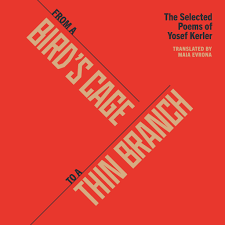
From a Bird’s Cage to a Thin Branch: The Selected Poems of Yoysef Kerler , translated by Maia Evrona (White Goat Press, 2023). 147 pages. $24.95.
Yoysef Kerler was a Ukrainian poet whose lifetime coincided with the century that followed the Russian Revolution. He traveled through many worlds in his life: a Ukrainian shtetl, a collective farm, an Odes(s)a literary community in the 30s, GOSET Yiddish theatre in the 40s, the Red Army, the Jewish Anti-Fascist Committee, a newspaper in Birobidzhan, labor camp, dissidence, immigration. His biography has the contours of a century, like a sample by which one can study the whole. Kerler’s poetry exists in tension with his belonging to his century, opening a gap between himself and his life.
Although From a Bird’s Cage to a Thin Branch, selected and translated by Maia Evrona, is the first book-length translation of Kerler’s work from Yiddish into English, his poems first appeared in Russian translation in the Soviet Union in the 1950s and 60s, after he had already served time as a political prisoner in the Vorkuta gulag. The poems in their Yiddish, Russian, and English incarnations have found very different readerships and have continued to transform in relation to these groups, both because of the translations themselves and because of the changing context, the shifting of the poet’s persona within each language. I belong to two of these three groups of readers, because I grew up speaking Russian in Odes(s)a, half a century after Kerler published his first poems there, and then immigrated to the United States. Like many of Kerler’s readers, I know a little Yiddish, but not enough to read the poems in the original.
From a Bird’s Cage to a Thin Branch begins with poems Kerler wrote while serving in the Red Army during the Second World War. These earlier poems are romantic and nostalgic, converting violence — blood, fire, obliteration — into something mild and representational, removed from both the author and the world. The poems in the third section, written in the Vorkuta Gulag, are both softer and more sharply alive. The earlier poems linger on the edge between subjectivity and Soviet social reality; the Vorkuta poems, written in middle age, move toward the author’s stranger, more adolescent forms of experience. They are attempts to care for his dream-life, that describe their own failure, and in that just barely succeed.
Evrona’s selection differs significantly from those available in Russian. Many of Kerler’s poems in Russian translation mention children and childhood, words that do not appear often in the poems in From a Bird’s Cage. Childhood in the Russian translations is a talisman made of both nostalgia and a desire for future, frameworks linked, in turn, to socialist realism and Yiddish modernist experimental writing, two traditions Kerler is heir to. Childhood in these poems is a time before and forever without collectivization, war, imprisonment, terror, a form of being linked to animals, plants, rivers, which cannot and will not ever perceive war, even as war destroys them.
The talisman “childhood” is an entity that resembles an unbearable form of the real. It is a mutated version of an actual childhood interrupted by unassimilable change, that therefore can’t end, but continues inside the time of one’s life, pulling the mind into a place that seems to be the past, but isn’t. How does a person free this feeling from its arc, how does one stop the interior transformation of longing, grief, and anger into this empty infinity, “childhood”? It’s a question that is a form of life in itself, in which a person is both an artifact of violence and a world of their own making.
Although childhood figures rarely in From a Bird’s Cage, when it does appear, it’s transformed into a clarity of dream, a goldenness:
And the mountains, the golden mountains,
which I forgave you,
where have they escaped to,
tell me, in which streams of smoke?
…………………………………………….
And the mountains, the golden mountains,
they flew off in all directions,
when I only made the slightest try
to open wide my eyes.
The golden mountains are a dream that must be forgiven, both beautiful and harmful. Although they are faint and seem to vanish, they are what survive the violence of the army and the gulag, often appearing in some way in the last words of the poems.
The image of an embodied dream that flies away recurs also in the Russian translations. In one poem, children born to bad fathers fly from their parents’ houses:
Пусть растут и вырастают,
из-под крыши вылетают
от отца, от подлеца,
нет прекраснее конца!
Let them grow up,
And fly from under the roofs
Of fathers, traitors,
There is no better ending
1
1
Translation mine
This moment in the poem closely resembles lines by Kerler’s friend, the anarchist poet Peretz Markish, in which children also take flight:
And what is a border and what is a limit
When children are springing from land to land?
And what could be forbidden to them, after all,
If the earth rushes to meet them?
2
2
See Anna Elena Torres, “The Horizon Blossoms and the Borders Vanish: Peretz Markish’s Poetry and Anarchist Diasporism.” The Jewish Quarterly Review 110, no. 3 (2020): 458–90. https://www.jstor.org/stable/2....
In a note on her selection process for From a Bird’s Cage, Evrona writes that she “was particularly drawn to poems about Kerler’s complicated relationship to both Ukraine and to Russia.”
3
3
Maia Evrona, “#YIDDISHLITMONTH: From a Bird’s Cage to a Thin Branch,” Global Literature in Libraries Initiative, October 12, 2023. https://glli-us.org/2023/10/12... Kerler’s poems in this collection suggest that, over the course of his life, he tried to fall in love with several countries – with his country of birth, which he calls his “cradleland,” with the Soviet Union (his first collection is called Far mayn erd, for my country), and with Israel, to which he wrote poems of praise. He was imprisoned for “nationalist anti-Soviet activity,” after seeing many of his Jewish friends murdered by the Soviet regime, and strived for years to immigrate to Israel. However, in other, mostly later work, Kerler imagines the borders of any country as the walls of a cell:
Border to border
like wall to wall —
I - in the middle
as if in a cell —
Oh, how just and powerful
is the longing of my heart —
fenced in by all.
In another poem, he dreams of blowing out the great cities of the present and past one by one, like Hanukkah candles:
I extinguish the Greek Acropolis,
I extinguish the Roman Colosseum.
………
And paler, paler, paler grow
these looming, blood-red walls. (96)
Instead of praise of nations, Kerler writes: “May all wanderer’s homes / together take flight!” (132). Like the golden mountains, and the children of bad fathers “who can no longer keep quiet …Like the heart in ragged fists, / like the faraway lunar plain—” (78): the heart is not able to take root in a country, and is “like” nothing, moving out and away via the comparison.
In From a Bird’s Cage, Kerler often imagines that he might or might not become stone. Sometimes the longing for stone is like a death wish: “let me be the stone … / rather than this life, this wandering” (66). But elsewhere, he writes that he will become like the grass:
I will stay, this alone I know
I am stronger than iron, I am harder than stone,
I burn up flame and freeze over frost
and as I sprout forth like the grass I split open rock. (64)
In this poem, written at the Vorkuta coal mines, Kerler suggests that grass is “harder than stone” – stone invoking the walls of cells, cities, and nations, the grass a fragment of childhood that survives in reality.