Jan 19, 2026
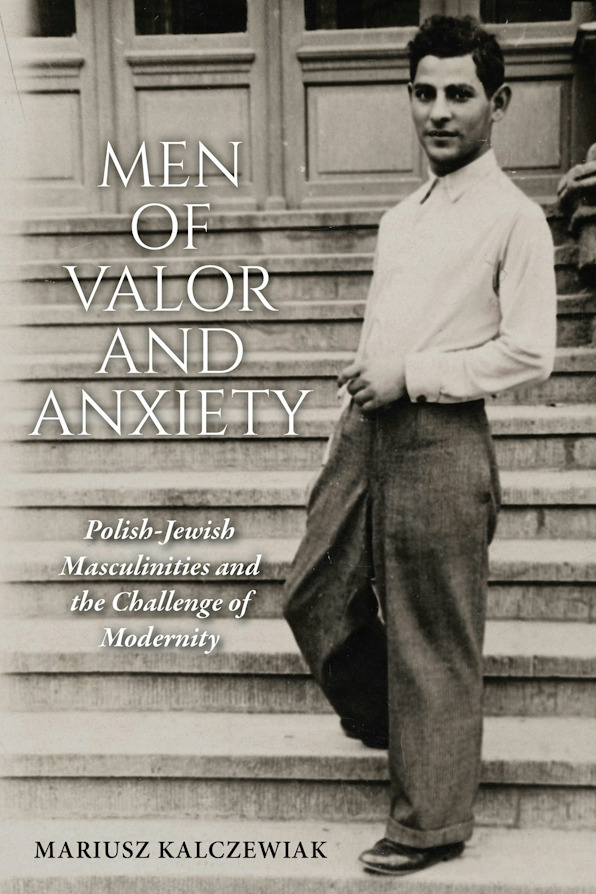
Mariusz Kalczewiak. Men of Valor and Anxiety: Polish-Jewish Masculnities and the Challenge of Modernity. Indiana University Press, 2025. 428 pp. $50.00 [paperback].
Both Jews and Jewish studies like to tell a set of stories about masculinity. Jewish men are kinder and gentler. They are family men. They embody a morally superior version of manhood than Euro-American ideas of a strong, powerful, and dominating man. Or, here’s another story: Jews were weak because they’d been excluded from occupations like farming and from political power, but Zionism rescued them from this weak diasporic masculinity.
Mariusz Kalczewiak’s Men of Valor and Anxiety tells us a different story. It tells us about the boxer Shapsel Rotholc (1913-1996), who exemplified a working-class attitude in which “Polish-Jewish men of the working class rarely conceived of themselves as ‘weaklings’ in need of transformation.” It tells the story of Krakow’s Bar Kochba fraternity, which both shaped its brothers into ideal Polish men with the “masculine values of obedience and discipline” while also serving as an alternative space because Polish-Jewish students were excluded from non-Jewish fraternities. It tells the story of Józef Halpern, who loved his friend Olek, but knew they should keep their sexual desires secret. They lived in a world where both Jews and non-Jewish Poles had similar homophobic ideas, and there was no cultural sense that there was any special connection between Jewishness and homosexuality. The care and attention with which Kalczewiak tells these stories should make us question those popular stories of Jewish exceptionalism.
Many of the existing scholarly works suggest either that Eastern Europe followed similar patterns of masculinist responses to antisemitism, Zionism, and secularism as Western Europe or that Eastern Europe represented a contrast to these forms of physical culture by embracing the image of the intellectual but weak Talmud scholar. Men of Valor and Anxiety demonstrates that neither of these assumptions is true. Instead, Polish-Jewish men’s masculinity drew on Jewish and non-Jewish sources and embraced physical culture without eschewing religious culture. This conclusion is made all the more convincing because Kalczewiak analyzes an impressive range of sources (both primary and secondary), including materials in Polish, Yiddish, German, Hebrew, and English. His argument relies on careful readings of this large body of historical materials, rather than solely relying on the kinds of anecdotal or theoretical lines of argument that appear in some of the most influential classic scholarship about European Jewish masculinity.
Throughout, Men of Valor and Anxiety pays sophisticated attention to the pushes and pulls of masculinity: it narrates neither a world in which a man simply goes out and puts together whatever kind of gender he wants, nor a world where there is a single, fixed masculinity without deviations. Kalczewiak writes, in a sentence whose length and grammar alone indicate the complexity of Polish-Jewish masculinity. In the context of Polish-Jewish masculinity, it means that “Men chose from elements characteristic of non-Jewish hegemonic masculinities (that is, idealized and recognized ways of being a successful man) and earlier dominant Jewish orthodox masculinities (that is, strictly adhering to religious Talmudic and rabbinical traditions) to build their own masculine identities through a process of selection, appropriation, and borrowing, and that the masculine identities they constructed were hardly fixed or stable” (7).
While this thesis may not be shocking to those who study gender and Jewish history (masculinity is usually complicated and negotiated!), such a careful study of Polish-Jewish men proves exemplary in its methods and its careful detail. Few works have addressed Polish-Jewish men’s masculinity at all, and this one is particularly valuable for its attention to comparative possibilities. Kalczewiak also writes in a way to include audiences beyond those who already know about Polish history. For example, he writes that “men in Poland operated to a great extent within the same masculine ideals as in the West, even when they could hardly be achieved in Poland,” explaining that economic conditions allowed less upward mobility than was possible at the same time in many other Western European countries (12). This kind of contextualization makes the research here especially useful to Jewish studies scholars beyond those who work on Poland, as well as scholars of masculinity beyond Jewish studies.
The book’s seven chapters work well together; they do not aim for some sort of complete picture, which would be impossible, but they give wide-reaching support for his claim that Polish-Jewish masculinity was neither entirely reactive nor entirely disentangled from Polish hegemonic masculinity. They explore various genres of human experience and interaction: the chapters treat the realms of religion, bodily ritual, sports, education, military, consumer culture, and sexuality. The yeshiva chapter is particularly convincing in how it shows that power, influence, respectability, and achievement characterize the ideal masculinity within the yeshiva, as well as without. The final chapter on male-male sexual desire was also impressive, in spite of the sparseness of archival material available that explicitly addresses homosexuality in a culture that socially penalized it even after it no longer legally did so.
In general, Kalczewiak pursues historical inquiry that deftly incorporates aspects of social and cultural history with theoretical work in gender studies. He has a wide variety of sources, from memoirs to pamphlets to the press. These also include things authored by Jews and non-Jews, homosexual and heterosexual men, and men and women. He is also reflective about what his sources may not show much of; as he notes in a nice methodological insight: “Sources are relatively silent about continued, uninterrupted processes” (25). Yet he nevertheless finds sources that inform us about the relatively placid gendered ideas and ideals alongside the more contentious or changing ones.
Men of Valor and Anxiety also shines in its methodological approach to antisemitism. It does not ignore antisemitism, but it also does not assign it the central role in determining how Jews saw their own masculinity. This is part of what allows Kalczewiak to see beyond a fixation that appears in some of the classic scholarship on Jewish masculinity: that of the feminized male Jew. The chapter on circumcision is particularly effective in this respect. It demonstrates that many Polish-Jewish men were proud of being circumcised. Some adult men who had not been circumcised as infants actively chose it and were celebrated by their communities, and even the relatively small number of Jews who did not circumcise their children articulated a number of reasons, only some of which echoed antisemitic rhetoric.
Throughout the book, Kalczewiak offers a very helpful corrective to antisemitism-centric scholarly narratives by showing that Polish-Jewish men’s gender was shaped by a variety of experiences, especially those that were class-based, generated by distinction from women’s perceived roles, or came out of homosocial environments such as the military, yeshivot, fraternities, or sports. The chapter on sports illustrates the wider range of what we can learn when a historian does not assume that the pursuit of physical culture must come from a sense of masculine inadequacy, weakness, or degeneracy. The popularity of fitness appeared across political, religious, and class spectrums, and was not at all limited to Zionist groups or even Zionist influences.
Kalczewiak rejects Jewish exceptionalism: “this book challenges major paradigms about Jewish masculinities, such as the idea that Jewish and non-Jewish masculinities differed historically; the idea that Jewish men were emasculated and excluded from the gentile notions of masculinity because their masculinities were flawed or deformed; the idea that Jewish men internalized a sense of masculine inferiority; and the idea that only Zionism has ‘straightened’ Jewish men and ‘normalized’ Jewish masculinities.” Kalczewiak’s work, however, does suggest there were some differences between Jewish and non-Jewish Polish masculinities. The differences may not have been categorical, but neither were the two identical. This insight aligns with many other recent studies of Jewish masculinity in other times and locations (such as recent books by Sebastian Huebel and Miriam Mora, both of whom Kalczewiak cites). Similarly, while many classic works do imply that Jewish men were “excluded from gentile notions of masculinity,” this is true far more of scholarship on Europe than the Americas or the Middle East, where historians have often argued for much more intertwined constructions of masculinity. This is not to suggest that Kalczewiak’s work is not valuable or new, but rather that it fits in with some of the best currents in contemporary scholarship about Jewish masculinity rather than swims against the stream of all of them.
If the complexity of Jewish masculinity Kalczewiak narrates is so convincing, and if it accords with what other scholars have studied in other historical contexts, why do scholars, students, and readers still love to tell the stories of Jewish exceptionalism? Perhaps it is because of the appeal of a story that reaffirms what we already think. Perhaps it is because it is easier to tell a simple, straightforward story than it is to tell a complex, inconsistent, and internally diverse one. But perhaps if scholars keep telling these complex stories of masculinity, they will slowly supplant the simple, appealing, and mythical ones.