Dec 03, 2025
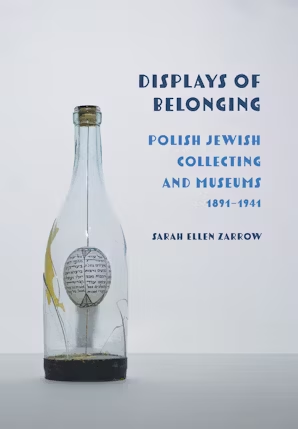
Sarah Ellen Zarrow. Displays of Belonging: Polish Jewish Collecting and Museums, 1891-1941. Cornell University Press, 2025. 294 pp. $54.95.
Even academic books these days have social media promotion campaigns to accompany their publication. An email announcement from the Association of Jewish Studies celebrating recently-published books featured cover images, brief descriptions, and purchase links, but only one included a link to watch a short video. The thirty seconds do not tell the full story of the book, but the video does give the reader a glimpse into the rich material culture of Polish Jewry at the core of Sarah Ellen Zarrow’s Displays of Belonging: Polish Jewish Collecting and Museums, 1891-1941 (2025).
In this book, Zarrow uncovers arguments for Jewish belonging in the Polish lands by tracing efforts to collect ethnographic material about and to display objects produced or owned by Jews in this region from the end of the nineteenth century through the end of the interwar period. As the chapters progress chronologically, we follow the fate of individuals, collections, and institutions over a turbulent half century of activity in what Zarrow terms “ethnoproduction,” defined in the book as “cultural production and corresponding patronage” (65). While the most explicit argumentative thrust of this work addresses core questions in Polish Jewish historiography, Zarrow’s work also presents a more subtle challenge to scholars of Jewish culture more broadly to consider the convictions, constraints, and conceptions of power of those who produced and collected the material we study. While focused on collectors in the late imperial and interwar periods—many of whom were Polish-speaking, wealthy, integrationist, and well-educated—this work reframes the significance of the culture created by Polish Jews of that time in all their linguistic, material, political, and cultural diversity.
***
The chapters follow an itinerary through four of Poland’s largest cities of the period: Warsaw, Lemberg/Lwów, Kraków, and Wilno. The first chapter examines the writings of Warsaw-based scholars—both Jewish and non-Jewish—in the context of European and Polish colonialist discourses. Warsaw and Lemberg/Lwów serve as the two poles for the second and third chapters, offering a study in contrasts between efforts to create institutions to display collections of objects. As the center of Congress Poland and later the capital of the Second Polish Republic, Warsaw was home to efforts characterized by individual initiative and communal ambivalence, with a sharp divide between the city and provinces. Austro-Hungarian Lemberg and later regional center Lwów, on the other hand, embraced Habsburg models that presented material from urban and rural settings together to demonstrate that diverse populations could be found close to home. Zarrow turns to Wilno in the fourth chapter to examine YIVO collecting projects in the paradigm of going to “the people,” closely associated with Sh. An-sky’s expeditions in the Russian Pale of Settlement. In the second half of the fourth chapter and in the fifth and final chapter, Zarrow moves across the territory of the Second Polish Republic as the book moves into the second half of the 1930s to offer an argument that, judging by the plans of Jewish cultural organizations—including traditional museums and the sight-seeing landkentenish organization—interwar Poland was good for the Jews. The fifth chapter picks up the story of formal museum projects in Warsaw, Lwów, and Wilno, as well as Kraków, where plans for a Jewish museum emerged only in the 1930s. In these cities and across the Polish lands, ethnographic research, personal collections, communal museums, and tourism organizations shared an impulse to demonstrate the rootedness of Jews in Poland through encounters with Jewish material culture, regardless of whether the proposed plans were carried to fruition due to lack of resources or the outbreak of war.
While Zarrow presents ample evidence to support the argument that using Polish in ethnoproduction allowed scholars and museum planners to shore up their own status as modern and belonging to a Polish nation, the sources also reveal more complex language politics, especially in regard to Yiddish. One appeal for ethnographic reports was printed in Polish, indicating that responses would be accepted in any language, "even in zhargon, which in this case we believe may be most appropriate" (31). The children’s games and rhymes reproduced in Regina Lilientalowa’s Dziecko Żydowskie (Jewish Child, 1904) included wordplay between Hebrew and Polish and between Yiddish and Polish, demonstrating how the youngest members of Polish Jewish society moved between different linguistic realms. In the framing of the book and in chapters on its projects, YIVO is presented as a Jewish particularist foil to the Polish integrationist politics of ethnographers and collectors, especially on the question of language; after all, the ethnographic commission was placed within the philological section (110). While Zarrow is right to emphasize the Yiddishism of many of YIVO’s projects, a significant number of the autobiographies written by young Jewish people throughout Poland and submitted to YIVO as part of contests throughout the 1930s were indeed submitted in Polish and, as the scholarship analyzing this rich set of sources has emphasized, often documented feelings of alienation from Polish state and society while also embracing Polish culture. Given Lilientalowa’s role as translator of Peretz into Polish, her exchanges with Max Weinreich, and the clear interest Zarrow demonstrates in her writings and career, this book left this reader eager for future researchers to build on Zarrow’s study and to draw out the complexities of language politics in these articulations of Jewish belonging through ethnographic collection. Within this book, Zarrow’s argument about collectors’ insistence on Polish as an expression of their own belonging to the society in which they lived becomes even more notable when presented against the linguistically varied material they collected to make that claim.
Objects were clearly important to the collecting and display projects Zarrow analyzes. Given the constraints of academic research and publishing, it is notable that this book contains many reproductions of objects from the collections Zarrow discusses. In addition to adding visual interest and supporting the argument about how material culture fostered rootedness and belonging, the illustrations also present more questions about what precisely counted as Polish Jewish culture. For example, items likely part of the collection of the Jewish Museum in Lwów (figures 17, 18, and 19) included a kosher-for-Passover vodka bottle produced in Lublin, a chandelier from a Galician synagogue, and a papercut for Shavuot. The last two items epitomize the range from folk art to artisan craft that one might expect from an ethnographic collection. The first introduces something else: industrial products and commercial goods. If placed in the context of the longer history of alcohol production and Polish Jewish economic niches, shifting modes of religiosity and observance, and changing relationships of the state to the market with the introduction of monopolies, this liquor bottle could support an even more expansive argument for the value of considering material culture (143-145). While Zarrow’s contribution to scholarship in the form of offering a term of analysis in “ethnoproduction” does extend beyond material culture to encompass theater, literature, and intangible heritage, I was left with even more questions about the objects themselves and why this book’s actors prioritized collecting and display above other forms of ethnically-specific cultural production.
The image chosen for the book’s cover evokes a larger question in the story that Zarrow traces: what was the role of politics? The influence of ideology and politics in culture are major questions of Polish Jewish historiography; this book articulates one answer while presenting evidence that suggests a greater ambivalence. “Despite differences,” Zarrow writes when placing YIVO in the context of other collecting projects discussed in the book, “at least one commonality exists between different collection initiatives: the desire to be seen as apolitical and nonpartisan” (107). The cover features a bottle with an egg suspended within it, featuring verses of the poem that was embraced by Ahavat Zion, the Zionist movement, and later the State of Israel as an anthem, from the collection of Maksymiljan Goldstein, a protagonist of the Lemberg/Lwów scene. Zarrow justifies attention to museum projects—even those that did not come to fruition—for their value in demonstrating the integrationist commitments held by certain Polish Jews specifically at a time when Jewish politics encompassed positions that advocated difference and departure. Zarrow convincingly characterizes these actors as integrationists; Goldstein apparently wrote to Adolf Hitler in March 1938 to send a copy of his personal collection’s catalog as an expression of his confidence that demonstrating the contribution of Jews to Polish culture would protect them from the threat of Nazi Germany (151). But the book leaves us with little understanding of how we should read the presence of an object featuring a Zionist text in the collection of a liberal integrationist. Did he recognize the content of the text as a reflection of what some or many Polish Jews believed? Did he value the object itself for its craft and artistry, ignoring or remaining neutral towards its text? Did “folk” in this “folk art” mean vernacular or national?
Given the state of the documentary record of Jews in the Polish lands, it is much easier to answer these questions for individual collectors who left traces than it might be for a society as a whole. Zarrow has done the former admirably well in her close examination of the personalities driving initiatives to gather ethnographic materials and establish museums. To do the latter and present the range of views on material culture and belonging for large swaths of Polish Jewry, characterized by divides of language, religion, and politics, is another task entirely. Throughout the chapters—from the programmatic plans for ethnographic research of the late imperial period to the interwar efforts to cultivate Polish Jews themselves as contributors to larger collecting efforts—Zarrow reads these institutional and individual perspectives carefully, attentive to how this small group of collectors understood the larger society they sought to represent.
***
The collecting and display projects of this book reveal, as Zarrow writes in the conclusion, “a community that grappled with competing ideas about how to use the past to spur creativity in the present, what to do when old beliefs and objects no longer feel useful, and how to develop new public and Jewish cultures in an evolving political situation” (179). In the book’s conclusion, Zarrow draws the reader into the present to consider contemporary claims about the Jewish past in Poland and Ukraine. Given the book’s focus on individuals who advocated for integration in Polish society, it is no surprise that Zarrow takes issue with claims by the State of Israel to the national patrimony of Jews in Poland, which undermine historical understandings of Poland’s multiethnic character and give “credence to those who would claim that Jews did not belong in Poland” (172). Glossing over fraught relations between Jews and Ukrainians during the Holocaust in the calls to revive a Ukrainian Jewish museum in Lviv even before Russia’s full-scale invasion in February 2022 can be understood differently when read against the initial proposals for a Jewish museum in Lemberg from just after the First World War, which as Zarrow emphasizes contained no mention of the November 1918 pogroms in the city (177).
As I read the conclusion, I found myself thinking about a different geography entirely: today’s United States. Where Zarrow reads efforts to collect and display as apolitical or expressions of integrationist convictions, I saw examples of how these minority cultural activists understood the power and potential of their relationship to the majority state and society, with particular attention to a nation-state’s capital. At a moment when national museums face pressure to revise the image of the American past into one that conforms to a certain vision of the American present, the still-quite-new Jewish museum in Washington, DC has opened an exhibit about LGBTQ Jews in the city and holds events on discrimination and immigration. The museum has also been the site of lethal violence, with the shooting of two staffers of the Israeli embassy just outside the museum in May 2025. At the museum’s reopening a week later, the director delivered remarks on the importance of the collections and programs in “build[ing] connections, identify[ing] points of commonality, encourag[ing] civic engagement, and—always—educat[ing] the public about the richness, diversity, and vibrancy of Jewish life,” a liberal integrationist vision updated for the twenty-first century. Through its presentation of the work of collectors and researchers in a different context, this book offers perspective on the importance of efforts to argue for belonging through collecting and display in our own time and place.