Jun 25, 2026
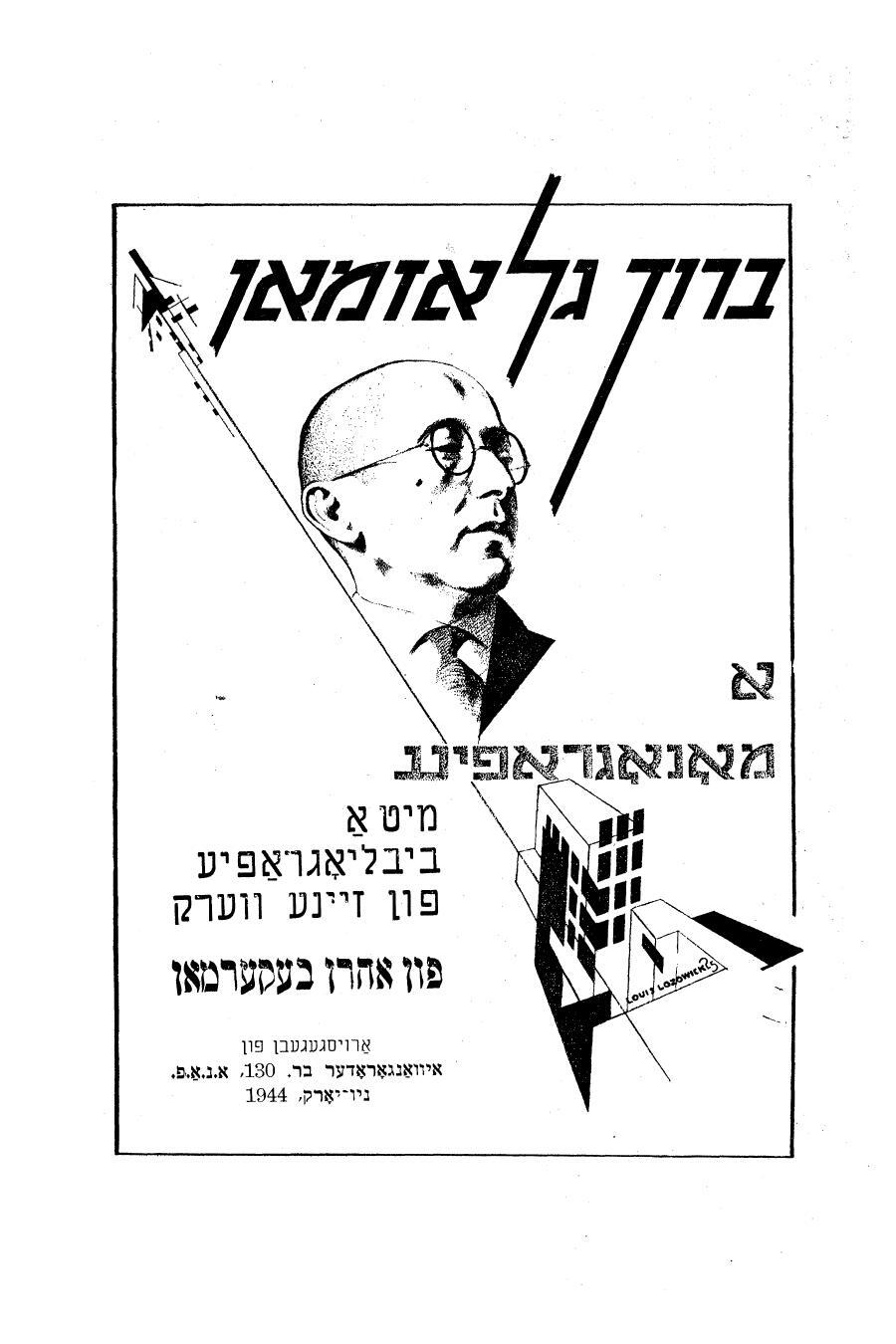
Portrait of Borukh Glazman by Louis Lozowick, cover page for Aron Beckerman, Borekh Glazman, a monografye : mit a bibliografye fun zayne verk (New York: Ivongoroder br. 130, A. N. A. P, 1944)
ABSTRACT
This article analyzes the fiction of Borukh Glazman, a key figure in early 20th-century American Yiddish literature, through the intersecting lenses of race, sex, gender, and Jewish identity. Drawing from his own immigrant experience, Glazman explored the psychological, social, and existential challenges faced by Eastern European Jews as they navigated American society. His stories, particularly “Gezindikt,” “Un damals iz gekumen di bin,” and the novel Lender un Lebns, reveal the deeply ambivalent process of assimilation, marked by the allure and peril of “whiteness.” Glazman’s protagonists, often caught between tradition and modernity, struggle with internalized racist and misogynist attitudes—especially toward Black women—reflecting both the prejudices of their era and anxieties about masculinity and belonging. While his narratives sometimes critique the exploitation inherent in striving for American integration, they also reproduce pervasive stereotypes and depict sexual encounters across racial and religious boundaries as fraught with existential threat, moral decline, and self-destruction.
Glazman’s modernism combines elements of Freudian psychoanalysis, American literary symbolism, and a fascination with metaphysical “darkness.” His work portrays attempts at either full assimilation or revival of Old World yiddishkayt as ultimately futile. Glazman harshly exposes the psychic fragmentation and persistent sense of alienation among Jewish immigrants. He frames the Jewish American experience as a “diabolical bargain,” suggesting that the very struggle for belonging in America reactivates unconscious forces that undermine psychic stability and moral cohesion.
Click here to view a pdf version of this article.
Introduction: Yiddish, Race, and the Crisis of Jewish Masculinity in America 1 1 I am grateful to my colleagues Julian Levinson and Ayelet Brinn, as well to Matthew Johnson and two anonymous reviewers, for their suggestions and comments.
A central preoccupation of American Yiddish literature in the first half of the twentieth century was how Eastern European Jewish immigrants adjusted to American life. Within that broader project, encounters with African Americans often became a defining, if fraught, site for negotiating difference, belonging, and power. Recent immigrants frequently portrayed Black Americans as intriguing and unfamiliar, sometimes unsettling. Yet, as the historian Hasia Diner observes, “The Yiddish papers sensed that a special relationship existed between blacks and Jews and because of this the press believed that these two groups were captivated by each other.” 2 2 Hasia R. Diner, In the Almost Promised Land: American Jews and Blacks, 1915-1935 (Greenwood Press, 1977), 67. Scholarship on American Yiddish culture has often stressed the more affirmative dimensions of this “special relationship,” foregrounding instances of empathy or solidarity between the two historically oppressed minorities. 3 3 See, for example, Amelia Glaser, Songs in Dark Times: Yiddish Poetry of Struggle from Scottsboro to Palestine (Harvard University Press, 2020); Gil Ribak, “’Negroes Must Not Be Likened to Jews’: The Attitudes of Eastern European Jewish Immigrants toward African Americans in a Transnational Perspective,” Modern Judaism 37 (October 2017), 271-296; Marc Caplan, “Yiddish Exceptionalism: Lynching, Race, and Racism in Opatoshu’s Lintsheray” in Sabine Koller et al. Joseph Opatoshu: A Yiddish Writer between Europe and America (Routledge, 2013), 173-187; and the special issue “Race in America, af yidish,” In geveb, June 2021. Eric Goldstein, for example, argues that “it was in Yiddish that the most assertive statements of identification with African Americans were made during the 1920s and 1930s. In their own language, unintelligible to a non-Jewish audience, Jewish writers could afford to express their deeply held emotional identification with blacks.” 4 4 Eric Goldstein, Price of Whiteness: Jews, Race, and American Identity (Princeton University Press, 2006), 153. That claim captures an important part of the record, but it also points to a complication: the same linguistic privacy that enabled bold identification could also enable the circulation of racial and racist stereotypes. Precisely because Yiddish was largely inaccessible to non-Jewish readers, Yiddish authors could potentially feel equally free to articulate contemptuous, even overtly hostile, attitudes toward Black people.
This ambivalence has drawn increasing scholarly attention. Gil Ribak has documented racist bias in depictions of Black characters across Yiddish and Hebrew journalism, theater, and both popular and “high” literature, tracing these representations back through traditional Judaic sources and forward into American contexts. On Ribak’s account, the borrowing of racist tropes was not merely incidental; it accompanied a broader process of cultural adaptation in which Yiddish-speaking Jews “blended their own culture into the American racial vocabulary.” 5 5 Gil Ribak, Crude Creatures: Confronting Representations of Black People in Yiddish Culture (New York University Press, 2025), 175. This dynamic became particularly visible during the 1920s, when racial issues were especially salient in American public life due to the Great Migration, the return of World War I veterans, and the resurgence of the Ku Klux Klan. The passage of the Johnson-Reed Act in 1924, which severely restricted immigration from eastern and southern Europe, intensified anxieties among many recent Jewish immigrants about their place within America’s racial hierarchy.
Jessica Kirzane similarly emphasizes the double movement in Yiddish writing: “Yiddish writers drew upon black figures and read into black bodies images of their own otherness, alienation, and subjugation, while also seeing them through the lens of racial hierarchies.” 6 6 Jessica Kirzane, “The ‘Yiddish Gaze’: American Yiddish Literary Representations of Black Bodies and Their Torture,” in Jordan Crane (ed.), Judaism, Race, and Ethics: Conversations and Questions (Penn State University Press, 2020), 127. Her argument also helps explain why this literature repeatedly stages Blackness as a problem of Jewish self-definition. As she notes: “Jews could not be easily identified in terms of color or superficial features.” This ambiguity often pushed Yiddish writers, as “cultural activists and producers within the language that marked them as outsiders to white Americanness,” 7 7 Kirzane, “The ‘Yiddish Gaze,” 126. to assert cultural distinctiveness even while adopting modern idioms and engaging American and European literary influences.
Addressing the gender aspect of the race issue, Kirzane observes that “Yiddish American writers use non-Jewish women as foils to demonstrate the social and cultural anxieties facing modern Jewish men through the trope of sexual attraction and restraint.” In this dynamic, Jewish men appear “hesitant and concerned with morality and discretion, while the non-Jewish women […] are sexually available in ways that highlight the Jewish male’s sexual desires and anxieties.” 8 8 Jessica Kirzane, “‘What Kind of a Man Are You?’: Interethnic Sexual Encounter in Yiddish American Narratives,” in Lisa Grushow (ed.), The Sacred Encounter: Jewish Perspectives on Sexuality, (CCAR Press, 2014), 195. The question of sexual anxiety cannot be separated from a wider crisis of Jewish masculinity. Miriam Eve Mora argues that “At the turn of the century, white masculinity was in a state of flux and deep anxiety.” 9 9 Miriam Eve Mora, Carrying a Big Stick: Jewish Acculturation and Masculinity in the Twentieth Century (Wayne State University Press, 2024), 36. In that context, the arrival of large numbers of Jewish immigrants intensified boundary-making: “white American men drew strong lines defining who belonged inside the masculine ideal and who fell outside of it.” 10 10 Mora, Carrying a Big Stick, 37.
Jews were thus positioned not simply as ethnic outsiders but as threats to the coherence of white manhood itself. Michael Kimmel captures the resulting stereotype of Jewish men as “effeminate, bookish, and conniving,” suggesting that they were perceived as undermining racial purity by trying to pass as “real men.” 11 11 Michael Kimmel, Jewish Manhood in America: A Cultural History (Oxford University Press, 2017), 78. After World War I, moreover, the problem of masculinity increasingly intersected with race as a practical condition of social mobility. As Goldstein notes, “As the Eastern Europeans became more enmeshed in American culture, more aware of its codes and values and more anxious to find acceptance within its ranks, they began to understand—often intuitively—the social significance of whiteness and its relevance to their own lives.” 12 12 Goldstein, Price of Whiteness, 138. Assimilation, in other words, was not merely cultural but racial, and that racial dimension carried significant psychological and ethical consequences.
Borukh Glazman (Boris Glassman/Glosman, 1894-1945) exemplifies these tensions. Glazman was more deeply integrated into American life and culture than most of his fellow Yiddish literati. Indeed, the poet and critic Yankev Glatshteyn even suggested that “it would have been much easier for him [Glazman] to write in English." 13 13 Yankev Glatshteyn, “Borukh Glazman,” in In tokh genumen: Eseyen, 1945–1947 (Farlag Matones, 1947), 163. Well-versed in both American and European literature as well as in traditional Jewish sources, Glazman also maintained a particular interest in Freudian psychoanalysis. The analysis that follows approaches race in Glazman’s fiction primarily through its psychological and metaphysical dimensions rather than its social history. Although his work reproduces prevailing racist stereotypes, especially in depictions of Black women, his deeper preoccupation is the corrosive effect of racism on the psyche of Jewish male characters. In his narratives, I argue, the pursuit of whiteness can require abandoning Jewish ethical and religious discipline in favor of the dominant racial attitudes of white American society; that capitulation, in turn, exposes Jewish men to destructive impulses that surface in the unconscious and are dramatized through sexual encounters with Black women.
Glazman’s protagonists are typically not recent immigrants but men who identify with their new homeland and are already “enmeshed in American culture,” as Goldstein put it. Precisely because they occupy this in-between position—socially integrated yet still insecure about recognition—they confront whiteness less as an abstract category than as a code of conduct. To enter the American working or middle class as “white men,” they must absorb its norms and prejudices, including its racial hierarchies. Kimmel’s broader claim about European immigrants clarifies the logic of this assimilation: the “price of admission” “was to embrace the already pronounced racism of native-born white working classes.” 14 14 Kimmel, Jewish Manhood, 81. In Glazman’s narratives, as I demonstrate, that price is paid at the level of the psyche. He often inverts the pattern Kirzane describes. His Jewish male characters are frequently neither hesitant nor morally cautious; they can be predatory toward Black women. This predation is not merely a character flaw but a narrative mechanism: it stages how the pursuit of whiteness can be enacted through domination and racialized sexual power, even as that enactment rebounds as guilt, paranoia, and self-destruction. The protagonists’ surface confidence, offered as proof that they have made it, fractures when encounters with racialized and sexualized “others” expose the violence and instability underlying their attempted performance of whiteness.
Across the 1920s, Glazman’s work grows notably darker, reflecting a mounting pessimism about whether Jewish moral norms and cultural practices can survive the pressures of Americanization. He may signal disapproval of his protagonists’ treatment of Black women, yet his figurative language and plot devices often reproduce the era’s racist stereotypes, creating a tension between critique and complicity. Read in this light, Glazman offers neither the familiar success story of Jewish upward mobility nor a primarily Marxist narrative of class solidarity. Instead, he describes a more intimate failure: even immigrants who appear fully integrated economically and socially may remain unable to become “fully American” without forfeiting ethical restraints—and the psychic costs of that forfeiture can be catastrophic.
Biographical Background
Borukh Glazman enjoyed remarkable international visibility during his lifetime. His Yiddish writings appeared not only in the United States but also in Poland and the Soviet Union, and they were translated into English, Polish, Russian, and French. One measure of his stature is the monographic study of his life and work published in New York in 1944. 15 15 Aron Beckerman, Borukh Glazman: A monografye (New York, Ivangoroder br[anzhe] 130, [I]disher [n]atsionaler [a]rbeter [f]arband, 1944). Its author, Aron Beckerman, was born in Poland and moved to Paris in 1926, where he became a prominent and prolific Yiddish journalist. He first encountered Glazman’s writing in the early 1920s and was struck by its novelty. The two men later met in France during the roughly two years Glazman spent there between 1928 and 1930. Beckerman completed the monograph in the summer of 1939 to mark the twenty-fifth anniversary of Glazman’s literary career, but the outbreak of World War II prevented its publication in France. In a note dated February 11, 1940, Beckerman expressed hope that his work would eventually appear in the United States. Paris fell to German occupation four months later. Beckerman joined the Resistance, was captured by the Nazis on March 6, 1943, deported to Majdanek, and murdered there. The book was finally published in New York in 1944, accompanied by an extensive bibliography of Glazman’s publications compiled by scholars at the YIVO Institute for Jewish Research, though that bibliography is not always accurate. According to the author of this study, Aron Bekerman, Glazman was born on January 12, 1894, 16 16 The introduction to his series of short stories “Tarnished Gold” states that he was born in 1893; this discrepancy can be due to the difference between the Grigorian and Julian calendars: January 12, 1894 in Russia would be December 31, 1893 in Europe and America. in the village of Kopytkevichy and spent his childhood in the nearby town of Mazyr (Mozyr) in present-day Belarus. 17 17 Beckerman, Borukh Glazman, 12. His father was a cobbler who could barely support his large family and was absent for most of the year travelling in search of work. In 1907 the family moved to Kyiv, where Borukh attended a Russian school. The following year he spent a summer studying at the yeshiva in Lida (today in Belarus), a school founded in 1905 by the rabbi and Zionist leader Yitshak Yaakov Reines and known for pairing traditional Talmudic study with general subjects taught in Russian. This early trajectory already placed Glazman at the intersection of traditional Jewish learning and secular education.
In Kyiv, Glazman joined a circle of young Yiddish intellectuals later referred to as the “Kyiv Group.” Some, such as the theater director Moyshe Rafalsky, would become prominent in Soviet Yiddish culture; others, such as the critic Nakhman Mayzel and the poet Ezra Korman, would emigrate and eventually settle in the United States, as Glazman did. He was also friends with the poet Osher Shvartsman, a key figure in the “Kyiv Group” who was killed in the Civil War and subsequently canonized as one of the founders of Soviet Yiddish poetry. Glazman later recalled that it was in the “Gentilized city” (fagoyishter shtot) of Kyiv that he first became an avid reader of Yiddish literature, including American Yiddish writers such as Leon Kobrin, Zalmon Libin, David Pinski, Avrom Lyesin, Yehoash, and Jacob Gordin, as well as proletarian poets such as Morris Rosenfeld, Morris Vintshevsky, Yoysef Bovshover, and David Edelstadt. 18 18 Borukh Glazman, “A partey fun der yidisher literatur,” Literarishe bleter, August 26, 1938, p. 1. At the same time, Beckerman argues that Glazman’s stimulating, cosmopolitan Kyiv years lacked a “Jewish core,” producing “inner alienation” and a longing for partly inarticulable Jewish roots. 19 19 Bekerman, Borukh Glazman, 13-14. Even so, the breath of his education suggests that before emigrating he had already built a substantial foundation in both traditional and modern Jewish sources.
Glazman arrived in the United States in December 1911. After moving through several jobs, he found work as a wall painter in New York while taking evening high-school classes. In 1915 he enrolled at the Ohio State University in Columbus. His decision to attend a Midwestern public university, rather than City College in New York, as many immigrant students did, can be understood in both pragmatic and cultural terms. The artist Louis Lozowick, who had emigrated from Kyiv in 1906 and also chose Ohio State, later explained that the school offered students employment opportunities. 20 20 Virginia Hagelstein Marquart (ed.) The Memoirs of Louis Lozowick (Smithsonian Institution Press, 1997), 143-44. A state university in Ohio could also provide a more immersive encounter with American society than an immigrant-heavy college in New York. Lozowick described a relatively liberal campus environment with clubs open to “members of various races,” and Lozowick and Glazman were active in Jewish student organizations, including the Ohio Zionist Society and the Menorah Society. 21 21 Marquart, Memoirs, 145.
At Ohio State, Glazman worked with Lozowick and other students, including Kenneth Burke, who would later become a major American cultural figure, on the radical campus magazine The Sansculotte. 22 22 Marquart, Memoirs, 171. The group’s faculty advisor was Ludwig Lewisohn, a German-Jewish writer who taught German language and literature at OSU from 1913 to 1917 and with whose family Glazman formed personal ties. Unlike many German-Jewish intellectuals of his era, Lewisohn was sympathetic to Yiddish literature and translated David Pinsky’s drama The Treasure (1915). 23 23 Melnick, Ralph. The Life and Work of Ludwig Lewisohn, Vol. 1, “A Touch of Wildness.” (Wayne State University Press, 2018), 200. Lewisohn helped Glazman meet Pinski and gain access to Yiddish cultural networks in New York, an example of how Glazman’s Midwestern education experience functioned as a bridge to, rather than a detour from, the Yiddish literary world. 24 24 In a letter of June 18, 1917, Glazman wrote to Pinsky: “I have a letter for you from Professor Ludwig Lewisohn, and also regards to your family from Mrs. and Mr. Ludwig Lewisohn. Would you kindly write to me when I could come see you?” The letter is written in English whereas all later letters to Pinsky are in Yiddish; perhaps the first, more formal letter was a way of introducing himself to Pinsky by referring to their common acquaintance. David Pinsky Papers, YIVO Archives, RG 204, box 6, folder 203. Glazman graduated in 1918 with a degree in German and Romance languages. He was then drafted into the U.S. Army, trained at Camp Hancock in Augusta, Georgia, and Camp Syracuse in New York State, and was discharged in February 1919. He subsequently moved to New York City, where he first worked as a news editor at the Forverts and later served as a Yiddish editor at the American Jewish Committee. 25 25 Letter of Syma Glassman to the editor of Di prese, Buenos Aires. Baruch Glassman Papers, YIVO Archives, RG 374, Box 1.
Glazman’s first Yiddish publication appeared in the anarchist New York paper Fraye arbeter shtime in 1913, and after 1917 he began publishing regularly. His first book, a collection of stories titled Baginen (Dawn), came out in 1921 and established his reputation as the “most American” Yiddish writer. It elicited a wide range of critical responses, with American reviewers generally more enthusiastic than their European counterparts. In the United States, Moissaye Olgin, the editor of the communist Frayhayt, described Glazman as a slightly crazy (meshuge) writer whose narratives captivate through wild fantasy. But he also noted stylistic weaknesses, including what he saw as pretentious symbolism and an inclination toward sentimentality. Olgin situated Glazman within the Inzikhist (Introspectivist) modernist circle that emerged in American Yiddish literature around 1919. Another leftist critic, Borukh Rivkin, framed Glazman’s prose as “psychoanalysis in the form of literature,” arguing that Glazman ventured into terrain unfamiliar to many Yiddish writers by portraying hidden affects, madness, and, most notably, the mystery of death. 26 26 B[orukh] Rivkin, Undzere prozaiker (IKUF, 1951), 274. Originally this essay was published in 1921 in Di tsayt.
Responses in Europe were sharply divided. Writing in Berlin, Bal-Makhshoves, a leading Yiddish and Hebrew critic, denied Glazman’s prose any real artistic value. He dismissed Glazman’s characters as thin variations on the lonely intellectuals found in the work of European Yiddish and Hebrew writers such as Hersh Dovid Nomberg, Anokhi (Zalman Yitshak Aronson), and Gershon Shofman, arguing that Glazman’s characters had no future as Jews in America and that his portrayals of their inner turmoil amounted to little more than “student’s work in the spirit of Professor Freud’s psychoanalysis.” 27 27 Bal-Makhshoves [Isidor Elyashev], “Literarishe geshprekhn,” Der morgnzhurnal, November 19, 1922, p. 5. By contrast, the influential Warsaw thinker and critic Hillel Tsaytlin hailed Glazman as an “ultra-modernist” who explored psychological depths previously unknown in Yiddish literature. For Tsaytlin, Glazman’s stories mirrored the experience and spiritual anguish of Jewish intellectuals in America who longed for authentic Yiddishkayt while recognizing that it had little future there. Tsaytlin nonetheless qualified his praise, arguing that Glazman lacked the psychological subtlety of the strongest writers and placing him in a third or fourth literary tier. 28 28 Hillel Tsaytlin, “Fun gaystige thoymes,” Der Moment, November 10, 1922, p. 7. Despite their opposing evaluations, Bal-Makhshoves and Tsaytlin converged on one point: Glazman’s writing is pervaded by pessimism about the prospects of authentic Yiddishkayt in America. A later assessment by the American scholar Janet Hadda puts it bluntly: Glazman’s work is “as strange and perverse as anything to be found in Yiddish literature,” a world where passions erupt, individuals lose control over their impulses and desires, and fragile stability remains perpetually on the verge of collapse. 29 29 Janet Hadda, Passionate Women, Passive Men: Suicide in Yiddish Literature (SUNY Press, 1988), 101.
The intensity of his literary work, which Glazman could only pursue when he was not working his main job as an editor, eventually resulted in a nervous breakdown. Increasingly dissatisfied with the state and prospects of Yiddish in America, Glazman decided to return to Europe to search for authentic Yiddishkayt. 30 30 Beckerman, Borukh Glazman, 23-29. He sailed off on March 24, 1924, and spent a few months lecturing on Yiddish and American literature across Poland while writing for the Polish Yiddish press. Like other American Yiddish authors such as Yosef Opatoshu, H. Leivick, Moyshe Nadir, and Peretz Hirschbein, Glazman began publishing his collected works with the prestigious Kletskin press in Warsaw, intended for global distribution. In the summer of 1924, he continued to the Soviet Union, where he spent over a year travelling around Belarus and Ukraine and visiting newly established Jewish agricultural settlements. 31 31 Glazman described his experience in Step un yishev (Warsaw: Kultur-lige, 1928). He was warmly received by Soviet Yiddish writers and published two books in Yiddish and one in Russian translation. He even considered settling in the Soviet Union but eventually decided to return to the United States.
After nearly two years in Eastern Europe, Glazman returned to America for a short stay before setting off for Europe again. This time he spent several months in Lublin, where he believed he had found genuine Yiddishkayt among the impoverished pious Jews. 32 32 Bekerman, Borukh Glazman, 28-29. In 1928 he moved to France, settling in Fontenay-aux-Roses, a Paris suburb popular with writers and artists, and traveled around France and Belgium. During this period, he wrote his largest published work, the two-volume novel Lender un lebns (Countries and Lives), drawing on his American experience and Soviet impressions. He returned to the United States in 1930 and was welcomed with a reception in his honor chaired by Pinsky. As his widow recalls, the family lost their savings when their bank collapsed in 1930, and they were no longer able to travel. 33 33 Letter of Syma Glassman to the editor of Di prese, Buenos Aires. Baruch Glassman Papers, YIVO Archives, RG 374, Box 1. In the 1930s his personal situation became difficult. Without a steady income, he supported himself and his family by literary work and occasional lectures. Korman notes that Glazman was further burdened by his wife’s serious illness. An additional source of anxiety, which Glazman confided to Korman, was his occasional work as a translator for Soviet trade delegations in the United States; he feared that this association might bring him troubles from American authorities. He died following several heart attacks in 1945. 34 34 Ezra Korman, “A bagegenish mit Borukh Glazman (a bisl zikkhroynes tsu zayn tsentn yortsayt),” Fraye arbeter shtime, July 13, 1956, p. 3.
“Gezindikt”/ “Oyf di felder fun Dzhordzhia” (1920): Temptation, Discipline, and Racial Boundary
Glazman’s early treatment of race and gender largely conforms to the pattern Jessica Kirzane identifies: a hesitant Jewish man encounters a non-Jewish woman figured as sexually available. In the short story “Gezindikt” (“Sinned,” 1920; later retitled “Oyf di felder fun Dzhordzhia,” “On the Fields of Georgia”), the anonymous protagonist is a Jewish peddler traveling by horse and wagon along a sandy road toward Florida. 35 35 “Gezindikt” was initially published in Shriftn, a literary journal associated with the Yiddish modernist group Di Yunge. Despite this initial involvement, Glazman, to my knowledge, did not continue to participate in Yiddish modernist projects. Though he is moving south, his thoughts remain in New York with the wife and children he sees only once a year, at Passover. His homesickness sharpens when he realizes it is the first night of Hanukkah. Exhausted and unable to reach the village of Durkeeville as planned, he seeks shelter at a farmhouse. A Black woman answers the door, welcomes him warmly, and invites him to a festive meal; only then does he recognize that it is also Christmas night. She is devoutly Christian yet respectful of his Jewish practices, serving fruit and coffee so he can maintain kosher restrictions. The peddler senses waves of warmth and desire emanating from the woman, who quietly imagines conceiving a child with him, viewing him, as Kirzane puts it, “as a potential gift from God.” 36 36 Kirzane, “‘What kind of Man Are You?’,” 199.
Glazman stages this encounter as a moral test in which Blackness is coded as sexual temptation and Jewishness as discipline and restraint. The seduction finds its focal point in a single charged object: the large watermelon the woman sets before the peddler, “like a big heart split open. Red juicy blood pours from it and gleams in the light: here, look....” 37 37 “vi a groys harts a tseshnitns un an oyfgeefnts. dos royte zaftike blut gist zkh fun dem un blitst in dem likht: na, ze…” Borukh Glazman, “Gezindikt,” Shriftn, Winter-Spring 1920, p. 9-10 (separate pagination). This image carries two layers of metaphorical associations. On the one hand, the watermelon refers to the biblical fruit of the Tree of Knowledge with which Eve seduced Adam; on the other, it echoes the racist watermelon trope, popular in the early twentieth-century American South, in which “watermelon came to symbolize a feast for the ‘unclean, lazy and child-like.’" 38 38https://nmaahc.si.edu/explore/stories/popular-and-pervasive-stereotypes-african-americans; William R. Black. “How Watermelons Became a Racist Trope”, The Atlantic, Dec. 8, 2024. The peddler’s refusal to touch the watermelon marks his rejection of the temptation. Despite the woman’s subtle overtures, he declines to share her bed, and she prepares a separate room for him. Restless, she intends to approach him in the morning, but when he hears his horse neigh, he takes it as a sign to leave. By the time she wakes and reaches for him, his bed is empty.
Glazman’s scenario draws on a recognizable social type. As Miriam Eve Mora notes, Jewish peddlers “occupied an odd, in-between space of masculine identity”: traveling alone under harsh conditions, they entered domestic spaces where husbands were often absent and sometimes slept in customers’ homes. 39 39 Mora, Carrying a Big Stick, 51. Yet, Mora also emphasizes, “customers generally did not perceive a threat to the women who purchased from Jewish men.” 40 40 Mora, Carrying a Big Stick, 52. Glazman, however, is less interested in the real-life social dynamic than in the encounter’s symbolic potential. He converts a plausible situation into a religiously and racially determined drama of temptation, purity, and boundary maintenance.
The story reinforces that symbolic framework through a set of stark binaries, such as black/white, darkness/light, night/day, so that racial difference becomes legible as metaphysical contrast. Details such as the woman’s bright white teeth and eyes emerging from the night’s darkness sustain the visual logic of the dichotomy. The calendrical coincidence of Hanukkah and Christmas intensifies the scene by giving it a doubled religious charge, as if the peddler’s private Jewish time has collided with a dominant Christian public world. Even the narrator’s claims about the woman’s biblical knowledge, offered in a racialized idiom (“the Negroes have more respect for the Bible than the Jews”), serve to heighten the spiritual stakes of the encounter. 41 41 “zi hot gevust zeyer fil fun dem yidishn gloybn, vayl neger haltn fun der bibel mer vi yidn.” “Gezindikt,” 8. Within this symbolic economy, the woman’s desire for a lighter-skinned child can be read as aligning whiteness with redemption: intimacy with the Jewish traveler is imagined as a passage out of darkness, not merely a personal longing.
In the end, the peddler escapes temptation through loyalty to faith and family. The leftist Yiddish poet, journalist, and critic Yitskhok Elkhonen Rontsh described this story as a folktale (folk mayse) in the spirit of Y. L. Peretz’s Folkshtimlekhe geshikhtn (Stories in Folk Style). Both characters, the Jewish man and the Black woman, are folksmentshn (folk types) committed to their respective traditions. 42 42 Yitshok Alkhonen Rontsh, “Der neger in undzer literatur,” in Rontsh, Amerike in der yidisher literatur (Y. E. Rontsh-komitet, 1945), 214. While Rontsh highlighted the continuity between Glazman and the Yiddish literary tradition, contemporary readers focus on its American context. Kirzane remarks that “the Jew’s anti-assimilationist tendencies win out in the end—he leaves without having slept with the black woman.” 43 43 Kirzane, “‘What kind of Man Are You?’,” 200. At the same time, as Gil Ribak argues, the depiction of the Black woman “reads as a catalog that merges many of the attributes associated with both peasant women in the Old World and African American women in the New World.” 44 44 Ribak, Crude Creatures, 161.
The plot of the story reworks an older Jewish archetype of threatened male purity, echoing the story of Joseph and Potiphar’s wife. Glazman builds the episode from precedents that are simultaneously textual and cultural, weaving together biblical and folkloric models with Old World images refracted through American racial categories. This cultural memory activates in the protagonist a defensive reflex to preserve Jewish purity. Significantly, however, the relatively optimistic outcome—temptation is resisted and identity remains intact—does not become Glazman’s dominant pattern. In later works, where Jewish male protagonists are more deeply integrated into American society, the same racial and sexual scripts tend to end not in an escape but in a psychological crisis.
“Un damals is gekumen di bin” / “Der tants fun di negers” (1922): The Return of the Repressed and the Price of Reinvention
Contemporaneous critics as ideologically diverse as the communist Olgin and the neo-Hasid Tsaytlin associated Glazman with modernism, largely because of his interest in sexuality and the unconscious. His early-1920s prose does share some traits with American modernist authors such as Sherwood Anderson and Theodore Dreiser: a frank treatment of desire, a focus on inner disturbance, and protagonists whose social mobility is shadowed by psychic disintegration. Yet his poetics also draw on an older, nineteenth-century American tradition in which the black/white contrast operates as a metaphysical language for fate, evil, and moral terror. This distinguishes him from other Yiddish writers who approached race primarily as an immediate social problem of discrimination. Glazman also engages “whiteness” and “blackness” as inherited literary concepts, symbolic categories that are never fully separable from the lived realities of the American racial order but are not reducible to it either.
In American cultural history, the black/white dichotomy has accumulated dense and layered meanings precisely because it can function simultaneously as an abstract opposition and a racial marker. As Harry Levin observed more than fifty years ago, the two colors “[set] forth all our dilemmas as inevitably as black print upon a white page.” 45 45 Harry Levin, The Power of Blackness: Hawthorn, Poe, Melville (Alfred A. Knopf, 1964), 28. Herman Melville offers a particularly useful point of reference for Glazman, all the more so because Melville’s “revival” was launched around the time of his centennial in 1919. 46 46https://beinecke.library.yale.edu/article/moby-dick-context-and-resources, accessed on May 30, 2025. Melville’s emphasis on the “power of darkness”— and his depiction of the sea as a dark, primitive, and destructive force that dwarfs human intention in Moby Dick—resonate with the sea imagery that recurs in Glazman’s fiction. Furthermore, Christopher Freeburg’s formulation is especially apt here: “for Melville blackness is not always racial but rather a figurative blackness to which racial difference is explicitly significant.” 47 47 Christopher Freeburg, Melville and the Idea of Blackness: Race and Imperialism in Nineteenth-Century America (Cambridge University Press, 2012), 2. That insight clarifies what Glazman is doing in the novella published as “Un damals is gekumen di bin” (“And Then There Came a Bumble-Bee,”) and later republished, with some revisions, under the more explicitly racial titles: “Der tants fun di negers” (“The Negroes’ Dance”) in Poland and “Shvarts af vays” (“Black on White”) in Moscow.
The protagonist, Bernard Cowan, owns a department store in a small North Carolina town. Through aggressive business tactics he has surpassed his competitors, the old Southern “gentlemen,” and built the largest store in town. His success, however, does not secure social acceptance: townspeople resent him both as an arriviste Jew and as an assertive Northerner from New York. Cowan embodies an assimilationist fantasy of reinvention. Raised in the Lower East Side “ghetto,” he left at the first opportunity, severed ties with his past, and refashioned himself into a “Yankee,” even changing his name from Cohen to the Irish-sounding Cowan. He is explicit about the logic of this self-making: “He knew that it was Yankees who occupied the top position in American life. Why would he, Bernard Cowan, be with the losers, with the failures? On the contrary: he always enjoyed crushing a loser underfoot.” 48 48 “Er hot dokh gevust az es zaynen take di yenkis, velkhe farnemen dem oybn-on in dem gantsn amerikaner lebn. Farvos zhe zol er, Barnard Kouen, zayn mit di gefalene, mit di yordim? Er hot ale mol mit fargenign tsugekvetsht mitn fus a gefalenem.” Borukh Glazman, Oyf a hor (New York, N. Mayzl, 1923), 49. He despises the “crushed ones” (tsekrokhene) who “could never detach themselves from the memories of their past life.” 49 49 “Vos kenen zikh nit avekraysn fun di derinerungen fun zeyer amolik lebn.” Ibid., 50. Married with two children, he nonetheless makes clandestine trips to a poor Black neighborhood on the town’s outskirts to buy sex from Black women. Although such behavior is normalized among the local “gentlemen,” he feels that he must conceal it to preserve his own respectability.
The novella opens as Cowan returns by overnight boat from his annual buying trip to New York, traveling toward Richmond. The trip was a manic blend of commerce and dissipation: after days of negotiating with suppliers and planning how to outmaneuver them, he “dragged himself around cabarets, roof gardens, fashionable restaurants and cafes, visiting secret, rare, and exotic spots of pleasure,” the addresses of which circulate as whispered knowledge. 50 50 “Er flegt zikh arumshlepn iber di kabarets, ruf-gardens, fashionble restoranen un kafe hayzer, iber geheyme, zeltene un virtsike azelkhe fargenigns-pletser”, Ibid. 52. To protect his anonymity he poses as an export merchant from Central America—an impersonation made easier, the narrator notes, by his dark complexion. This detail ties Cowan’s aspirational whiteness to a capacity for racial masquerade: his identity is not stable but performed, capable of sliding across categories when useful.
On the boat, Cowan is exhausted in both body and mind. Food poisoning from spoiled seafood deepens his nausea and intensifies his sense of disorientation. Waking in the darkness of his cabin, he finds that objects no longer register as solid, material things: “the objects have disappeared, only their reflections and forms remain, empty and hollow, waiting through the night for dawn to reattach themselves to their substance, their bodies.” 51 51 “Di gegnshtandn gufe zaynen farshvundn, nor di opshpiglungen , di formes zaynen do farblibn, hoyle un oysgeleydikte, durkh der nakht, un vartn oyf frimorgn, biz vanen zey veln zikh kenen onkleydn oyf zeyere inhaltn, oyf zeyere gufn.” Ibid., 57. Bodily sickness, incidentally brought on by non-kosher food, here becomes metaphysical disturbance. In Cowan’s mind, darkness does not merely obscure reality but seems to unmake it.
The ocean outside the cabin becomes the objective correlative for this inner disturbance. Glazman renders the sea as something almost sentient: “the ocean waters rose and swelled in breadth from the awareness of their great expanse, of ease and their force, which revealed itself as the mainland disappeared from sight.” 52 52 “Di vasern funem okean hobn zikh gehoybn un geshvoln fun breytkayt, fun dem bavustzayn fun groyser vaytkayt, fun rakhves un kraft, vos hobn zikh alts mer antplekt, vos mer di yaboshe iz fun oyg farshvundn.” Ibid., 47. This passage recalls Moby Dick: “And heaved and heaved, still unrestingly heaved the black sea, as if its vast tides were a conscience; and the great mundane soul were in anguish and remorse for the long sin and suffering it had bred” (Ch. 51). As the land recedes into “a dream, an imaginary object, an erased object,” the passengers surrender to the sensation of “eternal, eternal life on the dark, hostile and insecure waters,” 53 53 “a kholem bloyz, an oysgetrakhte zakh,” “lang-lang lebn oyfn okean--eybik, eybik oyf vasern tunkele, fayntlekhe, umzikhere.” Ibid., 48. irrationally but powerfully forgetting that they will soon arrive safely. The sea’s darkness becomes a total environment, at once physical, psychological, and metaphysical. In Melville’s terms, this is the mood of the “black tragedy of a melancholy ship” (Ch. 113).
The ocean’s darkness then “enters” the ship in racialized form. In the middle of the night Cowan stumbles out to vomit over the railing, nearly falls into the ocean, and is saved at the last moment by a Black servant. He recovers in the ship’s ballroom, now filled with Black people: the white passengers have retreated to their cabins, and the public space has been claimed, temporarily, by the ship’s Black laborers and a group of students from a Black college glee club returning from a Northern tour. A young Black pianist who had played submissively for white passengers now performs with a different intensity, as though channeling the ocean’s roar into sound. Banjoes and ukuleles join in, and waiters, cleaners, coal heavers, and other staff dance. Glazman frames the scene through primitivist horror: “It all looked like a late-night banquet of devils, of sea monsters who stealthily emerged from the depths of the sea onto the ship and took it over while the passengers were asleep.” 54 54 “Dos alts hot oysgezen , vi a shpet-nakhtike sude fun sheydim, fun yam-farzeenishn, vos hobn zikh arayngeganvet aher fun di yam-opgruntn un bahersht di shif, ven di pasazhirn zaynen geshlofn.” Ibid., 71. The storm “within” the ship becomes more violent than the storm without. Read alongside Moby Dick, the episode illustrates what Christopher Freeburg identifies as the “inextricable and even irreconcilable connection between racial difference and abstract concerns” in Melville. 55 55 Freeburg, Melville and the Idea of Blackness, 3. In Glazman’s novella, racialized bodies and metaphysical darkness are made to signify each other, so that the fear of Black collective energy and the fear of a ship sliding into the chaos of the sea become difficult to disentangle.
As the music grows louder and the dancing becomes more intense, white passengers wake and gather on the gallery to watch. Glazman interprets what they see through a racist lens, describing the scene as the release of “primitive instincts.” Their fear takes the form of familiar fantasies, such as images of apes escaping cages and threatening white women, while they cling to the hope that the dancers will not notice them, as if invisibility could guarantee safety. But when the Black revelers do notice the white passengers, the biracial chief steward abruptly halts the performance, and the dancers quickly disperse to their places, restoring the racial order of visibility and control. The spectacle that terrified the white Southern travelers also belonged to a newer urban performance culture. As Ann Douglas writes: “[t]he black moderns were the supreme players in the masquerade that was 1920s Manhattan culture,” and their disguises were “not intended to be fully decoded by their white audiences.” 56 56 Ann Douglas, Terrible Honesty: Mongrel Manhattan in the 1920s (Farrar, Straus and Giroux, 1995), 106. My thanks to Julian Levinson for drawing my attention to this study.
As a Yiddish author, Glazman faced an additional challenge of conveying this complex message to a global Yiddish readership. In the first, New York edition “Un damals is gekumen di bin,” embedded fragments of English lyrics, such as a song with the title line “And Then There Came a Bumble-Bee,” presume readers’ familiarity with that modern repertoire. Later editions for Polish and Soviet readers mute these cues: the English lyrics disappear, and Anglicisms such as indzhin-rum (“engine room”) become the more standard Yiddish mashin-opteylung. This editorial history highlights Glazman’s double frame of reference. He is trying to write both within the transnational Yiddish literary system and within an American symbolic vocabulary in which race and “blackness” are tightly, and often inseparably, entangled.
When the revelry ends, a Black crewman helps Cowan back to his cabin. In the surrounding darkness, the man’s white eyes strike Cowan with sudden force and unlock a suppressed memory. Years earlier, Cowan had seduced Cara, a young maid who was described as “half-Black.” When she became pregnant, he sent her away and used his influence to bar her from the public hospital he controlled. She gave birth on the street and died a few years later, leaving her son in her uncle’s care. When the son grew up and learned who his father was, he came to Cowan, who responded by striking him and driving him away, though he later provided financial support on the condition that they never meet again. Now, in his agitated state, Cowan imagines the son's eyes gazing at him in the darkness from all directions, recalling the pain they revealed at their confrontation. In his belated reckoning, Cara appears as the only person he truly loved, and his treatment of her and their son as the clearest evidence of his corruption. Overwhelmed by the awareness of his own wrongdoings, he reaches a final verdict on himself: “There is no forgiveness for me, and no forgiveness would help me anyway. I had better put an end to it.” 57 57 “Far mir iz nito keyn fargebung, un keyn fargebung vet mir say-vi nit helfn. To loz es beser nemen an ek.” Glazman, Oyf a hor, 82. At dawn, “the first rays of the sun broke in the pitch-black sheen” 58 58 “in der pekhiker glantsikayt hobn zikh shoyn di ershte zun-shtraln ibergebrokhn.” Ibid.,82. of the sea, and Cowan crawls onto the deck and plunges into the water without a sound.
The conclusion concentrates the novella’s governing binary of light and darkness. On one level it contrasts day and night, as well as the brightly lit order of the ship with the chaos of the dark ocean. During the day, order prevails, but at night its stability is disrupted, exposing the fragility of both the ship and its passengers in the face of the black ocean. On another level, the conclusion overlays those oppositions with race, associating whiteness with control, visibility, and social stability, and aligning Blackness with danger, opacity, and unleashed force. The point is not that darkness simply “stands for” Black people; rather, the text repeatedly maps metaphysical darkness onto racialized ideas, so that the ocean’s hostility seems to confirm white passengers’ fantasies of Black “primitivism.” This mapping draws on stereotypes common in the period. As Hasia Diner notes, Yiddish discussions of Black artistry often relied on the assumption that Blacks “reacted more sensitively, felt pain and suffering more sharply, and expressed themselves with greater depth and with more poignancy.” 59 59 Diner, In the Almost Promised Land, 60. Glazman mobilizes primitivist associations to stage a moral and psychological crisis.
Cowan’s crisis is the direct result of his pursuit of whiteness. His self-fashioning as a “Yankee” depends on forgetting—the deliberate erasure of Jewish origins and of obligations to those he has harmed. That forgetting initially shields him from guilt and enables his double life: public respectability alongside the sexual exploitation of Black women. Yet the same structure that secures his status also makes him vulnerable. The closer he comes to the privileges of whiteness, the more he is compelled to repress the violence that underwrites those privileges in his own conduct. On the ship, physical sickness and the night’s atmosphere weaken his defenses, and what he has tried to expel returns as unbearable knowledge.
Rontsh praised Glazman for “effectively” demonstrating “the contrast between a healthy, young and hardworking Black and the decaying, physically and morally lost Mr. Cohen.” The ship, he argued, “is the entire society, the Americans who use the Blacks as their servants, who treat them as the powerful treat the weak. Now, suddenly, they perceive their dance as writing on the wall.” 60 60 Rontsh, Amerike in der yidisher literatur, 212. However, a close reading reveals greater ambiguity in the narrator’s position on racism. As Gil Ribak notes, “the portrayal of African Americans as oversexed and animal-like is not conveyed only through Cowan’s perspective, but that of Glazman’s himself.” 61 61 Ribak, Crude Creatures, 163. The novella does, on the one hand, show racism’s destructive effects on men like Cowan, Jewish immigrants who, in the quest for privileged whiteness, abandon moral constraints and then collapse under the weight of what they have done. It also offers moments of sympathy for Black characters as victims of a rigid racial order, for example, the talented college students who return from a triumphant Northern tour only to be confined to the margins of the ship’s social space. On the other hand, as Riback argues, “Glazman’s social message against racism was formulated via an imagery that is deeply rooted in racist concepts.” 62 62 Ribak, Crude Creatures, 164. Glazman contrasts the “civilized” dances of whites with the “wild” ragtime of Blacks, and he describes Black dancing as grotesque and sexually explicit. A representative passage depicts “a Black devil” who “emerged from the engine room carrying a long poker. Balancing it in his hands like a tightrope walker, he stuck out his belly and, mimicking sexual movements, began a cakewalk in front of a broad-framed Negro whose massive belly resembled that of an elderly shtetl Jewish woman [who kept having children for decades].” 63 63 “A shvartser tayvl iz aruntergelofn in dem indzhin-rum, hot aroyfgebrakht a lange kotshere. Balansirndik dermit vi a drotgeyer zayn balans-shtekn, aroysshtekndik dem boykh foroys, nokhmakhndik ale geshlekhtlekhe bavegungen, hot er ongehoybn tantsn kegn a breytn neger mit aza groysn aroysstartshndikn boykh, vi bay a kleynshtetldiker elterer yidene, [vos hot gehaltn in kindlen eyn tsendlik yor nokhn andern] dem keyk-vok tants.” 70. The last segment in square brackets is added in the later, Polish edition, Borukh Glazman, Oyf yener zayt okean (Warsaw: Kletskin, 1928), 45. By linking racist and misogynist stereotypes, Glazman not only dehumanizes the Black dancers but also marks old-country Jewish femininity as excessive and animalized, thereby suggesting that Jewishness itself remains precariously positioned within whiteness.
This racist discourse is even more pronounced in the portrayal of Black women. Glazman repeatedly describes them as primitive, ugly, lustful, greedy, and eager to betray their husbands for a white man’s money. Cara, Cowan’s early love, stands out as the only exception, and significantly, she is described as half-Black. She genuinely loves him and pays for this love with her life. Her son, classified as Black, is described as light-skinned, repeating a pattern also present in “Gezindikt,” where “good” Black women are implicitly imagined as seeking uplift through proximity to whiteness. For Jewish men, however, both texts present sexual crossing of the racial divide as catastrophic because it threatens the fragile whiteness they are trying to acquire. The peddler in “Gezindikt” retains religious and familial guardrails and escapes; Cowan, having repudiated Jewish identity and adopted the habits of Southern “gentlemen,” has no such restraints. The past he tried to erase returns at the moment of psychological crisis, and he responds with self-annihilation.
This novella also clarifies how Glazman’s modernist interest in Freud intersects with American racial discourse. Bal-Makhshoves already mocked Glazman as “Professor Freud’s student,” and one influential strand of popularized psychoanalysis in the 1920s was Freud’s “quasi-anthropological equation of the ‘primitive’ with the unconscious and the id,” 64 64 Douglas, Terrible Honesty, 115. an equation that American commentators often projected onto African American cultural expression. Glazman’s novella extends that logic inward. The “primitive,” his novella suggests, is not only an external racialized other; it is also what the assimilated Jew tries to disavow in himself. The harder Cowan attempts to become a “Yankee” through self-erasure, the more violently the repressed returns. The finale thus delivers Glazman’s bleak verdict: the pursuit of whiteness promises belonging but produces spiritual catastrophe, because it demands a denial of origins and responsibilities that cannot be permanently sustained.
Between Two Worlds: Lender un lebns (1928–30) and the Limits of Reinvention
Written during Glazman's extended stay in France between 1928 and 1930 and published seven years later in New York, Lender un lebns (Countries and Lives) is a two-volume novel about a Jewish family torn apart by immigration and unable to reunite. The novel draws on Glazman’s own experience as an immigrant and on his impressions from his 1924 visit to the Soviet Union. The narrative spans roughly a decade, from the years before World War I to 1922, moving between two main settings: a Jewish town in the Palessie region of southeastern Belarus, (modelled on Glazman's hometown of Mazyr) and New York City. The central family consists of Bunim, a shoemaker, his wife, Stera, and their children Tamara and Vigdor.
Bunim is young and ambitious, eager to join the town’s middle class by building a house on the prestigious central street. He knows, however, that a shoemaker’s income will never generate the capital he needs. He therefore embraces a familiar plan: go to America for a few years, earn enough money, and come home. Yet his fantasy of America is not purely economic. It is also inspired by the story of Karpl, a local celebrity whose biography transforms emigration into a tale of transgression and exotic adventure. Years earlier, Karpl had fled after seducing a Christian girl and provoking her father’s wrath. He disappeared “somewhere in South Africa, Argentina, or Australia, or somewhere else,” then returned wealthy enough to build a fine house in the town center. 65 65 Borukh Glazman, Lender un lebns (Di geshikhte fun a mishpokhe in Amerike un Sovet-Rusland), vol. 1 (Landsmanshaftn, 1937), 18. Now, a dwarf with a large head, he parades through town in a fashionable salt-and-pepper jacket, smoking thick cigars and wearing diamond rings. He frequents the brothel, and rumor has it that he abandoned a wife somewhere in Argentina: “she is black… an Arab.” 66 66 “a shvartse iz zi … an arapnitse.” Ibid., 39. Karpl’s success story contains elements of sexual scandal, racialized rumor, and performative consumption. Bunim’s stated goal is still to provide for his family, but Karpl’s example casts emigration as an escape into risk, pleasure, and self-reinvention.
When Bunim arrives in New York, the city’s wealth and apparent openness to advancement overwhelm him. Glazman is careful to show, however, that economic opportunity comes with cultural demands. To succeed, Bunim must learn how to present himself as an American—and as a particular kind of American. His compatriots warn him that his surname, Rakhovski, immediately marks him as a “Poliak,” a stigmatized category in their telling: “here they hate them exactly like they hated us, Jews in the ‘old country’.” 67 67 “do hot men zey punkt azoy faynt, vi men hot in der ‘old country’ faynt undz, yidn.” Glazman, Lender un lebns, vol. 1, 53-54. He should rename himself Rachov because Americans cannot pronounce the Slavic “kh,” and a “less foreign” name reduces social friction. The example held up for his admiration is Fred O’Hara, a wealthy owner of a cloak-making sweatshop, formerly Pinele Zayets (zayats means “hare” in Russian). The lesson is not simply that America rewards effort, but that it rewards a specific performance of belonging, one that requires shedding audible and visible markers of Eastern Europe.
Bunim opens a shoe-repair shop in upper Harlem, near the Harlem River, in a neighborhood of recent Jewish immigrants and Black residents who had arrived from the American South and the Caribbean. The location suits him commercially, and Glazman makes sure the reader hears the racial logic by which Bunim interprets it. His Black customers are “poor people who apparently never bought new shoes—they always mended the old ones.” 68 68 “oreme mentshn, vos hobn, vayzt oys, keyn naye shikh keynmol nit gekoyft, —zey hobn eybik gelatet di alte.” Ibid., 62. Prosperity follows, and with it a shift in Bunim’s self-perception. Although he remains emotionally attached to Stera and sends money home regularly, he begins to feel “not like an alien, but like a local, almost like a native.” 69 69 “Bislekhvays hot er zikh ongehoybn tsu filn do nit vi keyn fremder, nor vi an eygener, kimet vi a mentsh a higer.” Ibid., 112. He enjoys restaurants and shows and becomes active in the landsmanshaft. American success appears as a form of physical rejuvenation: “juices of the new earth, of the broad American earth,” 70 70 “Zaftn fun der nayer erd, fun der breyter, i nokhgibiker un i feldziker amerkanisher erd.” Ibid., 113. made him “not only more agile and energetic, but even younger in his appearance.” 71 71 “Nit nor rirevdiker un energisher, nor afile yinger fun oyszen take oykh.” Ibid., 113.
One consequence of Bunim’s Americanization is the adoption of racist and misogynist attitudes that turn him into a sexual predator. He targets his Black female customers, exploiting their poverty and vulnerability: “Bunim’s main pleasure was women, Black women. Why Black? True, in that neighborhood lived a lot of Blacks, and a Black body was a cheap piece of flesh. Black poverty in that neighborhood was high, and in a poor family half a dollar went a long way.” 72 72 “Der iker freyd far Bunemen zaynen ober geven vayber, -- negershe vayber. Farvos grod negershe? Emes, in ot yenem kvartal hobn gevoynt take a hipsh bisl negers—negershe layb iz dort geven a volveler bisn. Negershe oremkayt in ot der gegnt iz groys, un a halber dolar geyt in an oremer mishpokhe beshum oyfn nit borves.” Ibid., 100. Glazman’s point is not only that Bunim commits sexual violence or coercion, but that Bunim understands this violence as compatible with, and even expressive of, his ascent into American manhood. The women “pay” not in cash but “in kind,” and he treats their bodies as extensions of the objects they bring for repair. 73 73 “der eygntimer funem shuster-keler krigt fun der gasn-froy zayn baloynung oykh—un nit mit gelt, khas-vesholem, nor in ‘natur’.” Ibid., 101. By contrast, he avoids involvement with white women, not out of fidelity, since “he would laugh if someone told him that a man sins against his wife if he sleeps with another woman,” 74 74 “er volt zikh geven gu oysgelakht ven imitser volt im gezogt az a man zindikt kegn zayn vayt oyb er shloft imt an ander froy”. Ibid, 101. but because white women return him emotionally to the old world. Their faces call up an image of his wife and children wandering alone in Polessye forests, hunted by invisible danger. White women activate guilt; Black women, in his imagination, do not.
Glazman then shows how social prejudice acquires a metaphysical dimension. Bunim links Blackness with sin, imagining that the black skin places Black women in a moral realm of transgression. Moreover, by having sex with Black women a white man implicates himself in that dark sin: “it is of course a sin, an ugly sin, a black sin. And if one does commit such a black sin, then, according to Bunim’s notion of justice, Black women were more suitable for that purpose—themselves black like sin.” The only way to manage the resulting guilt is immediate erasure: “a few minutes later one didn’t even need to raise his eyes at them.” 75 75 “Neyn, az es zoln im in aza tsayt lign in kop ‘azelkhe’ zakhn—iz es avade a zind, a miuse zind, a shvartse zind. Un oyb shoyn yo bageyn aza shvartse zind hobn zikh far dem, loyt Bunems yoysher-bagrif, gepast gikher di negershe vayber—aleyn shvartse take, vi zind… oyf zj hot men dokh, shoyn mit etlekhe minut shpeter, nit gedarft afile mer oyfheybn di oygn.” Ibid., 103. In this logic, whiteness is not merely a social privilege but a mark of virtue, while Blackness is placed beyond moral reciprocity. Racism is therefore not simply an acquired attitude; it becomes the organizing framework of Bunim’s ethical world.
While Bunim remakes himself in New York, the family at home endures the devastation of World War I and the violence of the Russian Revolution and Civil War. His son Vigdor moves to Kyiv, finds work as a printer, and joins the Bolsheviks. Stera and Tamara remain in their hometown and narrowly escape death at the hands of rogue troops led by the Polish general Stanisław Bułak-Bałachowicz. As the emotional distance between husband and wife grows with time, Stera refuses to touch the money Bunim sends, even when in dire need. When Soviet rule stabilizes the region, the family welcomes it as a restoration of order and as a path forward. Vigdor becomes an important Soviet official tasked with economic recovery; Tamara studies at a Jewish agricultural school; Stera works on a newly established Jewish collective farm.
When travel becomes possible again, Bunim’s landsmanshaft sends him back with relief funds. He finds his hometown completely changed. The old elite, shopkeepers and religious leaders, have been stripped of their property and now sell off their remaining possessions at the market. Bunim arrives hoping to impress the town with the Americanness that had once seemed like the surest route to prestige. The salt-and-pepper jacket, modeled on Karpl’s earlier costume, is meant to signal success. Some of the older townspeople are impressed, but the Sovietized younger generation, including his own children, is not. They regard America as the enemy of the revolution, and his taste for fine clothes, good food, and physical comfort, strikes them as ridiculous. Glazman sharpens this reversal through gendered imagery. The town is administered by young female officials who cultivate masculine appearances: short hair, leather jackets, cigarettes held at the corner of the mouth. Stera’s hands have become rough, “with yellowish skin like pieces of bark—a man’s hand.” 76 76 “Zi iz in gantsn badekt mit hartn onvuks, mit gelblekhn vild-fleysh, vi mit shtiklekh kore—a mansbilshe hant.” Borukh Glazman, Lender un lebns, vol. 2 (Landsmanshaftn, 1937), 148-49. Bunim, meanwhile, manicures and polishes his nails until they are “rounded, cleaned, pink blueish, even shiny.” 77 77 “Sara reyne negl er hot es—farkaylekhdikte, oysgeputste, roz-bloylekhe, glantsn azh.” Ibid., 252 In the Soviet context, his American refinement reads as weakness and feminization, while Soviet austerity produces a new ideal of the masculinized Jew.
Bunim’s plan to bring his family to America fails because none of them wish to go. He cannot understand their commitments to the Soviet regime, while they cannot recognize him as a husband or father. In an attempt to recover his standing, Bunim decides to stay and invest in the town’s development. He experiences a brief restoration of masculine confidence through contact with nature during a visit to Stera’s collective farm. The smell of freshly cut grass prompts him to take off his American jacket and join in the farmwork; later he swims in the river with other men. That night Stera visits him in the hayloft, in a scene that ironically echoes the biblical story of Ruth’s conversion to Judaism—here refigured as Bunim’s momentary conversion to communism. For a short time he imagines selling his New York possessions and financing a brick factory or a house in his hometown, but a former innkeeper warns him that the Soviets will seize whatever he builds. A chance encounter with Karpl, now reduced to begging, gives that warning a human face.
The decisive blow comes, however, not through economics but through a scene of near-existential dread. During a visit to the dilapidated prayer house of the Karliner Hasidim on the town’s outskirts, Bunim finds a handful of remaining Hasidim singing and dancing at the of Shabbat in near darkness. He experiences the scene as a cemetery: “and a group of dead people singing solemnly at night under the dark sky with no stars.” 78 78 “Un an eyde meysim zingen dort fayerlekh in der nakht unter a fintstern himl onshtern.” Ibid., 336. Terrified, he slips away. The scene inverts the novel’s symbolic logic. In New York, Bunim had managed his sense of “darkness” by projecting it onto Black women and exploiting them sexually under the cover of racist metaphysics. In the former shtetl, darkness returns as the residue of traditional Judaism, the only surviving space of the religious world he abandoned. The association of darkness with threat persists, but its object shifts. What Bunim now fears is not the racialized sexual “sin” of Harlem but the Jewish past itself, depleted, marginalized, and haunting. Glazman captures this shift through a vocabulary that echoes Melville’s description of a Black church in Moby-Dick: “A hundred black faces turned round in their rows to peer; and beyond, a black Angel of Doom was beating a book in a pulpit. It was a negro church; and the preacher’s text was about the blackness of darkness, and the weeping and wailing and teeth-gnashing there” (ch. 2). In Melville, that darkness is racial; in Lender un lebns, similar imagery relates to traditional Judaism, suppressed by the Soviet regime. 79 79 Judaism is also associated with dark night in Glazman’s earlier stories, where the attempt of the assimilated American Jewish man to return to his Jewish roots similarly ends in destruction.
The Hasidim appear as a single dark mass, their dancing recalling the earlier depiction of Black revelry in “Un damals is gekumen di bin.” There, darkness signified the racialized threat that the white passengers on the boat projected onto their Black fellow travelers. Glazman uses the same vocabulary here but reassigns it: what once marked race now marks the haunting presence of the Jewish past Bunim abandoned by emigrating. The darkness has followed him from Harlem back to the shtetl, changing its object but not its force. Despite differences in genre and setting, Lender un lebns and “Un damals is gekumen di bin” arrive at a similar argument about assimilation, race, and the psyche. In both works, Jewish immigrant men seek to secure whiteness and masculine authority in America, and Glazman dramatizes that pursuit partly through sexual domination of Black women. Yet domination and repression do not stabilize identity. The “blackness of darkness” returns in altered form at moments of crisis, exposing how fragile the protagonist’s self-invention really is. Bunim’s fate, however, differs from Bernard Cowan’s. Cowan’s crisis ends in suicide. Bunim does not kill himself. He recognizes that the past cannot be reclaimed, recoils from the darkness he encounters in that last surviving religious enclave, and quietly returns to America. His departure is not self-destruction but a form of resignation: he leaves without reunion, without resolution, and without the “home” that had justified his emigration to begin with.
“Erlekhkayt”: Jewish Masculinity and Racial Passing in an Old-World Encounter
Published in 1931, shortly after Glazman’s return from Poland, “Erlekhkayt” (“Honesty”) presents itself as a “true episode” from his travels. The first-person narrator is travelling on a night train from Brest to Warsaw in a second-class compartment, which, he notes, is typically occupied by Polish army officers and affluent merchants. His only companion is a “young blond Polish Gentile woman” (yunge blonde poylishe shiksl) seated across from him. Noticing that she seems cold, he offers her his travel blanket. As they both feign sleep, the narrator grows simultaneously unsettled and aroused when he feels her leg press against his. He attributes this contact to involuntary movements during her sleep, yet when he opens his eyes, he sees her smile at him. Upon arrival in Warsaw early in the morning, the woman appears disoriented in the big city. She must wait a couple of hours before a connecting train to her provincial hometown of Włocławek, and the narrator invites her to rest in his apartment. After performing brief indignation at his audacity, she quickly agrees. Once there, she insists on being left alone in his bedroom and even promises to barricade the door. When he wakes up hours later, she is still there, and the door was never barricaded. She is grumpy and shows little urgency about catching her train. After they part on the street, he notices her lingering, walking slowly, and pausing to stare into shop windows. Soon, he notices a Polish officer “with a sword that noisily rolled behind on little wheels” 80 80 “mit a shverd vos hot zikh hilkhik geshlept nokh im oyf redlekh,” Forverts, Philadelphia Edition, July 6, 1931, 5. approach her. They exchange friendly words then disappear together into a nearby hotel.
The story relocates a familiar trope, a Jewish man’s encounter with a Gentile woman, from the American immigrant context to an Old-World setting. The narrator opens by marking the compartment as a space of privilege: second class is “normally” for Christian Polish officers and wealthy merchants. He repeatedly underscores the woman’s blondness, a metonym for her presumed “whiteness” and her natural belonging in that world, while his own presence as a Jew remains implicitly conditional. What the narrator seems to be slow to recognize is that the woman is not a respectable traveler at all but a prostitute seeking paying clients. The narrator notes that she knows he is Jewish; his eagerness to accommodate her reads less as simple politeness than as a bid for acceptance from someone he codes as socially and racially dominant. Even once he realizes that she is a poor provincial, presumably, of a lower class standing than he, a man with a Warsaw apartment, he continues to defer to her because she is a “white” Christian Pole. The ending sharpens the irony: the narrator’s desire remains largely internal, expressed as arousal, hesitation, and self-monitoring rather than action. The woman’s turn to the Polish officer suggests disappointment not simply with a wasted night, but with the narrator’s failure to perform the kind of masculinity she expected. The officer’s absurd wheeled sword operates as a hyperbolic synecdoche of virility, a loud emblem of state-backed Polish masculinity set against the narrator’s anxious “Jewish” restraint. The story’s title, “Erlekhkayt” or “Honesty,” suggests that Jews should be honest in recognizing their inferior status in the socio-racial hierarchy rather than try “passing” as respectable members of Christian-dominated society.
Read alongside the American stories in the collection, the train compartment functions as a racially policed space in which the narrator experiences himself as an intruder among white bodies, a dynamic that mirrors the racial anxieties structuring Jewish life in the United States. The story draws on familiar stereotypes of Jewish submissiveness and thwarted sexuality, but it locates their source not in nature or neurosis but in a specific social logic. The narrator’s deference is not weakness of character but the internalized consequence of occupying a subordinate position in a racially structured social hierarchy. That this deference persists even toward a woman of lower-class standing underscores how racial and religious markers override other measures of social power. The story’s title works ironically: rather than signaling genuine virtue, the narrator’s honesty and restraint reflect his internalized acceptance of a subordinate position within a Christian-dominated social order.
Conclusion: Glazman’s Transatlantic Yiddish Modernism, Psychoanalysis, and Race
In 1937, Moissaye Olgin, the editor of the communist New York daily Morgn frayhayt, presented Glazman to the English-reading audience. Olgin introduced him as a writer preoccupied less with particular events than with the historical process and its human costs:
His main concern [is] the dialectics of human life. Time, Glassman seems to say, is playing amazing tricks with human beings. Situations undreamed of arise apparently from nowhere, but in reality from causes deeply at the bottom of society. Humans are placed in unexpected situations. The very nature of the human beings undergoes entirely unforeseen transformations. The outcome is often dramatic, sometimes comical and not seldom trivial. But time marches on, out of the broad stream of life new figures emerge, new conflicts fill the air with their noises and clatter, and new tragedies often pierce the heart of man. 81 81 M. J. Olgin, “Baruch Glassman”, Morgn frayhayt, February 21, 1937, p. 8.
The text appeared alongside an announcement of a concert marking the publication of Glazman’s novel Lender un lebns. The decision to address readers in English inside a Yiddish newspaper suggests an attempt to extend the paper’s reach beyond its usual readership and to position Glazman as a writer who could cross linguistic barriers.
Glazman was well capable of writing in English. Three early stories appeared in the Menorah Journal, a venue associated with acculturated Jewish intellectuals, many of Central European origin, who had little interest in Yiddish. 82 82 The stories were published in The Menorah Journal as a series under the title “Tarnished Gold,” the author’s name spelled as Boris Glossman: “Dusk”, August, 1921, 144-54; “It Is the Maariv Time,” October, 1921, 230-37; “Resurgam,” December, 1921, 287-297. On literary publications in the Menorah Journal, see Daniel Green, The Jewish Origins of Cultural Pluralism (Indiana University Press, 2011), 150-56. Ultimately, however, he chose Yiddish as his primary medium, despite his criticism of the Yiddish literary milieu and his general pessimism about the Jewish future in America. Borukh Rivkin explained this return as a fear of “Gentilizing” (fargoyishn), even though Glazman had “every chance of becoming an American writer.” Rivkin also hints at a romantic attachment to a non-Jewish woman, suggesting that Glazman, as a former yeshivah student, fled the prospect of marrying her. 83 83 Rivkin, Undzere prozaiker, 282. Rivkin adds that years later he met that woman in Boston, and, in his view, “it would be a good deed [a groyse mitsve] to have this woman converted to Judaism.” Whatever the biographical motives, the choice of Yiddish anchors his work in a minoritized literary system even as his themes, influences, and ambitions repeatedly reach beyond it.
Glazman’s memoirs, essays, and fiction confirm the breadth of his transatlantic reading. Among the authors he mentions are Leonid Andreyev, William Wordsworth, Thomas Gray, Henry Thoreau, Sholem Asch, Avrom Reyzen, Walt Whitman, and Henry Wadsworth Longfellow. Thomas Hardy occupied a special place for him. In an essay published in the Warsaw weekly Literarishe bleter during his 1924 stay in Poland, written on the occasion of Hardy’s Nobel Prize nomination, Glazman recalls “rare hours” stolen from farm labor in Ohio to read Hardy’s novels, which he credits with sustaining him through his student years. 84 84 Borukh Glazman, “Tomas Hardi,” Literarishe Bleter, August 1, 1924, p. 1. He singles out Hardy’s pervasive pessimism, the sense that “the world is chaos, the essence of disorder and injustice, is a hopeless mess.” 85 85 Glazman, “Tomas Hardi,” Literarishe Bleter, August 8, 1924, p. 3. This disposition toward metaphysical pessimism later feeds Glazman’s skepticism about the durability of Jewish life, Judaism, and Yiddish in America.
One example of Glazman’s interest in American literature is his engagement with Henry David Thoreau. In the novella “Shteynvebs” (Stone Webs, 1925), the protagonist Jake, a wall painter working for a small Jewish company in New York on the eve of World War I, is captivated by the city’s energy yet increasingly defeated by his working conditions and lack of prospects. While redecorating a luxurious Riverside Drive apartment, he discovers Walden. Inspired, he quits his job and attempts a Thoreauvian experiment at Bronx Lake in Bronx Park, but winter forces him back to his previous employer who humiliates him by offering lower wages. Jake’s brief attempt at self-liberation from social constraints ends in a futile fight with his foreman and a fall from the scaffolding onto Broadway. The episode reframes transcendentalist withdrawal as a fantasy that collapses under the economic realities of immigrant labor. America is not a site of moral clarity but a trap, the “stone webs” of an environment that strips Jake of the capacity to resist.
Glazman can also be situated within a broader modernist effort to read America through Freud. As Ann Douglas observes, “Freud and America in the modern era were not just conversationalists on a common theme, […] but mutual mind readers at work in an age fascinated with all forms of mind reading and mental telepathy.” 86 86 Douglas, Terrible Honesty, 147. For modernist critics in the 1920s, psychoanalysis offered a powerful vocabulary for interpreting American literature and the “mind reading” of its authors and characters. A useful point of comparison is D. H. Lawrence’s Studies in Classic American Literature. Lawrence, like Glazman, was a European immigrant. He began publishing these essays in England in 1917, while the American book edition appeared in New York in 1923, a year after the date under Glazman’s “Un damals iz gekumen di bin,” making direct influence unlikely. Even so, Lawrence’s framework helps clarify the kind of cultural diagnosis that Glazman performs in Yiddish fiction.
Lawrence asks: “What did the Pilgrim Fathers come for, then, when they came so gruesomely over the black sea?” and answers: “Oh, it was in a black spirit. A black revulsion from Europe, from the old authority of Europe, from kings and bishops and popes.” 87 87 D. H. Lawrence, Studies in Classic American Literature (Thomas Seltzer, 1923), 7. For Lawrence, the force driving these migrations was IT, his term for the Freudian “es” (id), since “IT chooses for us, and decides for us.” 88 88 Lawrence, Studies, 11. The Pilgrims were followed by later waves of immigrants escaping the Old World bondage: “When you consider the hordes form eastern Europe, you might say it: a vast republic of escaped slaves.” Yet America was not empty. Immigrants encountered “the demon of the place and the unappeased ghosts of the dead Indians,” forces that “act within the unconscious or under-conscious soul of the white American” and produce a “frenzy of restlessness in the Yankee soul, the inner malaise which amounts almost to madness.” 89 89 Lawrence, Studies, 51. The consequences, in Lawrence’s account, could be catastrophic: “If you prostitute your psyche by returning to the savages, you gradually go to pieces. […] And a white man decomposing is a ghastly sight.” 90 90 Lawrence, Studies, 204. And it was Melville who recognized the endpoint: “He knew his race was doomed. His white soul, doomed. His great white epoch, doomed. Himself, doomed. The idealist, doomed. The spirit, doomed.” 91 91 Lawrence, Studies, 287. In Lawrence’s scheme, the Pilgrim Fathers function as a prototype for later European arrivals, including Eastern European Jews. They flee Old World regimes but carry an internal darkness across the ocean, only to encounter a haunted landscape that releases destructive energies in the unconscious. Glazman’s fiction, though written from a different position and in a different language, resonates with this pattern. It similarly figures America as a site where migration intensifies rather than resolves psychic conflicts, and where racial contacts can become a catalyst for self-destruction.
Nearly four decades later, Leslie Fiedler echoed Lawrence’s bleak account in Love and Death in the American Novel: “To write, then, about the American novel is to write about the fate of certain European genres in a world of alien experience,” a world that exchanged the terrors of Europe not for innocence but for “new and special guilts associated with the rape of nature and the exploitation of dark-skinned people.” 92 92 Leslie A. Fiedler, Life and Death in American Novel, 3rd edition (Stein and Day, 1982), 31. In Fiedler’s reading, Melville envisions the American “world of appearance” as “at once real and a mask through which we can dimly perceive more ultimate forces at work.” This is a world where a “diabolical” element inhabits both humans and nature; and full knowledge of God and self remains impossible. 93 93 Fiedler, Life, 432. Read against these formulations, Glazman’s stories do more than document a particular immigrant subculture. They stage immigrant life as an existential predicament in which departure from Europe does not inaugurate freedom but introduces a different, often more opaque set of psychic and moral pressures.
Glazman thus belongs in the intellectual tradition that runs from Lawrence to Fiedler in its depiction of immigration as a “diabolical bargain” with America (to use Fiedler’s term). Jewish immigrants arrive hoping to escape tsarist oppression, but the deeper they integrate into American society, the more its structures of domination, most notably racism, infiltrate their inner lives. In Glazman’s fiction, that internalization activates forces that Judaism once disciplined, pushing characters toward breakdown, violence, or death. The sea, one of his most persistent symbolic images, crystallizes this logic by linking sea passage to a destructive, engulfing energy.
Throughout a literary career that lasted from 1913 to 1945, Glazman confronted many of the period’s central political and cultural anxieties. He worried about the future of Jews, Judaism, and Yiddish in America and Europe; he followed the fate of the Soviet experiment; and he repeatedly returned to the psychological problem of the unconscious, especially where sexuality and race intersect. Glazman shared an interest in psychoanalysis with the mainstream American modernists of his age, and this interest also informed his misogynist and racist bias. His writing style was often eclectic, combining elements of symbolism and critical realism, sometimes indulging in mystical and sensational effects. Glazman’s career illustrates how translingual ambition, radical politics, and the racial culture of interwar America could coexist in uneasy combination. He published primarily in the radical press, especially Frayhayt and Fraye arbeter shtime, and was praised by communist-leaning critics such as Olgin and Rontsh. He expressed enthusiasm for Soviet projects of Jewish agrarian resettlement, and his work circulated in the Soviet Union in Yiddish and in Russian translation during the 1920s. In the 1930s he assisted visiting Soviet trade delegations with contacts among American officials and companies, a role that later made him anxious about surveillance and persecution by the US government.
Yet his leftist commitments did not prevent him from reproducing racial and gender hierarchies. Like many American Yiddish writers, he expressed sympathy for victims of discrimination, especially Black men, while his depictions of Black women frequently relied on racist and misogynist assumptions. His writing registers both a critique of oppression and the internalization of American racial ideology, particularly where sexuality and gender are concerned. His engagement with psychoanalysis and with nineteenth-century American literature contributed to this dynamic. He appropriated the metaphysical idiom of canonical American authors and reworked it through Freudian associations, producing a vocabulary in which spiritual dread, unconscious desire, and racial fantasy become tightly entangled. The prejudices that appear in his work should therefore be read not merely as incidental personal flaws, but also as the product of his close and conflicted engagement with American culture.
Glazman’s stories often end in suicide or mental breakdown as characters buckle under the pressures of modernity and the contradictions of immigrant life. Rivkin compared Glazman to the investigator in Dostoyevsky’s Crime and Punishment who “pulls out the guts” of characters until confession becomes inevitable. 94 94 Rivkin, Undzere prozaiker, 280. The comparison captures both Glazman’s fascination with psychic extremity and his characteristic method of forcing hidden motives into the open. Within this framework, Glazman’s representations of Jewish encounters with what Melville, borrowing from the Epistle of Jude 13, called “the blackness of darkness”—embodied in his fiction by Black characters—carry a cultural and spiritual weight that exceeds their immediate social context. 95 95 I am grateful to Matthew Johnson for this reference. These encounters test immigrant Jewish men who have traded religious discipline for the American dream and are left vulnerable to temptations they can neither name nor master. Drawn by visions of material success and social elevation, coded as Yankee whiteness, some attempt to assert their status through the sexual subjugation of Black women, a move that functions as a claim to belonging, but it also triggers what Glazman imagines as a dormant destructive force within the self. Cut loose from the prohibitions of Judaism and destabilized by their encounters with Black women, his immigrant protagonists are overwhelmed by unconscious forces they can neither control nor understand.